劳动与雇佣 劳动与雇佣

劳动争议处理的路径与方法:事实、理由、价值判断与利益衡量

Paths and Methods for Resolving Labor Disputes: Facts, Reasons, Value Judgments, and Interest Balancing

预计阅读 9 分钟 9 MIN READ

引 言:

劳动争议是社会经济发展中不可避免的问题,其处理需要遵循一定的路径和方法。本文通过对劳动争议处理的四步法,即固定事实、陈述理由、价值判断和利益衡量进行深入探讨,旨在为劳动争议的妥善解决提供理论支持和实践指导。

劳动争议的处理关系到劳动者和用人单位的切身利益,也影响着社会的稳定与和谐。在市场经济环境下,劳动关系日益复杂多样,劳动争议的数量和类型不断增加。因此,建立科学合理的劳动争议处理路径具有重要的现实意义。

一、固定事实:举证与质证

在劳动争议案件中,准确而详尽地固定事实是解决纠纷的首要步骤。这包括对劳动合同的签订、履行、变更和解除等各个环节的相关情况进行全面梳理和确认。例如,劳动合同的具体条款,如工作内容、工作地点、工作时间、劳动报酬等;劳动者的实际工作表现,包括出勤情况、工作任务完成情况、是否遵守工作纪律等;用人单位的管理行为,如绩效考核、奖惩措施、规章制度的执行、解雇的法定理由、解雇的制度依据、解雇的事实依据等。通过对这些事实的固定,可以为后续的争议处理提供坚实的基础。

(一)举证责任的分配

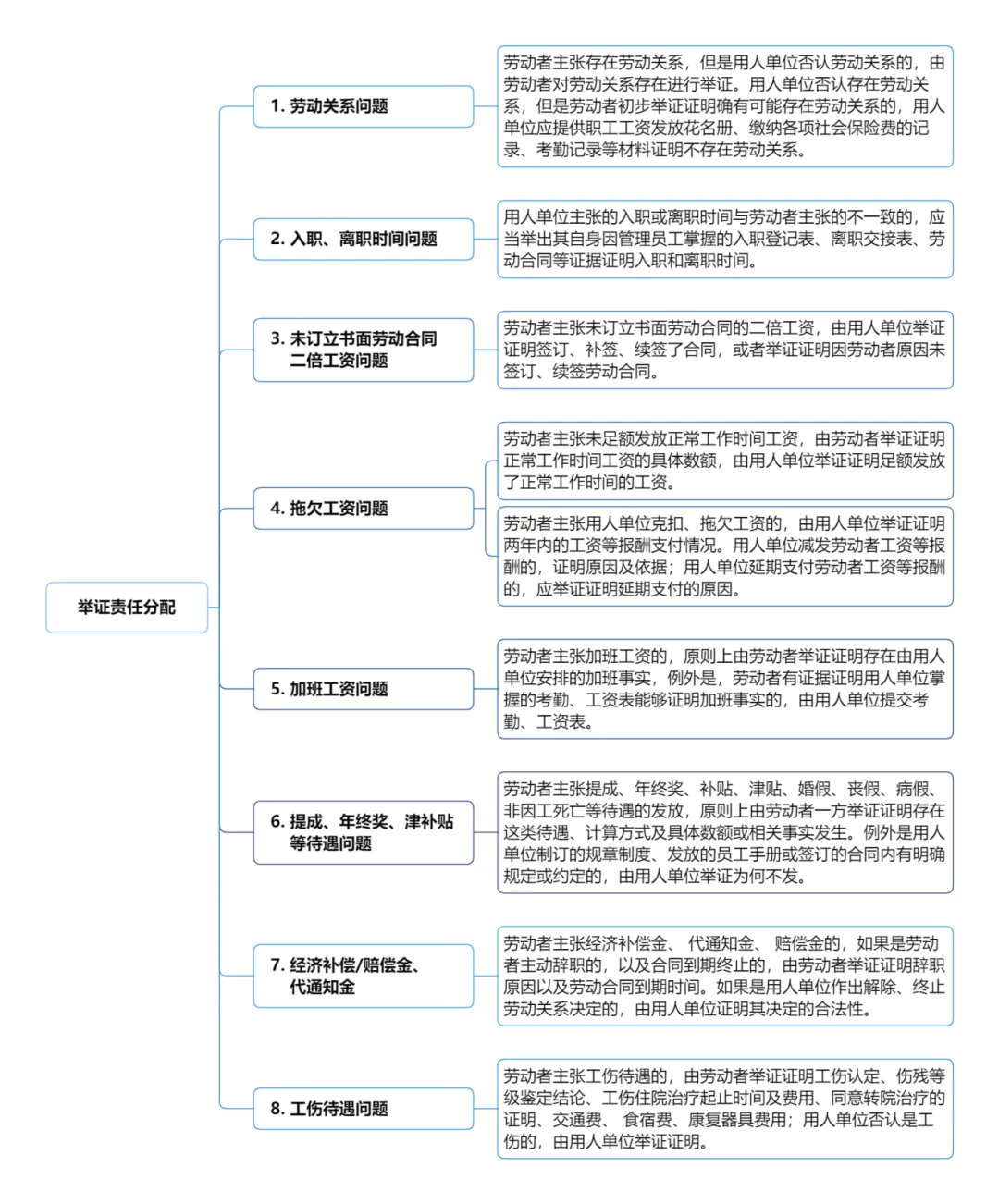
在劳动争议中,举证责任的分配至关重要。一般而言,对于解除劳动合同、减少劳动报酬等用人单位作出的决定,由用人单位承担举证责任;而对于劳动者主张的加班工资、工伤赔偿等,通常由劳动者承担初步的举证责任。以下列举主要的情形:
(二)证据的种类与收集

常见的劳动争议证据包括劳动合同、工资条、考勤记录、工作邮件、证人证言等。用人单位应建立健全的人事档案管理制度,妥善保存与劳动关系相关的各类文件。劳动者也应注意保存工作中的相关证据,如加班申请单、工作成果等。

(三)质证的程序与要点

证据质证是劳动争议司法审判中的重要环节,其真实性、合法性与关联性具有以下内涵:

真实性,指证据所反映的内容应当是真实存在的,而非虚构或歪曲的。例如证人证言应当是证人基于其亲身经历或直接感知所作的陈述;书证应当是真实的原始文件或经过合法确认的副本;物证应当是确实存在且未被篡改的实物。对于证据的真实性,需要审查其来源是否可靠、内容是否前后一致、有无矛盾之处等。

合法性,强调证据的获取、形成和表现形式必须符合法律的规定。

这包括证据的收集主体合法、收集程序合法、证据形式合法等。例如,通过非法手段获取的被告人供述应当予以排除;以侵害他人合法权益或者违反法律禁止性规定的方法取得的证据不能作为认定案件事实的依据。

关联性,是指证据与待证事实之间存在实质性的联系,能够对案件事实起到证明或反驳的作用。关联性要求证据能够在逻辑上合理地推断出案件事实,有助于法官对案件形成准确的判断。

总之,真实性、合法性和关联性是判断证据能否被采信和作为认定案件事实依据的重要标准,三者缺一不可。

二、陈述理由:解除劳动合同的法定理由、规章制度依据

(一)解除劳动合同的法定情形

用人单位单方解除劳动合同的法定理由涵盖了多个方面。在试用期内,若劳动者被证明不符合录用条件,用人单位有权解除合同。这里的“不符合录用条件”需要有明确的标准和证据支持,不能主观随意判定。此外,严重违反劳动纪律、严重违反用人单位的规章制度、严重失职,营私舞弊,给用人单位造成重大损害等情况也是法定的解除理由。

(二)规章制度的合法性与合理性

以严重违反规章制度为解除法定理由时,用人单位制定的规章制度必须符合法律法规的规定。这意味着规章制度不能与现行的劳动法律法规相冲突。同时,其应经过民主程序制定并向劳动者公示,确保劳动者知晓其内容。规章制度的内容应当合理明确。例如,对于迟到早退的处罚规定应适度,不能过于严苛或随意扩大后果。

(三)解除劳动合同的程序要求

用人单位解除劳动合同应严格遵循法定的程序。通知工会是其中重要的一环。

此外,解除通知是用人单位单方解除劳动合同发生法律效力的法律文件,至关重要。实务中常见的错误包括发出主体与劳动合同签订主体不一、解除理由不恰当或者与事实不符、未明确解除的时间等。同时对于解除通知,用人单位必须履行相应的送达程序,尤其是应对不辞而别的劳动者。送达优先选用当面送达并要求签署,退而求其次可以是快递、邮件等。穷尽所有手段仍然无法送达时,可以选择公告送达。

三、利益衡量与价值判断

 “利益衡量”与“价值判断”,我国台湾著名学者杨仁寿先生在其《法学方法论》一书中对“利益衡量”一词曾作过这样的解说:“……利益衡量乃在发现立法者对各种问题或利害冲突,表现在法律秩序内,由法律秩序可观察而得知立法者的价值判断。发现之本身,亦系一种价值判断。”

而在劳动法律事务实践中,其实每一桩每一件也都在诠释着“价值判断”与“利益衡量”。在劳动法律事务中,无论表现形式如何,背后都是各种利益的博弈,而对利益保护的先后顺序的认识,对于指导我们的人事管理实务具有极大的意义。在人事管理领域,我们通常所见到的劳动者的各种利益包括:生命健康权、就业平等权、就业选择权、劳动者获得劳动报酬的权利、获得劳动安全卫生保护的权利、休息休假的权利、生育权、享有社会保险和社会福利的权利等等 ;而用人单位最主要的权益则是:经营自主权、用工管理权

在企业的权益和劳动者的权益发生冲突的时候,如何进行调和?例如在客观情况发生重大变化情况下,企业的经营自主权和劳动者的劳动权利就会发生冲突。在这种情况下,企业的经营自主权是需要保护的,法律允许企业在客观情况发生重大变化时解雇劳动者,但是协调利益冲突的方案是:在相应情况发生时,企业应当与劳动者协商变更,协商不一致时才可解雇,而且解雇时应当支付经济补偿金以及未提前通知的代通知金。

再比如说两次不能胜任解雇的情况,是劳动者的就业权与企业的用人自主权的冲突,法律允许企业解雇不胜任工作的劳动者,但是协调方案时对不胜任工作的劳动者要进行调岗或者培训,两次均不能胜任后才可以解雇,而且解雇时应当支付经济补偿金以及未提前通知的代通知金。

所以法律其实是通过这些方法来平衡企业和劳动者间的利益冲突。除此之外,在劳动法领域还包括一些社会利益、行政利益。比如缴纳社保的权利,这种权利涉及到行政权利,是绝对权利,即使劳动者和企业协商确定不缴社保,也是无效的。

而当这些利益交织在一起时,孰高孰低?将是引导劳动实务处理问题的重要方向和突破口。

所谓“价值判断”,笔者将其理解为国家大环境或者说是立法、执法的导向,以及“常识常情常理”、社会主义核心价值观例如公平、诚信在案件审理中的体现 。“价值判断”为“利益衡量”提供了指导原则和说理基础,而“利益衡量”更具体的阐释了“价值判断”的实际应用,两者可以说相辅相成。在劳动法律事务处理实践中,我们都应当学会并善于运用“价值判断”和“利益衡量”的分析方法,在纷繁复杂的规定中,在千头万绪的实务中,找到构建和谐劳动关系的最佳方式。

四、结论

劳动争议的处理是一个复杂而系统的工程,需要综合运用固定事实、陈述理由、利益衡量、价值判断等方法。在处理过程中,应充分保障劳动者的合法权益,尊重用人单位的合理诉求,同时兼顾社会利益,遵循公平、诚信等原则,以实现劳动争议的妥善解决,构建和谐稳定的劳动关系,促进社会的经济发展和长治久安。

Introduction:

Labor disputes are inevitable issues in social and economic development, and their handling requires following certain paths and methods. This article conducts an in-depth discussion on the four-step method for handling labor disputes, namely fixing facts, stating reasons, value judgments, and interest balancing, aiming to provide theoretical support and practical guidance for the proper resolution of labor disputes.

The handling of labor disputes concerns the vital interests of both workers and employers and affects social stability and harmony. In a market economy environment, labor relationships are becoming increasingly complex and diverse, and the quantity and types of labor disputes continue to increase. Therefore, establishing a scientific and reasonable approach to handling labor disputes holds important practical significance.

I. Fixing Facts: Evidence and Cross-Examination

In labor dispute cases, accurately and thoroughly fixing facts is the primary step in resolving disputes. This includes comprehensively sorting out and confirming all aspects related to the signing, performance, modification, and termination of labor contracts. For example, specific terms of labor contracts such as job content, work location, working hours, and remuneration; the worker’s actual work performance including attendance, task completion, and compliance with work discipline; and the employer’s management actions such as performance evaluations, disciplinary measures, enforcement of rules and regulations, statutory grounds for termination, institutional basis for termination, factual basis for termination, etc. Through fixing these facts, a solid foundation can be established for subsequent dispute handling.

(1) Allocation of Burden of Proof

In labor disputes, the allocation of burden of proof is crucial. Generally, for decisions made by the employer regarding termination of labor contracts, reduction of remuneration, etc., the employer bears the burden of proof; for worker claims such as overtime pay and work injury compensation, workers typically bear the initial burden of proof. The main scenarios are listed below:

(2) Types of Evidence and Collection

Common labor dispute evidence includes labor contracts, pay slips, attendance records, work emails, witness testimonies, etc. Employers should establish and improve personnel file management systems and properly preserve various documents related to labor relationships. Workers should also preserve relevant evidence from work, such as overtime applications and work results.

(3) Procedures and Key Points of Cross-Examination

Evidence cross-examination is an important link in judicial trials of labor disputes. Its authenticity, legality, and relevance have the following meanings:

Authenticity means that the content reflected by the evidence should be genuinely existing, not fabricated or distorted. For example, witness testimony should be statements made by witnesses based on their personal experience or direct perception; documentary evidence should be genuine original documents or legally confirmed copies; physical evidence should be genuinely existing and unaltered objects. For the authenticity of evidence, it is necessary to examine whether its source is reliable, whether the content is consistent, whether there are contradictions, etc.

Legality emphasizes that the acquisition, formation, and expression of evidence must comply with legal provisions.

This includes that the subject collecting evidence is legitimate, the collection procedure is legitimate, the form of evidence is legitimate, etc. For example, defendant confessions obtained through illegal means should be excluded; evidence obtained by infringing on the legitimate rights of others or violating legal prohibitions cannot be used as the basis for determining case facts.

Relevance means there is a substantive connection between the evidence and the fact to be proven, which can prove or refute the case facts. Relevance requires that evidence can logically and reasonably infer case facts and help the judge form an accurate judgment on the case.

In summary, authenticity, legality, and relevance are important standards for judging whether evidence can be accepted and used as the basis for determining case facts. All three are indispensable.

II. Stating Reasons: Statutory Grounds and Institutional Grounds for Terminating Labor Contracts

(1) Statutory Grounds for Terminating Labor Contracts

The statutory grounds for the employer to unilaterally terminate a labor contract cover multiple aspects. During the probationary period, if the worker is proven not to meet the recruitment conditions, the employer has the right to terminate the contract. Here, “not meeting recruitment conditions” requires clear standards and evidentiary support and cannot be subjectively and arbitrarily determined. Additionally, serious violations of labor discipline, serious violations of the employer’s rules and regulations, serious dereliction of duty, favoritism and fraud causing major damage to the employer, etc., are also statutory grounds for termination.

(2) Legality and Reasonableness of Rules and Regulations

When using serious violations of rules and regulations as a statutory ground for termination, the rules and regulations formulated by the employer must comply with legal provisions. This means that rules and regulations cannot conflict with current labor laws and regulations. At the same time, they should be formulated through democratic procedures and brought to the attention of workers to ensure workers are aware of their content. The content of rules and regulations should be reasonable and clear. For example, penalties for tardiness and early leave should be moderate, not overly severe or arbitrarily expanding consequences.

(3) Procedural Requirements for Terminating Labor Contracts

Employers should strictly follow statutory procedures when terminating labor contracts. Notifying the labor union is an important step.

Additionally, the termination notice is a crucial legal document that brings the employer’s unilateral termination of the labor contract into legal effect. Common errors in practice include the issuer being different from the labor contract signing party, the termination reason being inappropriate or inconsistent with facts, and the termination date not being specified. At the same time, employers must fulfill the corresponding service procedures for termination notices, especially when dealing with workers who leave without saying goodbye. Face-to-face service with signature is preferred, followed by express delivery and email. When all means have been exhausted and service remains impossible, public notice service can be chosen.

III. Interest Balancing and Value Judgment

“Interest balancing” and “value judgment”—Taiwanese scholar Yang Renshou, in his book “Legal Methodology,” offered the following explanation of “interest balancing”: “…interest balancing is to discover the legislature’s value judgments regarding various issues or conflicts of interest, as can be observed within the legal order. Discovering it is itself also a kind of value judgment.”

In labor law practice, every case exemplifies “value judgment” and “interest balancing.” In labor law affairs, regardless of the form of expression, there are underlying games of various interests, and the understanding of the priority order of interest protection is of great significance in guiding personnel management practice. In personnel management, the various interests of workers commonly seen include: the right to life and health, equal employment rights, freedom of occupational choice, the worker’s right to receive labor remuneration, the right to labor safety and sanitation protection, the right to rest and leave, reproductive rights, the right to social insurance and social welfare, etc.; the employer’s primary rights and interests include: business autonomy, and the right to employment management.

When the employer’s rights and the worker’s rights conflict, how should they be reconciled? For example, in situations of significant changes in objective circumstances, the employer’s business autonomy and the worker’s labor rights will conflict. In this case, the employer’s business autonomy needs protection—the law allows the employer to dismiss workers when significant objective changes occur, but the plan to reconcile the conflict of interests is: when the corresponding circumstances occur, the employer should negotiate changes with the worker; only when negotiation fails can termination occur, and economic compensation and advance notice compensation for failure to give advance notice should be paid upon termination.

Another example is termination due to being incapable of performing work twice—this is the conflict between the worker’s right to employment and the employer’s autonomy in employment. The law allows the employer to dismiss workers who are incapable of performing their work, but the reconciliation plan is: workers incapable of performing their work should be transferred to other positions or trained; only after being incapable twice can they be dismissed, and economic compensation and advance notice compensation should be paid upon termination.

Therefore, the law actually balances the conflicts of interest between employers and workers through these methods. Additionally, the labor law field includes some social interests and administrative interests. For example, the right to participate in social insurance—this right involves administrative rights and is an absolute right; even if the worker and the employer agree not to participate in social insurance, such agreement is invalid.

When these interests intertwine, which takes precedence? This will be an important direction and breakthrough for guiding labor practice handling.

The author understands “value judgment” as the direction of the national environment or legislation and enforcement, as well as the embodiment of “common sense, normal feelings, and normal reasons” and core socialist values such as fairness and integrity in case trials. “Value judgment” provides guiding principles and reasoning basis for “interest balancing,” while “interest balancing” more specifically explains the practical application of “value judgment.” The two complement each other. In labor law practice, we should all learn and be good at using the analytical methods of “value judgment” and “interest balancing”—to find the best way to build harmonious labor relationships amid complex regulations and numerous practical matters.

IV. Conclusion

The handling of labor disputes is a complex and systematic project that requires comprehensive application of methods such as fixing facts, stating reasons, interest balancing, and value judgment. During the handling process, the legitimate rights and interests of workers should be fully protected, the reasonable demands of employers should be respected, social interests should be considered, and principles such as fairness and integrity should be followed, to achieve proper resolution of labor disputes, build harmonious and stable labor relationships, and promote social economic development and long-term peace and stability.