
前沿研究 Frontier

金银、珠宝等贵重饰品在离婚纠纷中的分割问题浅析

Analysis of the Division of Precious Metals and Jewelry in Divorce Disputes

预计阅读 11 分钟 11 MIN READ

一、引言

暂且不谈金价的水涨船高,现如今,翡翠、珍珠等昂贵宝石也逐渐成了人们日常佩戴、收藏乃至投资的热门选择。那么,对于在离婚纠纷中金银、珠宝等贵重饰品能否作为夫妻共同财产予以分割的问题,其核心考量因素主要包括两个方面:一是获得贵重饰品时间点的确定;二是贵重饰品是否具备显著的人身专属性质。基于此,本文将以婚姻关系的建立(即结婚时间)为分界点,深入探讨婚前与婚后获得的贵重饰品在离婚纠纷中的分割问题。

二、婚前获得的贵重饰品

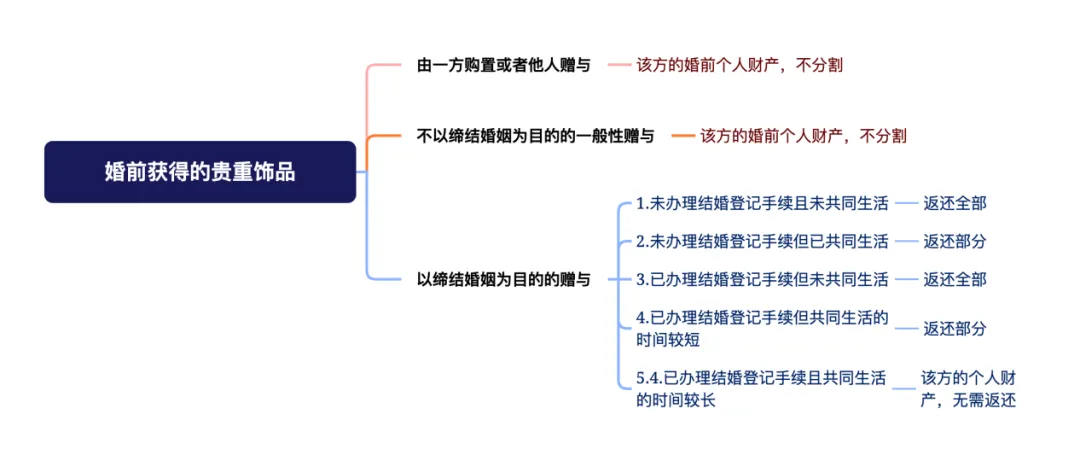
(一)婚前由一方购置或者他人赠与

婚姻关系建立之前,一方支付价款并已受领或者接受他人赠与而获得的贵重饰品,符合相关的法律规定及民法物权取得的原理,除另有约定外,应当视为该方的婚前个人财产。根据《中华人民共和国民法典》(以下简称《民法典》)第一千零六十三条规定,在离婚时不应纳入夫妻共同财产的分割范围。

(二)不以缔结婚姻为目的的一般性赠与

双方恋爱期间,若一方赠与另一方贵重饰品,且不附带缔结婚姻为前置条件,亦不视为传统意义上的结婚彩礼,则此类赠与应被界定为一般性赠与行为。根据《民法典》第六百五十七条、第一百五十八条规定,一方(赠与人)向另一方(受赠人)交付贵重饰品,另一方已受领,即该方在婚前已获得的贵重饰品的所有权,应当视为该方的婚前个人财产,独立于婚后夫妻共同财产之外,在离婚时不应分割。

(三)以缔结婚姻为目的的赠与

作为结婚彩礼为一方购置的贵重饰品,可以参照彩礼的相关法律规定处理。立法者将共同生活、是否登记结婚、彩礼给付是否致使给付方生活困难作为彩礼返还比例的考量因素。在司法实践中确定彩礼返还比例时,如果双方共同生活时间越长,彩礼返还比例越低;相反没有共同生活的,原则上彩礼受赠一方应当全额返还彩礼。同时兼顾考虑哪一方主动悔婚、是否存在过错、有无妊娠生育子女等现实情况。根据现行法律规定,以缔结婚姻为目的的赠与可分为以下四种情形:

1. 未办理结婚登记手续且未共同生活

此为婚约财产纠纷,一方以缔结婚姻为目的赠与另一方贵重饰品,系附条件的赠与,现双方既未办理结婚登记手续且未共同生活,即所附条件未成就,根据《民法典》第一百五十八条规定,受赠人应当向赠与人返还前述作为彩礼的金银、珠宝首饰。

2. 未办理结婚登记手续但已共同生活

此亦为婚约财产纠纷,因双方业已共同生活则不宜全部返还作为彩礼的贵重饰品,根据《最高人民法院关于审理涉彩礼纠纷案件适用法律若干问题的规定》(以下简称《涉彩礼纠纷规定》)第六条规定,一方请求返还作为彩礼的贵重饰品的,应当部分返还。法院应当根据彩礼实际使用及嫁妆情况,综合考虑共同生活及孕育情况、双方过错等事实,结合当地习俗,确定是否返还以及返还的具体比例。

3. 已办理结婚登记手续但未共同生活

此种情形属于《最高人民法院关于适用〈中华人民共和国民法典〉婚姻家庭编的解释(一)》第五条第一款第(二)项的情形,如若双方仅办理了结婚登记手续,但完全不存在共同生活的实质内容的,受赠人应当全部返还作为彩礼的贵重饰品。

4. 已办理结婚登记手续但共同生活时间较短

双方既已办理结婚登记手续,也已共同生活,但是共同生活的时间较短,根据《涉彩礼纠纷规定》第五条规定,如果彩礼数额过高的,人民法院可以根据彩礼实际使用及嫁妆情况,综合考虑彩礼数额、共同生活及孕育情况、双方过错等事实,结合当地习俗,确定是否返还以及返还的具体比例。

举例说明,董某与朱某涉彩礼返还纠纷一案[1],董某与朱某于2020年9月登记结婚,董某在结婚当月向朱某银行账户汇入两笔款项:一笔为人民币80万元并附言为“彩礼”;另一笔为26万元并附言为“五金”。其后,因筹备举办婚礼等事宜发生纠纷,双方于2020年11月协议离婚,婚姻关系存续不到三个月。法院认为,除已明确注明为彩礼的80万元款项外,备注为“五金”的26万元亦符合婚礼习俗中对于彩礼的一般认知,也应当认定为彩礼。此外,不论是已办理结婚登记还是未办理结婚登记的情况,在确定彩礼是否返还以及返还的具体比例时,共同生活时间均是重要的考量因素。本案中,双方婚姻关系存续时间短,登记结婚后仍在筹备婚礼过程中,双方对于后续如何工作、居住、生活未形成一致的规划,未形成完整的家庭共同体和稳定的生活状态,不宜认定为已经共同生活。但是,考虑到办理结婚登记以及短暂同居经历对女方的影响、双方存在共同消费、彩礼数额过高等因素,判决酌情返还大部分彩礼,能够妥善平衡双方利益。

5. 已办理结婚登记手续且共同生活时间较长

婚姻关系存续期间较长,双方已构建了一个完整的家庭共同体并形成了稳定的生活状态,彩礼作为缔结婚姻的目的已然实现,赠与条件业已达成。受赠人所获得的贵重饰品等彩礼,依法应视为其个人财产。因此,在双方离婚时,作为“彩礼”的贵重饰品不应作为共同财产进行分割。
三、婚后获得的贵重饰品

婚后购置的贵重饰品在离婚时的分割,主要涉及考量是否存在应认定为个人财产的情节,其中何为“一方专用的生活用品”这一情形目前法律并未对此进行明确界定。反观司法实践,法院一般会全面评估婚后双方经济条件和家庭收入水平,并结合购买时间与感情破裂时间,经综合分析和权衡婚后再行判断该贵重饰品是属于“一方专用的生活用品”抑或夫妻共同财产。

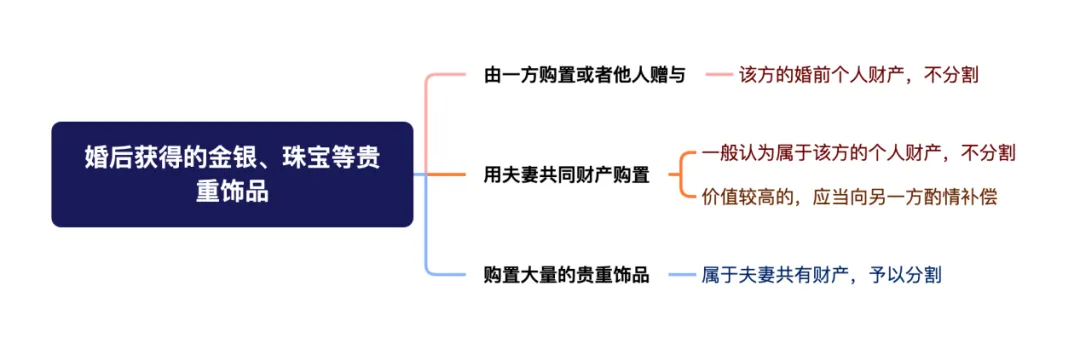
(一)婚后由一方单独购置或者他人赠与

婚后一方用其个人财产购置,因是夫妻个人财产的代位物(替代物),在所不问价值如何,通常应认定为该方的个人财产;如果由他人赠与,且明确受赠人为该方一人,根据《民法典》第一千零六十三条规定,则认定为该方的个人财产。

(二)婚后用夫妻共同财产购置

一方日常佩戴的贵重饰品,鉴于其强烈的人身依附性以及非投资性质,符合“一方专用生活用品”的特性,通常倾向于被认定为该方的个人财产。然而,在离婚纠纷中,若该首饰价值较高,法院可能会酌情考虑,判决该方给予对方相应的现金补偿。比如黄某与李某离婚后财产纠纷一案[2],法院认为,李某当庭确认港币15426元的999.9黄金项链、4853元的足金手镯、5058元的足金手镯在其处保管,因上述首饰均在夫妻关系存续期间购买,故应认定为夫妻共同财产予以分割。但是,若该方能提供充分证据,证明该首饰系另一方明确赠与其个人的,则法院一般会认定该首饰属于该方的个人财产。

(三)婚后购置大量贵重饰品

如若购置的贵重饰品数量较大且价值较高,明显具备投资属性,根据《民法典》第一千零六十二条规定,一般会被认定为夫妻共同财产,基于公平原则,离婚时应当予以分割。
四、总结

离婚纠纷中,贵重饰品的归属问题并非一概而论,而是需要法院根据具体案件情况,审查购置这些财产的时间点,深入探究婚后家庭的经济条件及出资情况,同时关注贵重饰品的数量、价格以及是否具有人身专属性等多重因素予以认定。这一过程旨在确保夫妻财产分割的公平性和合理性,维护双方的合法权益。

法条指引 (上下滑动查看更多):

《中华人民共和国民法典》

第一百五十八条 民事法律行为可以附条件,但是根据其性质不得附条件的除外。附生效条件的民事法律行为,自条件成就时生效。附解除条件的民事法律行为,自条件成就时失效。

第二百二十四条 动产物权的设立和转让,自交付时发生效力,但是法律另有规定的除外。

第五百九十五条 买卖合同是出卖人转移标的物的所有权于买受人,买受人支付价款的合同。

第六百五十七条 赠与合同是赠与人将自己的财产无偿给予受赠人,受赠人表示接受赠与的合同。

第一千零六十二条 夫妻在婚姻关系存续期间所得的下列财产,为夫妻的共同财产,归夫妻共同所有:

(一)工资、奖金、劳务报酬;

(二)生产、经营、投资的收益

(三)知识产权的收益;

(四)继承或者受赠的财产,但是本法第一千零六十三条第三项规定的除外;

(五)其他应当归共同所有的财产。

夫妻对共同财产,有平等的处理权。

第一千零六十三条 下列财产为夫妻一方的个人财产:

(一)一方的婚前财产;

(二)一方因受到人身损害获得的赔偿或者补偿;

(三)遗嘱或者赠与合同中确定只归一方的财产;

(四)一方专用的生活用品;

(五)其他应当归一方的财产。

《最高人民法院关于适用<中华人民共和国民法典>婚姻家庭编的解释(一)》

第五条 当事人请求返还按照习俗给付的彩礼的,如果查明属于以下情形,人民法院应当予以支持:

(一)双方未办理结婚登记手续;

(二)双方办理结婚登记手续但确未共同生活;

(三)婚前给付并导致给付人生活困难。

适用前款第二项、第三项的规定,应当以双方离婚为条件。

《最高人民法院关于审理涉彩礼纠纷案件适用法律若干问题的规定》

第五条 双方已办理结婚登记且共同生活,离婚时一方请求返还按照习俗给付的彩礼的,人民法院一般不予支持。但是,如果共同生活时间较短且彩礼数额过高的,人民法院可以根据彩礼实际使用及嫁妆情况,综合考虑彩礼数额、共同生活及孕育情况、双方过错等事实,结合当地习俗,确定是否返还以及返还的具体比例。

人民法院认定彩礼数额是否过高,应当综合考虑彩礼给付方所在地居民人均可支配收入、给付方家庭经济情况以及当地习俗等因素。

第六条 双方未办理结婚登记但已共同生活,一方请求返还按照习俗给付的彩礼的,人民法院应当根据彩礼实际使用及嫁妆情况,综合考虑共同生活及孕育情况、双方过错等事实,结合当地习俗,确定是否返还以及返还的具体比例。

参考案例:

[1]参见江苏省苏州市中级人民法院(2021)苏05民终第10300号民事判决书。

[2]参见广东省广州市越秀区人民法院(2021)粤0104民初第38170号民事判决书。

注意:

本文提及的“金银、珠宝首饰”是指以金、银、铂等金属及钻石、宝石(如玉石、翡翠)、珍珠、水晶等珍贵材料为原料,经过加工和镶嵌等方法制成的饰品和工艺品。而金条具有明显的投资属性,不在本文的讨论之列。

I. Introduction

Setting aside the rising price of gold, precious gemstones such as jade and pearls have become popular choices for daily wear, collection, and investment. Regarding whether precious metals and jewelry can be divided as marital property in divorce disputes, the core considerations primarily involve two aspects: first, determining the timing of acquisition of the precious items; second, whether the items possess significant personal exclusivity. Based on this, this article explores the division of precious items acquired before and after marriage in divorce disputes, using the establishment of the marriage relationship (i.e., marriage time) as the dividing point.

II. Precious Items Acquired Before Marriage

A. Purchased by One Party or Given as a Gift by Others Before the Marriage

Precious items purchased by one party through payment or received as a gift from others before the establishment of the marriage relationship, in accordance with relevant legal provisions and the principles of property acquisition under civil law, shall, absent any other agreement, be regarded as the party’s premarital personal property. According to Article 1063 of the Civil Code of the People’s Republic of China (hereinafter referred to as the “Civil Code”), such items shall not be included in the scope of marital property division upon divorce.

B. General Gifts Not Given for the Purpose of Entering into Marriage

During a romantic relationship, if one party gifts precious items to the other party without attaching the precondition of entering into marriage, and such gifts are not considered traditional betrothal gifts (cai li), such gifts shall be characterized as general gift-giving. According to Articles 657 and 158 of the Civil Code, when one party (the donor) delivers precious items to the other party (the donee) and the donee has received them, the ownership of the precious items acquired by that party before marriage shall be regarded as that party’s premarital personal property, separate from marital community property, and shall not be subject to division upon divorce.

C. Gifts Given for the Purpose of Entering into Marriage

Precious items purchased as betrothal gifts may be handled with reference to relevant legal provisions on betrothal gifts (cai li). Legislators consider joint life, whether marriage registration has been completed, and whether the provision of betrothal gifts has caused difficulties for the donor’s livelihood as factors in determining the proportion of betrothal gifts to be returned. In judicial practice, when determining the proportion of betrothal gifts to be returned, the longer the joint life, the lower the return proportion; conversely, if there has been no joint life, the donee of the betrothal gifts shall in principle return the full amount. Consideration is also given to practical circumstances such as which party actively后悔 (regretted the marriage), whether there is fault, and whether there are children or pregnancy. According to current legal provisions, gifts given for the purpose of entering into marriage can be divided into the following four situations:

1. Marriage Registration Not Completed and No Joint Life

This constitutes a breach of promise (marriage agreement) property dispute. When one party gifts precious items to the other party for the purpose of entering into marriage, it constitutes a conditional gift. Since neither party has completed marriage registration nor engaged in joint life, the conditions have not been satisfied. According to Article 158 of the Civil Code, the donee shall return the precious metals and jewelry given as betrothal gifts to the donor.

2. Marriage Registration Not Completed But Joint Life Has Occurred

This also constitutes a breach of promise property dispute. Since the parties have engaged in joint life, it would be inappropriate to require the return of all precious items given as betrothal gifts. According to Article 6 of the Supreme People’s Court’s Provisions on the Trial of Betrothal Gift Dispute Cases (hereinafter referred to as the “Betrothal Gift Dispute Provisions”), if one party requests the return of precious items given as betrothal gifts, a partial return shall be made. The court shall, based on the actual use of the betrothal gifts and dowry circumstances, comprehensively consider facts such as joint life and pregnancy situations, faults of both parties, etc., and determine whether to return and the specific proportion based on local customs.

3. Marriage Registration Completed But No Joint Life

This situation falls under Item (2), Paragraph 1 of Article 5 of the Interpretation of the Supreme People’s Court on the Application of the Civil Code of the People’s Republic of China Regarding Marriage and Family Matters (I). If the parties have only completed marriage registration but there is absolutely no substantive content of joint life, the donee shall return all precious items given as betrothal gifts.

4. Marriage Registration Completed But Short Duration of Joint Life

If the parties have completed marriage registration and engaged in joint life, but the duration of joint life was short, according to Article 5 of the Betrothal Gift Dispute Provisions, if the betrothal gift amount is excessively high, the people’s court may, based on the actual use of the betrothal gifts and dowry circumstances, comprehensively consider facts such as the gift amount, joint life and pregnancy situations, faults of both parties, etc., and determine whether to return and the specific proportion based on local customs.

For illustrative purposes, in the case of Dong and Zhu regarding betrothal gift return [1], Dong and Zhu registered their marriage in September 2020. Dong transferred two payments to Zhu’s bank account in the month of marriage: one of 800,000 RMB marked as “cai li” (betrothal gift); another of 260,000 RMB marked as “wu jin” (five gold items). Later, due to disputes over wedding preparations and other matters, the parties divorced by agreement in November 2020, with the marriage lasting less than three months. The court held that in addition to the 800,000 RMB clearly marked as cai li, the 260,000 RMB marked as “wu jin” also conforms to the general understanding of betrothal gifts in wedding customs and shall also be characterized as cai li. Furthermore, whether for situations where marriage registration has or has not been completed, when determining whether to return betrothal gifts and the specific proportion, the duration of joint life is an important consideration. In this case, the parties’ marriage lasted a short time; after marriage registration, they were still in the process of preparing for the wedding, and the parties had not formed consistent plans regarding future work, residence, and life, nor had they formed a complete family community and stable living situation. Therefore, it is inappropriate to characterize this as having engaged in joint life. However, considering the impact of marriage registration and brief cohabitation on the female party, the parties’ joint consumption, the high amount of betrothal gifts, and other factors, the judgment moderately returned most of the betrothal gifts, which can properly balance the interests of both parties.

37f69f25cb464816e81a9458c0c1d0ed

5. Marriage Registration Completed and Long Duration of Joint Life

If the marriage has lasted a long time and the parties have formed a complete family community and stable living situation, the purpose of the betrothal gift—entering into marriage—has already been fulfilled, and the gift conditions have been satisfied. The precious items received by the donee as betrothal gifts shall legally be regarded as that party’s personal property. Therefore, upon divorce, precious items given as “betrothal gifts” shall not be subject to division as community property.

4c01fdbe33f1cb1c796beafa5ae15133

III. Precious Items Acquired After Marriage

The division of precious items purchased after marriage upon divorce primarily involves considering whether there are circumstances that should characterize them as personal property. Among these, what constitutes “daily necessities exclusively used by one party” is currently not clearly defined by law. In judicial practice, courts generally make a comprehensive evaluation of the economic conditions and family income levels of both parties after marriage, combined with the purchase timing and the time of emotional breakdown, to comprehensively analyze and weigh whether the precious items belong to “daily necessities exclusively used by one party” or marital community property.

A. Purchased Solely by One Party After Marriage or Given as a Gift by Others

If precious items are purchased after marriage using that party’s personal property, since they are substitutes (replacements) for the party’s personal property, regardless of their value, they shall generally be characterized as that party’s personal property; if given as a gift by others and the donee is explicitly designated as that one party alone, according to Article 1063 of the Civil Code, they shall be characterized as that party’s personal property.

B. Purchased Using Marital Community Property

For precious jewelry worn daily by one party, given their strong personal attachment and non-investment nature, they conform to the characteristics of “daily necessities exclusively used by one party” and generally tend to be characterized as that party’s personal property. However, in divorce disputes, if the jewelry has a high value, the court may make an appropriate consideration and order that party to provide corresponding cash compensation to the other party. For example, in the case of property disputes after divorce between Huang and Li [2], the court held that Li acknowledged in court that a 999.9 gold necklace worth HKD 15,426, a fine gold bracelet worth HKD 4,853, and a fine gold bracelet worth HKD 5,058 were in his possession for safekeeping. Since the above jewelry was purchased during the marriage, it shall be characterized as marital community property and subject to division. However, if that party can provide sufficient evidence proving that the jewelry was explicitly gifted to that party alone by the other party, the court will generally characterize the jewelry as that party’s personal property.

C. Large Quantities of Precious Items Purchased After Marriage

If the precious items purchased are in large quantities and have high value, clearly possessing investment attributes, according to Article 1062 of the Civil Code, they shall generally be characterized as marital community property, and based on the principle of fairness, shall be subject to division upon divorce.

IV. Conclusion

In divorce disputes, the ownership of precious items is not a matter of blanket determination; rather, courts need to examine the timing of purchase of such property based on specific case circumstances, deeply investigate the family’s economic conditions and source of funds after marriage, while also focusing on factors such as the quantity and price of the precious items and whether they possess personal exclusivity. This process aims to ensure fairness and reasonableness in the division of marital property and protect the legitimate rights and interests of both parties.

Legal Provisions (scroll up/down to view more):

Civil Code of the People’s Republic of China

Article 158: Civil juristic acts may be subject to conditions, except where the nature of such acts precludes conditions. Civil juristic acts subject to conditions for effectiveness shall become effective when such conditions are fulfilled. Civil juristic acts subject to conditions for termination shall become ineffective when such conditions are fulfilled.

Article 224: The creation and transfer of ownership of movable property shall take effect upon delivery, unless otherwise provided by law.

Article 595: A sales contract is a contract whereby the seller transfers ownership of the subject matter to the buyer and the buyer pays the price.

Article 657: A donation contract is a contract whereby the donor gratuitously gives his property to the donee and the donee expresses acceptance of the donation.

Article 1062: The following property acquired by spouses during the existence of a marriage shall be the spouses’ community property, owned jointly by the spouses:

(1) Wages, bonuses, and remuneration for labor services;

(2) Income from production, business operations, and investments;

(3) Income from intellectual property;

(4) Property inherited or received as a gift, except as provided in Item (3) of Article 1063 of this Code;

(5) Other property that should belong to the community.

Spouses shall have equal rights to dispose of community property.

Article 1063: The following property shall be the personal property of one spouse:

(1) Premarital property of that party;

(2) Compensation or indemnification obtained by that party for personal injury;

(3) Property specified in a will or donation contract as belonging to only one party;

(4) Daily necessities exclusively used by that party;

(5) Other property that should belong to that party.

Interpretation of the Supreme People’s Court on the Application of the Civil Code of the People’s Republic of China Regarding Marriage and Family Matters (I)

Article 5: If a party requests the return of betrothal gifts given according to customs, and the circumstances specified in any of the following items are verified, the people’s court shall support such request:

(1) Neither party has completed marriage registration procedures;

(2) Both parties have completed marriage registration procedures but have not engaged in joint life;

(3) Premarital gifts given caused difficulty in livelihood for the donor.

The provisions of Items (2) and (3) of the preceding paragraph shall apply only when divorce is a condition.

Provisions of the Supreme People’s Court on the Trial of Betrothal Gift Dispute Cases

Article 5: If both parties have completed marriage registration and engaged in joint life, and one party requests the return of betrothal gifts given according to customs upon divorce, the people’s court shall generally not support such request. However, if the duration of joint life is short and the betrothal gift amount is excessively high, the people’s court may, based on the actual use of the betrothal gifts and dowry circumstances, comprehensively consider facts such as the gift amount, joint life and pregnancy situations, faults of both parties, etc., and determine whether to return and the specific proportion based on local customs.

When the people’s court determines whether the betrothal gift amount is excessively high, comprehensive consideration shall be given to factors such as the per capita disposable income of the donor’s location, the donor family’s economic circumstances, and local customs.

Article 6: If both parties have not completed marriage registration but have engaged in joint life, and one party requests the return of betrothal gifts given according to customs, the people’s court shall determine whether to return and the specific proportion based on the actual use of the betrothal gifts and dowry circumstances, comprehensively considering facts such as joint life and pregnancy situations, faults of both parties, etc., in light of local customs.

Reference Cases:

[1] See Civil Judgment of Suzhou Intermediate People’s Court, Jiangsu Province, (2021) Su 05 Min Zhong No. 10300.

[2] See Civil Judgment of Yuexiu District People’s Court, Guangzhou City, Guangdong Province, (2021) Yue 0104 Min Chu No. 38170.

Note:

The “precious metals and jewelry” mentioned in this article refer to accessories and crafts made from precious materials such as gold, silver, platinum and diamonds, gemstones (such as jade and emerald), pearls, and crystal through processing and setting methods. Gold bars, having clear investment attributes, are not within the scope of this article’s discussion.