Handling Cross-Border Inheritance with Missing Singapore Testament: Case Study of Longan Guangzhou's Major 2025 Business Achievement
Handling Cross-Border Inheritance with Missing Singapore Testament: Case Study of Longan Guangzhou's Major 2025 Business Achievement
As high-net-worth individuals increasingly have cross-border factors in wealth allocation, identity planning, and work-life balance, combined with the trend of Chinese enterprises going global, disputes involving foreign testaments handling mainland property have been continuously increasing. Under this growing reality, properly using testaments to achieve post-mortem property arrangements presents a complex and significant topic for exploration.
I. Case Introduction
A, who фактически had dual citizenship of Singapore and China, died in Singapore in December 2022. The decedent had not entered into any support agreement with others during their lifetime, but had executed a testament in Singapore determining the ownership and shares of real and movable property, as well as naming an executor. In addition to property in Singapore, Malaysia, Hong Kong and other locations, A left real estate and bank deposits in Guangdong Province totaling approximately 30 million yuan. However, when handling inheritance in the mainland, because heirs could not find the original testament, some mainland notary offices could not confirm the Singapore testament, making it impossible to handle inheritance notarization. Additionally, due to the immature supporting systems for domestic estate administration, the estate administrator confirmed in the testament could not properly perform duties. Furthermore, because there was no substantial dispute among heirs, there was no way to directly proceed through judicial procedures for confirmation. The heirs were completely at a loss.
The testament clearly specified in sequence: the executor candidate and replacement, the executor’s authority and duties, ownership and shares of Singapore property, ownership and shares of global bank deposits, and ownership and shares of other global property. A single testament, just a few hundred words, attempting to handle property types across different legal jurisdictions presented considerable difficulties in subsequent practical operations.
II. Legal Analysis
A. Characterization of the Testament
According to Article 8 of the Law on Application of Laws to Foreign-Related Civil Relations, characterization is governed by the law of the forum. Additionally, according to the Supreme People’s Court’s Interpretation (I) on the Application of the Law on Foreign-Related Civil Relations, relevant facts can be determined as involving foreign-related disputes based on factors such as the parties’ nationality or habitual residence, location of the subject matter, or location where legal facts occurred. In this case, all factors including nationality, habitual residence, location of subject matter, or testament execution location have foreign-related elements, making this a foreign testament case.
An important note: in this case, the decedent had de facto dual citizenship of China and Singapore, but according to both countries’ nationality laws, neither legally recognizes dual citizenship or acknowledges the other country’s nationality. According to Article 9 of China’s Nationality Law: Chinese citizens who have settled abroad and voluntarily acquire or have acquired foreign citizenship automatically lose Chinese citizenship. However, regarding the determination of “settlement,” there is a lack of factual investigation and authoritative determination by domestic or foreign exit-entry administration authorities, and the decedent’s family went to Singapore to avoid the COVID-19 pandemic. The decedent also purchased real estate in multiple locations in Guangdong and still received retirement benefits in a certain location. The legal concept of “settlement” requires satisfying both “physical element” and “mental element,” and fixed residence in a country can only serve as preliminary evidence.
B. Formal Requirements of the Testament
According to Article 32 of the Law on Application of Laws to Foreign-Related Civil Relations, testament form is valid if it complies with the law of the decedent’s habitual residence or nationality at the time of execution or death, or the law of the place of testament act. Singapore’s Wills Act Section 5 adopts similar legislative approach. From the perspective of maximum respect for the testator’s wishes, as long as one country’s law recognizes the testament’s form as compliant, it does not affect the testament’s validity under the favorable law.
According to Singapore’s Wills Act Section 6, a testament must be a written document, signed by the decedent at the end of the testament, with two non-beneficiary witnesses present and signing in the presence of each other. The testament’s formal requirements complied with Singapore law.
C. Substantive Validity of the Testament
According to Article 33 of the Law on Application of Laws to Foreign-Related Civil Relations, testament validity is governed by the law of the decedent’s habitual residence or nationality at the time of execution or death. Since Singapore law was recognized for formal requirements examination, substantive validity can be re-examined under Singapore law. There was no clear evidence the decedent lacked civil rights capacity or capacity to act under Singapore law, and the property disposed was in the decedent’s name. Additionally, there were no circumstances under Singapore’s Wills Act Section 13 (marriage revocation) or Section 15 (new testament revocation).
However, due to marital property regime issues, testament content validity cannot be uniformly determined. In Singapore, both during marriage or testament processing phases, separate property systems apply. Property registered under one spouse’s name alone remains that spouse’s personal property regardless of whether acquired before or after marriage.
III. Practical Operation Highlights
A. New Approach for Dual Citizenship Heirs’ Inheritance
The firm bypassed the dual citizenship issue by submitting a legal opinion as expert testimony to the Singapore court for testament certification, directly promoting testament certification in Singapore first, removing substantive disputes, and giving domestic notary offices more confidence to handle mainland inheritance.
B. Innovative Transformation of Estate Administrator Role
Due to China’s immature estate administration system and the testament-named administrator being a Singapore citizen working and living in Singapore, practical performance was inconvenient. The firm facilitated the transfer of administrator authority through a general power of attorney issued simultaneously with the administrator notarization.
C. Feasible Method for Missing Original Testament
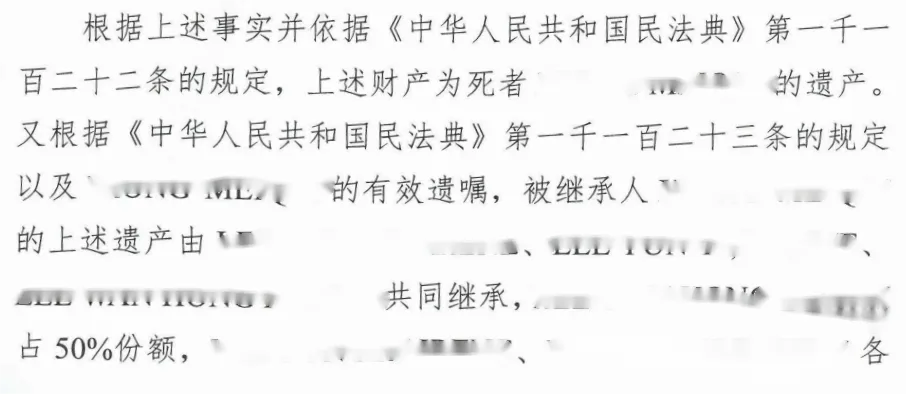
The firm proposed a combination of “Singapore court testament certification + Singapore lawyer legal opinion + all heirs’ no-dispute confirmation” to remedy the evidence chain for the missing original testament.
D. New Attempt Combining Litigation and Non-Litigation Approaches
When some notary offices expressed hesitation, the firm promptly filed a case with Guangzhou Yuexiu District Court with the case subject of confirming the estate administrator, adding the real estate registration center and banks as defendants. Through the court’s pre-litigation mediation, various concerns were resolved.
IV. Reflections
A. Testament Executor/Estate Administrator Setup in Cross-Border Testaments
Due to China’s imperfect testament executor/estate administration system, cross-border testament executors cannot smoothly perform duties. Clients are advised not to adopt this approach for domestic property.
B. Custody of Key Documents
If heirs had valued custody of the original testament, many new problems would not have arisen. In cross-border asset planning and inheritance, special attention should be paid to custody of testament and trust documents.
C. Lack of Unified Standards for Cross-Border Testament
The inheritance processing time and cost for heirs significantly increased due to inconsistent standards. Fortunately, the heirs had no substantial disputes over property ownership and distribution.