
Hong Kong's Stablecoin Ordinance: HKD 25 Million Registered Capital + Full-Process License Control, Digital Finance Rules Set for Reshaping!
Hong Kong's Stablecoin Ordinance: HKD 25 Million Registered Capital + Full-Process License Control, Digital Finance Rules Set for Reshaping!
Hong Kong's Stablecoin Ordinance came into effect on May 30, aiming to fill the regulatory gap for virtual assets through comprehensive chain-wide compliance controls. The core of the Ordinance lies in establishing a strict licensing system, requiring issuers to have a minimum paid-up capital of HKD 25 million, implementing 100% independent segregation of reserve assets with redemption at par value at any time, and mandating compliance requirements such as anti-money laundering reviews, periodic audit disclosures, and prohibition of interest promises. The enactment not only effectively prevents financial and money laundering risks and protects investor rights but will also promote the sustainable development of the stablecoin industry on a compliant track, consolidate Hong Kong's status as an international financial center, and set a benchmark for global stablecoin regulation. Future applications are expected to deepen in areas such as cross-border payments and digital finance, while promoting international regulatory coordination.
On May 21, the Hong Kong Legislative Council completed the Second and Third Readings of the Stablecoin Ordinance Bill and passed it on the same day. On May 30, the Stablecoin Ordinance (hereinafter referred to as the “Ordinance”) was formally gazetted and came into effect, sparking immediate heated discussion in the financial and blockchain industries.[1]
The enactment of the Ordinance not only establishes a critical institutional framework for Hong Kong’s virtual asset regulatory system but also sets a benchmark for global stablecoin regulation that combines innovation and risk prevention through a comprehensive chain-wide compliance control model. As an important part of Hong Kong’s efforts to improve financial infrastructure in the digital economy era, the Ordinance aims to build a safe and transparent stablecoin system through core mechanisms such as a licensing system and reserve asset supervision, providing clear guidance for market participants while promoting high-quality development of the virtual asset industry on a compliant track.

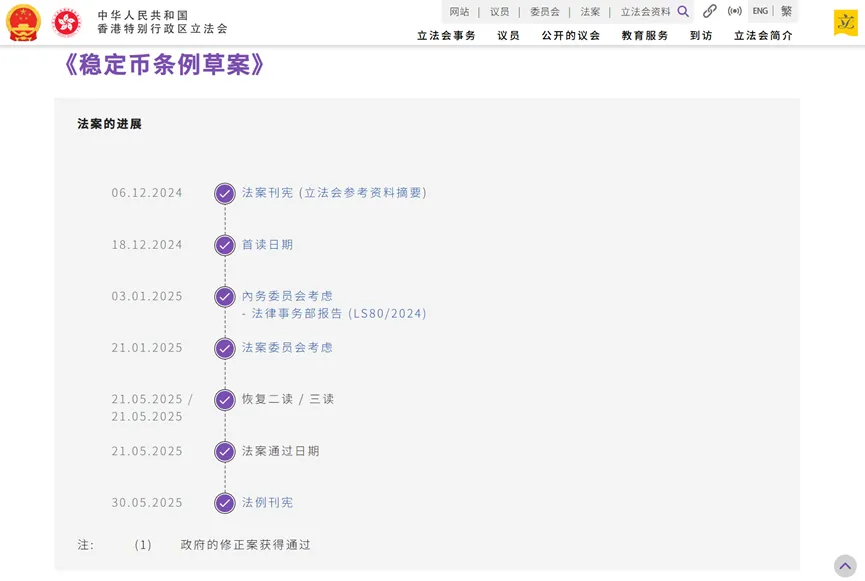
(Source: Hong Kong Special Administrative Region Legislative Council)
1 Background of the Ordinance
A stablecoin is a type of cryptocurrency designed to minimize price volatility by pegging its value to a stable asset (such as fiat currency like the US dollar, gold, etc.), aiming to achieve a stable store of value and medium of exchange. The emergence of stablecoins into public view and widespread attention is not accidental, but mainly due to their unique advantages. Compared to fiat currencies issued by governments, stablecoins feature peer-to-peer payment capabilities, meaning transactions can be conducted directly between parties without going through cumbersome intermediaries, greatly improving transaction convenience. Their payment efficiency is high while costs are relatively low, which is undoubtedly highly attractive to users who frequently engage in small or cross-border transactions. Moreover, the value of stablecoins is relatively stable, unlike other cryptocurrencies such as Bitcoin and Ethereum that experience剧烈 price fluctuations, making them more reliable as a store of value and medium of exchange. For these reasons, stablecoins are increasingly used in conventional financial activities such as cross-border payments and investment transactions.
From a classification perspective, stablecoins can mainly be divided into the following types.
Stablecoin Type | Core Mechanism | Typical Representative | Advantages | Risks/Challenges |
Fiat-Collateralized | 1:1 pegged to fiat currency reserves | USDT, USDC | Relatively stable, easy to understand | Centralized, requires trust in the custodian; transparency of reserves is an issue |
However, the insufficient transparency of reserve assets of stablecoin issuers means that investors often cannot ascertain whether the issuer’s reserve assets are truly sufficient, which undoubtedly increases investment uncertainty and risk. Once an issuer faces a liquidity crisis and cannot meet user redemption demands, the stablecoin’s value is at risk of collapsing. Furthermore, the anonymity of stablecoins also presents a series of棘手 problems. In traditional financial institution transaction systems, every transaction has detailed records, and the flow of funds is clearly traceable, which strongly supports anti-money laundering efforts. However, the anonymity of stablecoins makes transaction information difficult to trace, significantly increasing the difficulty of anti-money laundering, providing opportunities for illegal fund flows, and posing serious threats to financial order and social stability.
Faced with the various risks and challenges posed by stablecoins, countries and regions around the world have recognized the importance and urgency of regulation. For example, in Europe, the Markets in Crypto-Assets Regulation (MiCA)[2] came into effect on December 30, 2024, which provides a detailed and nuanced definition of stablecoin types and sets strict reserve and compliance standards for issuers within the EU. Similarly, on May 20 this year, the U.S. Senate passed a key procedural vote on the so-called “GENIUS Act” (Guiding and Establishing National Innovation for U.S. Stablecoins Act of 2025[3]), requiring stablecoin issuers to maintain 100% reserves of high-quality, low-risk liquid assets, providing a solid material foundation for the value stability of stablecoins. The passage of Hong Kong’s Ordinance also reflects Hong Kong’s alignment with global stablecoin regulatory trends. As Hong Kong Legislative Council Member Johnny Ng stated, the enactment of the Ordinance is a milestone in the global development of Web3 and an important step for Hong Kong to become an international Web3 hub.
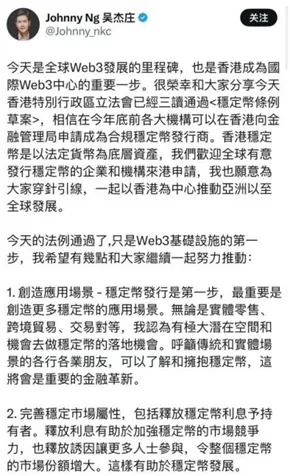
(Source: X (Twitter) @Johnny Ng)
2 Core Content Analysis of the Ordinance[4]
(I) Definition of Stablecoins
1. Stablecoin:
Article 3 of the Ordinance defines the stablecoins under regulation as crypto-protected digital forms of value that meet the following characteristics:
- Expressed as a unit of account or store of economic value;
- Used or intended to be used as a medium of exchange accepted by the public for paying for goods or services, discharging debts, or investment purposes;
- Transferable, storable, or tradable by electronic means;
- Operate on a distributed ledger or similar information repository;
- Designed to maintain a stable value relative to a single asset or a group or basket of assets. “Distributed ledger” means an information repository using technology where transaction records are kept within the ledger, shared across a network, verified by consensus mechanisms among network participants, and synchronized across network nodes.
2. Specified Stablecoin:
Article 4 of the Ordinance defines a “specified stablecoin” as a stablecoin that maintains a stable value by referencing one or more official currencies, or a unit of account or store of economic value specified by the Hong Kong Monetary Authority (HKMA). This definition also includes the HKMA’s power to specify a certain digital form of value or class of digital forms of value, meaning the HKMA can expand the scope of regulation as technology develops. Algorithmic stablecoins fall within the scope of regulated “specified stablecoins.” At the same time, the definition excludes certain financial products already subject to existing regulatory regimes, such as bank deposits and securities.
(II) Scope of Regulated Stablecoin Activities
Article 5 of the Ordinance specifies the activities requiring a license:
- Issuing specified stablecoins in Hong Kong in the course of business;
- Issuing specified stablecoins that purport to reference the Hong Kong dollar outside Hong Kong;
- Whether in Hong Kong or elsewhere, actively promoting to the public any activity that, if conducted in Hong Kong, would constitute a regulated stablecoin activity — whether or not the activity is actually conducted — will be deemed as holding oneself out as conducting a regulated stablecoin activity, requiring a license;
- The HKMA has the power to specify an activity as a “regulated stablecoin activity,” considering factors including whether the activity is or is likely to be important to Hong Kong’s monetary or financial stability, or Hong Kong’s functioning as an international financial center, and whether it involves matters of substantial public interest.
(III) Licensing System
The core of the Ordinance lies in its introduction of a licensing system to regulate stablecoins, with comprehensive provisions covering various aspects of the stablecoin licensing system, aiming to standardize the stablecoin market and maintain financial stability and investor rights.
1. Entities Eligible to Apply and Conditions
Article 14 of the Ordinance and Schedule 2 set out the core operational standards that licensees must comply with, aiming to ensure the security, transparency, and financial stability of stablecoin issuance.
(1) Eligibility and Financial Foundation
- Corporate Status: Eligibility is restricted to companies incorporated in Hong Kong or recognized overseas institutions, excluding individuals or other unincorporated entities (Schedule 2, Article 3).
- Capital Threshold: To ensure licensees have basic financial capacity, in addition to restricting eligibility, qualifying companies and institutions must also meet a minimum paid-up capital of HKD 25 million (Schedule 2, Article 4).
(2) Reserve Assets and Redemption Mechanism
- 100% Reserve Coverage: To avoid the risk of fund flow disruption, the Ordinance requires that the market value of reserve assets must at all times equal the face value of outstanding stablecoins, and the asset type must be consistent with the peg target. Specifically, if pegged to the Hong Kong dollar, reserves must be in Hong Kong dollars or equivalent assets, and short issuance is prohibited (Schedule 2, Articles 5(2)-(3)).
- Independent Segregation: For the benefit of holders and to protect against claims from the licensee’s creditors, reserve assets must be kept separate from the licensee’s other assets (Schedule 2, Article 5(4)).
- Mandatory Redemption Right: Holders have the right to redeem stablecoins at face value, and the licensee must pay in the pegged asset within a reasonable time, with disguised restrictions on redemption prohibited (Schedule 2, Article 6).
(3) Risk Management and Compliance Requirements
- Personnel Qualifications: The CEO, directors, and other management of the licensee must pass a “fit and proper” assessment, requiring relevant financial industry experience (Schedule 2, Article 7).
- Anti-Money Laundering Measures: To comply with the Anti-Money Laundering and Counter-Terrorist Financing Ordinance, licensees should establish internal control mechanisms to prevent money laundering and terrorist financing (Schedule 2, Article 10).
- Business Concentration: Without approval, licensees shall not engage in unlicensed business, to avoid diversified operations diverting risk management resources (Schedule 2, Article 12).
(4) Transparency and Public Accountability
- White Paper System: The Ordinance requires qualifying companies and institutions to publish detailed documents explaining the stablecoin design, reserve composition, risk factors, etc., ensuring investor知情权 (right to know) to meet transparency requirements (Schedule 2, Article 13).
- Prohibition of Interest Promises: Since the nature of a “fiat-backed stablecoin” is to maintain a 1:1 ratio with its pegged fiat currency, the Ordinance provides that stablecoins shall not carry interest or return commitments, to avoid misleading the public into viewing them as investment products (Schedule 2, Article 15).
- Operational Disclosure: Qualifying companies and institutions shall regularly publish reserve asset audit results, redemption procedures, and complaint handling mechanisms for public supervision (Schedule 2, Articles 5(7), 14).
(5) Contingency and Exit Mechanisms
- Recovery Plan: To ensure the continued operation of the stablecoin payment system, contingency plans should be developed to address technical failures or financial crises (Schedule 2, Article 16).
- Orderly Wind-Down: If a licensee exits the market, it must ensure the orderly redemption of stablecoins to avoid systemic risk (Schedule 2, Article 16).
2. Provisions on Application Determination
- Determination Outcome: The Monetary Authority decides whether to grant a license to an applicant, authorizing it to conduct regulated stablecoin activities (Article 15).
- License Conditions: The Monetary Authority may grant a license without conditions, or impose specific conditions when granting a license under Article 17. Conditions may include:
- Restrictions on the licensee’s business activities;
- Requirements for the management of reserve assets;
- Standards for maintaining additional financial resources;
- Trigger conditions for cessation of business activities;
- Requirements for account disclosure;
- Limits on the scale of stablecoin issuance. Articles 18 and 19 specify procedural requirements before imposing conditions on new licenses and before removing conditions, i.e., written notice must be given to the applicant. Notably, the notice for imposing conditions on a new license should state the intention to impose conditions, the content of the conditions, the reasons, and specify a 14-day period for the applicant to make representations, and the applicant’s representations must be considered. Similar procedures apply when imposing or modifying conditions on an existing license, though some procedures may be inapplicable in specific urgent circumstances.
- Notice Requirements: If a license is refused, the Monetary Authority must give written notice to the applicant stating the refusal decision and reasons. If a license is granted, written notice must be given stating the grant decision, the license number, and the effective date.
3. Licensee Responsibilities (Articles 22-27)
- Fee Payment: Article 22 requires licensees to pay the license fee specified in Schedule 3 (HKD 113,020) to the Monetary Authority within the prescribed time limit. The fee shall be paid into the Exchange Fund.
- License Number Display: Licensees must ensure their license number is clearly stated in relevant promotional materials and application software. Violation may result in criminal penalties.
- Compliance with Criteria and Reporting Obligations: Licensees must ensure compliance with minimum criteria. If they become unable to fulfill obligations, change their address, or experience material changes in circumstances, they must promptly report to the Monetary Authority.
4. License Revocation and Suspension Provisions (Articles 28-35)
- Revocation by the Monetary Authority: If the Monetary Authority is satisfied that a ground for revocation specified in Schedule 4 exists, including failure to meet minimum criteria, insolvency, illegal issuance of stablecoins, non-payment of license fees, etc., it may give written notice to the licensee stating the revocation intention, reasons, and specifying a period for the licensee to make representations. After deciding to revoke, another written notice must be given stating the revocation decision, reasons, and instructions for handling reserve assets.
- Revocation in Specific Circumstances: If a licensee has been wound up, dissolved, or its registration revoked, its license will be revoked.
- Effect of Revocation: After license revocation, the former licensee must comply with prior instructions and related conditions. Violation may result in criminal penalties.
- Suspension: In specific urgent circumstances, the Monetary Authority may suspend a license, either temporarily (not exceeding 14 days) or generally (not exceeding 6 months). During suspension, the licensee must cease relevant business activities and comply with relevant instructions and conditions.
5. Ownership and Management of Licensees (Articles 36-72)
- Controller Approval: Becoming a controller of a licensee requires the Monetary Authority’s consent. Becoming a controller without consent is an offense.
- Management Qualifications: The CEO, directors, stablecoin managers, etc., require the Monetary Authority’s consent and must be “fit and proper persons.” Changes must be notified to the Monetary Authority.
- Business Change Approval: Selling the business or capital restructuring requires the Monetary Authority’s approval.
3 Significance of the Ordinance
The enactment of the Ordinance holds significant importance for Hong Kong’s financial market, investors, and industry development.
(I) For Hong Kong’s Financial Market
1. Improving the Regulatory Framework:
It fills the regulatory gap for fiat-pegged stablecoins in Hong Kong, completes Hong Kong’s regulatory framework for virtual asset activities, makes Hong Kong’s financial regulatory system more robust, and adapts to the development trends of digital finance.
2. Maintaining Financial Stability:
By strictly regulating all aspects of stablecoin issuance and operation, it reduces risks and maintains the stable operation of Hong Kong’s financial market.
(II) For Investors
Providing Better Protection:
The licensing system limits the scope of selling institutions and sellable stablecoins. Only fiat stablecoins issued by licensed issuers can be sold to retail investors, and only advertisements for licensed fiat stablecoin issuance are permitted, preventing fraud and protecting investor rights.
(III) For Industry Development
1. Promoting Sustainable Industry Development:
It provides a stable foundation for Hong Kong’s virtual asset market, attracts more compliant institutions to participate, and promotes the healthy, responsible, and sustainable development of the virtual asset industry.
2. Enhancing Hong Kong’s Status as an International Financial Center:
It aligns with international regulatory requirements, demonstrates Hong Kong’s active exploration in balancing financial innovation and regulation, and consolidates and enhances Hong Kong’s status as an international financial center.
4 Future Outlook
1. Expansion of Application Scenarios:
With the implementation of the Ordinance, the application of stablecoins in areas such as cross-border payments, digital asset trading, supply chain finance, and gaming is expected to further expand, improving transaction efficiency and reducing transaction costs.
2. Promotion of Financial Innovation:
Under strict regulation, the industry will be motivated to continuously explore technological innovation, product design, and risk management, such as developing safer and more efficient stability mechanisms and innovative reserve asset management models.
3. International Cooperation and Exchange:
Hong Kong’s experience in stablecoin regulation may attract other countries and regions to learn from it, promoting international cooperation and exchange in the field of digital financial regulation and driving the harmonization of global digital financial regulatory rules.
Intern Shen Zidan contributed to this article.
Reference Notes:
[1]https://www.legco.gov.hk/cn/legco-business/council/bills.html?bill_key=10009&session=2025
[2]https://eur-lex.europa.eu/legal-content/EN/TXT/?uri=CELEX%3A02023R1114-20240109
[3]https://www.legco.gov.hk/yr2025/chinese/ord/2025ord017-c.pdf