
Exploring the Application of Offshore Testamentary Trusts in Mainland China — Taking the "Father's Trust" Case as an Example
Exploring the Application of Offshore Testamentary Trusts in Mainland China — Taking the "Father's Trust" Case as an Example
Attorney LI Dingbang first elaborates on the institutional advantages of testamentary trusts in wealth传承, personalized property planning, and expanding the scope of beneficiaries. It then uses the "Father's Trust" case as an example, pointing out that the trial court erroneously equated foreign notarization with domestic Chinese notarization, and in determining the applicable law for the trust, ignored the parties'明确 choice of California law, directly ordering the transfer of trust property to the beneficiary, contrary to the settlor's intent and trust jurisprudence. The author analyzes this from the perspective of the Law on the Application of Laws to Foreign-Related Civil Relations and relevant comparative law experience, arguing that foreign-related testamentary trusts should fully respect party autonomy,优先 apply the chosen governing law, and legally recognize the trustee's formal ownership of trust property. The article concludes that when handling such cross-border testamentary trust disputes, courts should balance respect for party autonomy with the maintenance of judicial sovereignty, leveraging professional expertise to achieve safe and effective cross-border asset arrangements.
Introduction
The Trust Law of the People’s Republic of China, which came into effect in 2001, recognized testamentary trusts as a form of trust through a separate legal provision. However, it was not until the Civil Code of the People’s Republic of China (hereinafter referred to as the Civil Code) came into effect in 2021 that testamentary trusts began to become known to the public. So, how can testamentary trusts truly realize the wealth management and传承 functions of the trust system? With the rise of family trusts, issues concerning foreign-related trusts inevitably arise, because trust relationships are property-centered and involve at least two parties. Personal and family wealth frequently flows across borders. When trust parties or trust property are located in two or more jurisdictions, legal conflicts may arise upon disputes. How to precisely apply the trust conflict rules under Article 17 of the Law on the Application of Laws to Foreign-Related Civil Relations becomes an important课题.
I. Introduction and Advantages of Testamentary Trusts
Traditional Anglo-American trusts originated from English equity law and were mostly established for the purpose of family wealth传承, hence also known as family trusts. Later, the trust system was introduced into civil law jurisdictions and has been implemented and developed in China. In recent years, family trusts have emerged in China, and in 2021, “testamentary trusts” were formally written into the Civil Code, making their subsequent development a课题 of significant observational and research value. In brief, a testamentary trust is a trust arrangement where a testator, based on trust, entrusts all or part of their estate to a trustee for management. As an import from Anglo-American law, the trust system is an independent form of legal relationship. Although it challenges the traditional boundaries of civil law, its essence remains a special branch of civil law.
Testamentary trusts and inheritance (legacy) systems share many similarities, both involving the transfer of property or interests to others through a will. However, the differences are also evident: First, in a testamentary trust, the trustee handles trust affairs and delivers trust benefits to beneficiaries, constituting an ongoing legal relationship; while inheritance (legacy) directly transfers estate to heirs or legatees, where property transfer is typically immediate, constituting a一次性 legal relationship. Second, the settlor of a testamentary trust can achieve flexible and personalized planning of trust property through the trustee, while inheritance (legacy) usually finds it difficult to attach various conditions to property transfers to achieve the testator’s specific purposes. Generally, the advantages of the testamentary trust system are mainly reflected in the following aspects:
(I) Achieving Accumulation and传承 of Family Wealth
Since its development from the USE design in 13th century England, the trust system has derived rich应用 functions, such as combining “generation-skipping trusts” with “accumulation trusts” to achieve family wealth accumulation and传承. Generation-skipping trusts separate and allocate trust benefits to different beneficiaries, granting primary trust benefits to grandchildren. In accumulation trusts, trust benefits are temporarily undistributed but incorporated into trust property, to be delivered to beneficiaries upon adulthood or other agreed times. Additionally, “consecutive beneficiary trusts” can achieve long-term家族信托 continuation by setting multiple beneficiaries with sequential priority.
(II) Meeting the Testator’s Personalized Property Arrangement Needs
In reality, testators’ needs are complex and diverse, including wealth传承, property planning, asset isolation, tax planning, public charity, etc. Testators can not only use testamentary trusts to grant trust benefits to法定 heirs or other specified persons but also to the unspecified public. Testators may even establish trusts for specific purposes (such as pet care, monument upkeep). As long as they comply with legal regulations and do not violate public order and good customs, testators can freely create testamentary trust content according to their needs to achieve intended goals.
(III) Expanding the Range of Beneficiary Selection
Regarding the interests of fetuses in the inheritance (legacy) system, the new provisions of the Civil Code advance the civil rights of natural persons to the fetal period. Unlike the Civil Code, the Trust Law requires that beneficiaries or the range of beneficiaries be specified, without special restrictions. Therefore, it becomes possible to designate the testator’s future descendants as beneficiaries.
II. The “Father’s Trust” Case
The testamentary trust system in Anglo-American countries is relatively mature, and the public is more receptive to the concept of testamentary trusts. With relatively完善 conflict rules, a larger number of cross-border/foreign-related wills are executed. In contrast, China’s testamentary trusts have only recently received formal statutory recognition, and the legal application of foreign-related testamentary trusts requires extensive衔接 work, considering both China’s legal system and integrating characteristics of other countries’ or regions’ legal systems. This work is quite challenging. The real case of the “Father’s Trust” that occurred in China serves as a good sample for exploration ((2023) Jing 0106 Min Chu No. 1368 Civil Judgment):
(I) Facts:
Ms. Wang is a Chinese citizen, and Mr. David is a US citizen. They met and fell in love while working in Singapore and registered their marriage in Singapore in 2003. Both Ms. Wang and Mr. David were equally accomplished elites. They signed a prenuptial agreement at the time of marriage, agreeing to separate property ownership, with property registered in各自 names belonging to them individually. In 2010, they left Singapore and moved to Hong Kong, China, for work and生活. In 2015, Ms. Wang was diagnosed with cancer. Starting from 2016, she went to Germany for treatment and unfortunately passed away there in 2018.
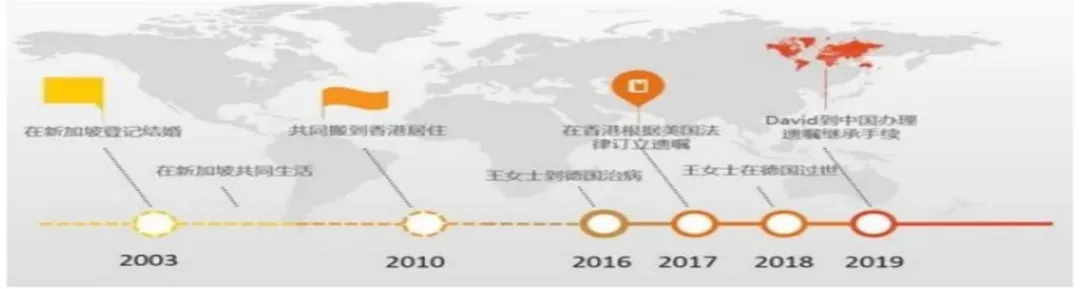
In 2017, Ms. Wang and Mr. David both decided to各自 execute their final wills. The wills were drafted in English by a US attorney and witnessed by two Hong Kong witnesses at signing. The US attorney was also a notary public in active任期 and notarized the signing of the上述 three persons. Ms. Wang’s estate registered in her individual name included assets both in Mainland China and the United States. The assets located in Mainland China included相当一部分 real estate and some cash. Ms. Wang’s executor was her husband, Mr. David. Among the estate was a villa in Shenzhen valued at approximately RMB 50 million. The will stipulated that after her death, this villa would be given by David, as trustee, to the “Father’s Trust,” with the beneficiary being the father. If David predeceased Ms. Wang, a trust company in California, USA, would serve as successor trustee. The distribution rules for the “Father’s Trust” were as follows: During the father’s lifetime, if the trustee deemed it necessary for the father’s health, support, and maintenance of his customary lifestyle, the trustee could distribute trust net income and principal to or for the benefit of the father, up to full distribution. The termination clause for the “Father’s Trust” was: After the father’s death or upon exhaustion of trust assets (whichever occurs earlier), the “Father’s Trust” would terminate, and the剩余 property would be distributed equally to the “Sister’s Trust” and the “Niece’s Trust.” The will also stipulated that all terms of the will, including provisions relating to the rights of the executor and trustee, would be governed by California law.
(II) Court Ruling:
First, regarding the validity of the will. Article 32 of the Law on the Application of Laws to Foreign-Related Civil Relations provides: A testamentary form shall be deemed valid if it complies with the law of the testator’s habitual residence at the time of making the will or at the time of death, the law of the country of nationality, or the law of the place where the testamentary act was performed. Article 33 provides: The validity of a will shall be governed by the law of the testator’s habitual residence at the time of making the will or at the time of death, or the law of the country of nationality. The will was notarized by a notary public in California, USA, and formally resembles a notarized will under Chinese law, differing only slightly due to differences in notarization systems between the two countries. Based on the jurisprudence of the notarization system, this testamentary form does not violate Chinese legal provisions or public order and good customs and should be considered a valid testamentary form with corresponding legal effect.
Second, regarding the validity and execution of the “Father’s Trust.” Chinese law prohibits the direct attribution of trust property ownership to the trustee. From the content of the will, the testamentary trustee only had the rights to manage, use, benefit from, and distribute the property; the testator did not indicate that the trust property could be directly owned by the trustee. Based on these two points, the trustee’s claim that the trust property belonged to him did not comply with legal provisions and contradicted the spirit of the will. The testator had already considered the distribution form of the trust property when making the will, and her ultimate intention was to give all rights and interests in the villa to the father. Considering that the trustee, David, was a foreigner who常年 lived abroad and could not actually manage the testamentary trust, for convenience and to maximize the protection of the beneficiary’s rights, directly distributing all testamentary trust property to the beneficiary father was more consistent with the testator’s intent. Therefore, the beneficiary father’s request to obtain ownership of the house was supported by this court.
III. Analysis of the “Father’s Trust” Case
The author believes that there are aspects of the above court’s reasoning in this case that are open to discussion and require careful consideration:
(I) Regarding the Validity of the Will
In this case, the court considered Ms. Wang’s will to be a notarized will, a point worth reflecting upon. Article 1139 of the Civil Code provides: A notarized will shall be handled by the testator through a notarial institution. Article 6 of the Notarization Law also provides a clear definition: A notarial institution is a proof institution established according to law, operating on a non-profit basis, independently exercising notarial functions and bearing civil liability. That is to say, in China’s legal context, notarial institutions refer to various notary offices. If parties or relevant interested parties believe a notarial certificate is erroneous, they may request review from the notarial institution. If dissatisfied with the review result, they may file a complaint with the local notary association. Both the Notarization Law and the Notarization Procedural Rules provide clear provisions on this. Article 39 of the Notarization Law provides: Parties or interested parties in notarial matters who believe a notarial certificate is erroneous may request review from the notarial institution that issued the certificate. If the content of the notarial certificate is illegal or inconsistent with facts, the notarial institution shall revoke the certificate and make an announcement; the certificate shall be void ab initio. If there are other errors in the notarial certificate, the notarial institution shall correct them. Article 61, Paragraphs 1 and 2 of the Notarization Procedural Rules provide: A party who believes a notarial certificate is erroneous may request review from the notarial institution that issued the certificate within one year of receiving it. An interested party in a notarial matter who believes a notarial certificate is erroneous may request review from the notarial institution that issued the certificate within one year from the date they knew or should have known of the notarial matter, unless they can prove they did not know. The review period shall not exceed twenty years from the date of issuance of the notarial certificate. Article 67, Paragraph 1 provides: If a party or interested party in a notarial matter has objections to the notarial institution’s decision to revoke or not revoke a notarial certificate, they may file a complaint with the local notary association.
Overall, simply equating foreign notarial institutions or notaries with China’s notarial institutions would, firstly, impact the existing management order of notarial institutions, and secondly, encourage wrongdoers to use foreign notarial institutions to circumvent China’s administrative and judicial supervision mechanisms, which is detrimental to both society and individuals. In fact, after China formally joined the Hague Apostille Convention system, notarization results issued by foreign notarial institutions should be authenticated by the foreign affairs authorities of the country where the notarial institution is located and issued with an Apostille. The process has been relatively simplified. In this context, if Chinese courts directly recognize the authentication results of foreign notarial institutions or notaries by analogy with China’s notarization procedures and legal effect without going through this process, it would also risk directly bypassing the Hague Apostille Convention, violating the basic principle of cross-border/foreign-related proof mutual recognition, directly damaging China’s international image and legitimate sovereign interests, and is not commendable.
Therefore, this article believes that Ms. Wang’s will should not be confirmed as a notarized will. Although Ms. Wang chose California law in her will, because testamentary capacity and testamentary validity involve the scope of subject capacity and social public interests, they are generally considered mandatory provisions, excluding party choice. In this regard, Articles 3 and 4 of the Law on the Application of Laws to Foreign-Related Civil Relations provide: Parties may expressly choose the law applicable to foreign-related civil relations in accordance with legal provisions. If Chinese law has mandatory provisions on foreign-related civil relations, such mandatory provisions shall directly apply. Once the relevant provisions of the Civil Code apply, the rules for “wills written on behalf of the testator” or “oral wills” may be considered, and the law of her habitual residence—Hong Kong—should also be considered (Germany was only a place of medical treatment; Hong Kong remained Ms. Wang’s habitual residence). From the perspective of respecting the parties’ intent, the law that validates and renders the will effective should be chosen, rather than simply prioritizing the forum law based on convenience.
For example, according to Section 5.1 of Hong Kong’s Wills Ordinance (2019): A will shall be invalid unless it is in writing, signed by the testator or by some other person in the testator’s presence and by the testator’s direction; it appears that the testator intended by their signature to give effect to the will; the testator made or acknowledged their signature in the presence of two or more witnesses present at the same time; and each witness either attests and signs the will or acknowledges their signature in the testator’s presence. Combining this provision, the author tends to believe that the form and validity of Ms. Wang’s will comply with Hong Kong law and therefore最终 have corresponding legal effect.
(II) Regarding the Validity and Execution of the Trust
According to Article 17 of the Law on the Application of Laws to Foreign-Related Civil Relations, parties may agree on the law applicable to a trust. If the parties have not chosen, the law of the trust property location or the place where the trust relationship arose applies. The court in this case found that the parties involved did not agree on the applicable law for the testamentary trust, and the trust property was all in China, thus applying Chinese law. It should be noted that in this case, Ms. Wang clearly stipulated that all terms of the relevant will were to be governed by California law. Even if one considers the form and validity of the will to be subject to mandatory rules in conflict of laws, it cannot be concluded that the choice-of-law rules for foreign-related trusts are mandatory. Combining Article 17 of the Law on the Application of Laws to Foreign-Related Civil Relations, the Hague Trust Convention, and the legislative practices of major countries and regions, the choice of law for foreign-related trusts is generally considered permissive. From the perspective of maximizing respect for party autonomy, there is no need to强制 require that the same law apply to both the will and the trust. At the root, the costs of reasoning and finding law influence judges’ decision-making.
According to the UK’s Recognition of Trusts Act 1987, for the interpretation of a trust, if it is a testamentary trust, the law chosen by the testator applies, usually the law of the testator’s domicile at the time of making the will. If it is an inter vivos trust, immovable property trusts are governed by the law of the property’s location, and movable property trusts are governed by the law expressly chosen by the parties. If no express choice exists, or if the choice of law is invalid, the court presumes the law most closely connected to the trust applies. Whether inter vivos or testamentary trusts, trust management is governed by the law of the place of administration. Similarly, US trust conflict of laws is relatively complex, with multi-factor consideration aimed at applying the law most closely connected to the parties and their dispute. The 1971 Restatement (Second) of Conflict of Laws adopts the more flexible “most significant relationship” principle. Section 107 of the Uniform Trust Code, which serves as a model for US state legislation, provides that when no applicable law is designated in trust provisions, the meaning and validity of trust provisions shall be determined by the law most closely connected to the matter, essentially adopting the Restatement (Second)‘s standard. Section 6 of the Restatement (Second) of Conflict of Laws lists factors courts should consider in determining applicable law, including: (1) the needs of the interstate and international systems; (2) relevant policies of the forum; (3) relevant policies of other interested states; (4) protection of justified expectations; (5) basic policies underlying the particular field of law; (6) certainty, predictability, and uniformity of result; and (7) ease in determining and applying applicable law. Specifically, under the Restatement (Second), determining the applicable law for a trust relationship requires distinguishing between movable and immovable property trusts, and between inter vivos and testamentary trusts.
Based on the above comparative analysis, Chinese academia has various criticisms of the current Article 17 of the Law on the Application of Laws to Foreign-Related Civil Relations, mainly regarding the limited legal space available for trust choice of law and the lack of core guidance. The court’s judgment in this case was biased towards Mainland law in terms of foreign-related trust choice of law, and erroneously applied the civil law concept of property ownership to trusts. However, from the wording of Article 2 of the Trust Law, “the settlor entrusts his property rights to the trustee,” it is also acceptable for the trustee to directly obtain legal ownership (formal ownership) of trust property. Moreover, China’s current law does not accommodate the system and rules of ownership分割. This is a defect of legislative technique and concept, not attributable to foreign-related parties. Therefore, to facilitate the subsequent distribution and处理 of trust property, Chinese courts could recognize the trustee’s ownership of property in foreign-related trusts, but should simultaneously clarify in the judgment that the trustee shall not engage in activities beyond the necessary scope of testamentary trust property management. In conclusion, from the perspective of maximizing respect for party autonomy and establishing a favorable international image of Chinese courts fully respecting the foreign-related testamentary trust system, the applicable law for the testamentary trust in this case should be California law.
According to relevant provisions of California trust law (PROBATE CODE - DIVISION 9. TRUST LAW 15200-15212), the valid establishment of a trust requires intent, property, compliance with public interest, etc. Where trust property includes real estate, it requires clear signing of a written agreement by the settlor or trustee. In this case, Ms. Wang’s testamentary trust complies with California law and has corresponding legal effect. Furthermore, according to the section on trustee’s duties in California trust law (Trustee’s Duties in General [16000 - 16015]), the trustee holds legal title to trust property and enjoys rights to manage, sell, exchange trust property, etc. If Chinese courts do not support the executor of Ms. Wang’s will’s request to transfer Mainland real estate to the executor’s name, and even attribute this to the executor being a foreigner, inconvenience in management, deprive the executor of possession, and directly transfer the relevant property to Ms. Wang’s father, disregarding Ms. Wang’s clearly expressed subsequent intentions regarding the “Sister’s Trust” and “Niece’s Trust,” this would clearly violate California law and the principle of testamentary sanctity.
In fact, whether to support the trustee’s request for transfer of Mainland trust property in foreign-related trusts has clear precedent from the Supreme People’s Court. In the Supreme People’s Court Civil Judgment (2020) Zui Gao Fa Min Zai No. 111, the Supreme Court supported the Hong Kong estate administrator’s request for registration of change of remaining equity, recognizing that formal ownership had been transferred to the trustee. Since estate administration is普遍 recognized as a trust relationship in common law systems, this reasoning can be extrapolated to become a flexible approach for handling foreign-related trusts. Unfortunately, the judge in this case似乎 did not refer to it.
IV. Conclusion
Testamentary trusts themselves are a new phenomenon in China, encompassing at least two legal fields—wills and trusts—making related issues relatively complex. Once cross-border asset allocation and management are involved, the foreign-related elements of testamentary trusts become apparent, and how to衔接 foreign-related applicable law with other countries’ or regions’ laws becomes an even more complex issue. When handling foreign-related testamentary trust cases, courts should fully compare the differences between China’s legal system and foreign legislation, both fully respecting party autonomy and maintaining China’s judicial sovereignty and authority. With the assistance of professionals such as foreign-related lawyers and tax advisors, the safety and effectiveness of cross-border asset arrangements can be achieved.