Legal Nature and Validity Determination of Memoranda and Letters of Intent
Legal Nature and Validity Determination of Memoranda and Letters of Intent
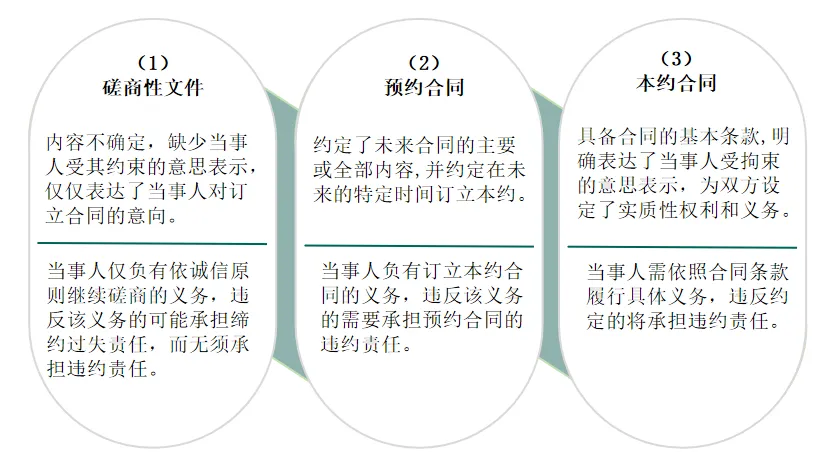
Memoranda and letters of intent are extremely common in commercial transactions. Their legal nature and validity depend not on the document title but on the specific content and whether the parties demonstrate an intention to be bound. Judicial practice typically categorizes them into three types: (1) Negotiating documents—lacking or ambiguous key terms with no expression of intent to be bound, not creating contractual effect, only imposing a duty of good faith negotiation; (2) Preliminary contracts—clearly stipulating the future conclusion of a formal contract, binding on both parties, with breach giving rise to preliminary contract liability; (3) Formal contracts—with specific and clear content and conditions capable of performance, directly establishing substantive rights and obligations, with breach giving rise to liability for breach of contract. In determining the nature, courts comprehensively examine the completeness of terms, genuine contracting intent, and actual performance. Article 495 of the Civil Code no longer presumes such documents to be preliminary contracts, reflecting more rigorous legislation. Parties should specify core transaction terms as clearly as possible and clearly define the document's nature and liability for breach to prevent legal risks.
Memoranda and letters of intent are two types of documents frequently signed in commercial transactions. Since they are not named “contracts” or “agreements,” disputes may arise in practice regarding their nature and validity. Article 2 of the Supreme People’s Court’s 2012 “Interpretation on Issues Concerning the Application of Law in the Trial of Sales Contract Disputes (Fa Shi [2012] No. 8)” provided for preliminary contracts, recognizing the concept of preliminary contracts for the first time, and listed memoranda and letters of intent together with subscription agreements, order forms, and booking notes—i.e., suggesting that memoranda and letters of intent may constitute preliminary contracts. However, Article 495 of the Civil Code promulgated in 2020, while partially adopting the above view, no longer lists memoranda and letters of intent alongside standard preliminary contracts such as subscription agreements, order forms, and booking notes—i.e., it does not consider them necessarily as preliminary contracts. This has sparked extensive discussion about the nature of these two types of documents.
Through case law research, it is found that in judicial practice, courts typically determine the nature and validity of memoranda and letters of intent in the following three ways, based on whether the content is specific and clear and whether the parties have expressed an intention to be bound, considered in conjunction with the transaction background: (1) Negotiating documents without legal binding force; (2) Preliminary contracts with legal binding force; (3) Formal contracts with legal binding force.
That is to say, the true nature of documents entitled “Memorandum” or “Letter of Intent” depends not on their title but on their content. The change in the Civil Code avoids misunderstandings in application and represents progress and maturity in legislative technique. Below, detailed interpretation of the adjudicative approach is provided with case examples and the nature ultimately determined for such documents:
I. Negotiating Documents Without Legal Binding Force
Negotiating documents generally refer to documents used by parties to express their willingness to cooperate (also called “contracting intent”), indicating that both parties are willing to conduct further negotiations on the future conclusion of a formal contract. The content of negotiating documents often lacks or is ambiguous regarding key terms and also lacks an expression of the parties’ intention to be bound by the document, thus not constituting a contract. When a memorandum or letter of intent only constitutes a negotiating document, the rights and obligations between the parties are not yet fully defined, and neither party has the obligation to conclude a formal contract. Therefore, when a signed memorandum or letter of intent falls within the category of negotiating documents, it does not create contractual effect between the parties. Both parties need only continue negotiations in accordance with the principle of good faith. If no clear consensus is ultimately reached, neither party bears liability for breach of contract. However, it is worth noting that if one party’s conduct falls within the circumstances described in Article 500 of the Civil Code, it may constitute pre-contractual fault, giving rise to liability for pre-contractual damages.
Therefore, when signing such documents, parties should fully understand their nature and proceed with further negotiations or abandon the conclusion of a formal contract based on their actual needs, rather than mistakenly believing that a formal contract has been signed or that performable terms exist, which could lead to missed business opportunities. When asserting their rights, parties should focus on examining whether the other party has pre-contractual fault liability, rather than blindly claiming breach of contract.
Legal Provisions
The Civil Code of the People’s Republic of China
Article 500 Where a party causes loss to the other party in the course of concluding a contract under any of the following circumstances, the party shall assume liability for damages:
(1) Negotiating in bad faith under the pretext of concluding a contract;
(2) Intentionally concealing material facts relating to the conclusion of the contract or providing false information;
(3) Engaging in any other conduct that violates the principle of good faith.
Case
(2013) Min Yi Zhong Zi No. 107 — Yangpu Economic Development Zone Management Committee v. Aohua Asset Management Co., Ltd. (Construction Land Use Right Dispute)
Basic Facts: On April 19, 2008, Aohua Company and Yangpu Economic Development Zone Administration Bureau signed a “Letter of Intent for Investment in Building a High-End Hotel” (hereinafter “Letter of Intent”). Article 3(1) of the Letter of Intent stipulated that, with approval from the Ministry of Finance, Aohua Company had acquired the land use rights for two plots, D2-17-1 and D2-17-2, in Yangpu Development Zone from Guangda Company, totaling 15,951 square meters (approximately 24 mu), with the land designated for commercial use. Article 3(2) stipulated that the Yangpu Economic Development Zone Administration Bureau supported Aohua Company’s investment in building a high-end hotel in Yangpu and agreed to coordinate land replacement… On February 20, 2010, the Yangpu Economic Development Zone Administration Bureau was renamed the Yangpu Economic Development Zone Management Committee.
Aohua Company later never obtained the replacement land use rights, could not proceed with hotel project construction, and was informed by the Yangpu Management Committee that it could no longer coordinate land replacement. Aohua Company then sued the Yangpu Management Committee in court, claiming that the committee’s failure to perform its contractual obligations constituted fundamental breach of contract, and requested the court to rescind the Letter of Intent and order the Yangpu Management Committee to compensate Aohua Company for losses of RMB 159,607,700.
During the litigation, the parties disagreed on the nature and validity of the Letter of Intent. Aohua Company argued that the Letter of Intent was a civil agreement that did not violate mandatory provisions of laws or administrative regulations, reflected the genuine intent of both parties, and should be protected by law. The Yangpu Management Committee argued that the Letter of Intent was merely an意向 document with no specific provisions on rights and obligations and no binding force.
The second-instance court, citing Article 1 of the Supreme People’s Court’s “Interpretation (II) on Several Issues Concerning the Application of the Contract Law of the People’s Republic of China”—which provides that “if the people’s court can determine the name or title of the parties, the subject matter, and the quantity, the contract shall generally be deemed concluded”—made the following findings: First, although the parties to the Letter of Intent were definite and clear, regarding the subject matter and quantity, the document merely described the land acquired by Aohua Company from Guangda Company and provided for Aohua Company’s intent to replace the land and the Yangpu Development Zone Administration Bureau’s agreement to coordinate replacement, without clearly stipulating whether the replacement must be successful or the specific location and area of the replacement land. Therefore, the Letter of Intent did not contain the main terms of a contract and did not constitute a formal land replacement contract. Second, the Letter of Intent did not clearly define the rights and obligations of the Yangpu Management Committee in the land replacement process, and the parties did not express an intention to be bound by it. Therefore, the Letter of Intent was not an agreement reached between relevant land use right holders to conduct a land replacement in the future or to conclude a land replacement contract in the future. Consequently, the Letter of Intent was a negotiating and谈判 document, lacking the basic elements of a contract, not establishing civil rights or obligations for either party, and no civil legal relationship was formed between the parties.
Case Analysis: This case demonstrates that Aohua Company mistakenly believed that after signing the Letter of Intent, it only needed to wait for the Yangpu Management Committee to arrange coordinating land replacement, while ignoring that the Letter of Intent’s terms actually lacked binding force on both parties and did not stipulate what liability the Yangpu Management Committee would bear if it failed to successfully replace the land, ultimately resulting in Aohua Company’s significant losses.
II. Preliminary Contracts with Legal Binding Force
A preliminary contract is an independent contract, the purpose of which is to conclude a formal contract (the “main contract”). A preliminary contract must contain the main or all terms of the main contract and provide for the conclusion of the main contract within a specified future period. Under a preliminary contract, the parties have the obligation to conclude the main contract, and breach of this obligation gives rise to liability for breach of the preliminary contract.
As mentioned above, although Article 495 of the Civil Code no longer treats memoranda and letters of intent as standard forms of preliminary contracts, the nature of these two types of documents is determined by their specific content rather than their title. That is, if a memorandum or letter of intent clearly defines the parties, the subject matter, and the expression of intention to conclude the main contract in the future, and other main terms, it may still constitute a preliminary contract because it contains the elements of a preliminary contract.
Preliminary contracts and main contracts are both related and distinct. In terms of expression of intent, a preliminary contract also requires the parties to express an intention to be bound, and this expression of intent reflects the agreement to conclude the main contract. Therefore, a preliminary contract gives rise to a right to request contracting, with the effect of legally binding the parties in advance when there are factual or legal obstacles to concluding the main contract. In terms of content, a preliminary contract also needs to satisfy the requirement of specific and clear content, but the requirement for completeness of content for a preliminary contract is generally lower than for a main contract.
It should be noted that there is no preliminary contract system in Anglo-American law. An agreement for “a contract to make a contract” or an agreement that is “subject to contract” is generally deemed to have no legal effect [see 1. Darton Ltd. v Hong Kong Island Development Ltd (2001); 2. Walford and Others v Miles and Another (1992)]. Therefore, if a memorandum/letter of intent provides for the conclusion of a main contract within a specified future period and simultaneously stipulates the application of the law of a common law country or region, such as Hong Kong law, the memorandum/letter of intent only has the effect of protecting reliance interests in contracting and does not create a right to demand contracting.
Therefore, parties that have signed such documents should promptly be aware of whether they are obligated to conclude the main contract according to the agreed time and conditions, and what liability they will bear if they fail to do so.
Legal Provisions
The Civil Code of the People’s Republic of China
Article 495 Subscription agreements, order forms, booking notes, and other such documents where the parties agree to conclude a contract within a specified future period constitute preliminary contracts.
Where one party fails to perform the obligation to conclude a contract as agreed in the preliminary contract, the other party may request that party to bear liability for breach of the preliminary contract.
Case
(2020) Hu 0115 Min Chu No. 1614 — Shanghai Xinshengyuan Pharmaceutical Co., Ltd. v. Jiaochen Biomedical Technology (Shanghai) Co., Ltd. (Technology Transfer Contract Dispute)
Basic Facts: On November 12, 2018, Shanghai Xinshengyuan Pharmaceutical Co., Ltd. (hereinafter “Xinshengyuan”) and Jiaochen Biomedical Technology (Shanghai) Co., Ltd. (hereinafter “Jiaochen”) signed a “Memorandum on the Transfer of Project 009” (hereinafter “Memorandum”), stipulating that Xinshengyuan would transfer the research results of Project 009 (i.e., the “YGY009 Pharmaceutical Research” and “YGY009 Prevention of Post-Colon Cancer Chemotherapy Recurrence Pharmacological and Efficacy Research” projects) to Jiaochen, with the transfer price tentatively set at RMB 10 million (excluding equipment costs), and that the parties would sign a formal transaction contract based on the basic principles and content determined in the Memorandum. The actual implementation of each work would be subject to the final transfer agreement signed by both parties.
After signing the Memorandum, Jiaochen failed to perform its obligations under the Memorandum to acquire the project technology and purchase project-specific equipment. Xinshengyuan filed a lawsuit requesting the court to rescind the Memorandum and order Jiaochen to compensate for its corresponding losses. Jiaochen agreed to rescind the Memorandum but argued that the Memorandum was an意向 document for negotiation, that there were no statutory grounds for rescission and no agreed liability for breach, that Jiaochen had no breach of contract during negotiations, and that it disagreed to compensate Xinshengyuan for the alleged economic losses.
The court listed the nature and validity of the Memorandum as one of the points of contention and held that: The Memorandum did not clearly stipulate many key terms directly affecting the rights and obligations of both parties, such as the specific content of the technology and equipment to be transferred, the transfer price, and the payment time. These were unresolved terms that needed to be agreed upon through consultation when signing the Technology Transfer Contract and the Equipment Transfer Contract. The Memorandum was the result of negotiations and consensus between Xinshengyuan and Jiaochen for the future conclusion of a formal transfer agreement. Both parties’ understanding of the nature of the Memorandum as a preliminary contract was clear and without doubt when signing it. The court found that the Memorandum was a preliminary contract aimed at concluding a transfer agreement in the future, and the content determined therein had binding force between the parties.
The court further held that the significance of a preliminary contract is to create conditions for continuing negotiations under the principles of fairness and good faith and ultimately concluding a formal, complete main contract. Based on the facts found, Jiaochen had communicated and negotiated with Xinshengyuan multiple times regarding the total transaction price and specific terms of the transaction contract. However, because Jiaochen’s shareholders’ meeting did not agree with the contract terms proposed by Xinshengyuan, a formal contract was ultimately not signed—this was simply a failure of negotiations. Additionally, there was no evidence proving that Jiaochen engaged in bad faith negotiations during this process. Jiaochen was not at fault in performing the Memorandum. Therefore, the court did not support Xinshengyuan’s claim regarding Jiaochen’s breach of the preliminary contract. As Jiaochen explicitly agreed to rescind the Memorandum, the court ordered its rescission but Jiaochen was not required to bear compensation liability.
Case Analysis: In this case, when signing the Memorandum, the parties indicated through specific and clear terms that their understanding regarding the future conclusion of the main contract was clear—i.e., the Memorandum clearly constituted a preliminary contract. However, the parties failed to explicitly stipulate what would happen if the main contract was not concluded and did not细分 the liability for failing to conclude the main contract. Therefore, although the preliminary contract was formed, due to the absence of corresponding liability for breach of contract provisions in the Memorandum itself, Xinshengyuan could neither directly demand Jiaochen to sign the main contract nor assert that Jiaochen was in breach.
III. Formal Contracts with Legal Effect
A formal contract (main contract) is a contract that establishes substantive rights and obligations for the parties, enabling them to directly perform the contract’s content. When a memorandum or letter of intent contains the main terms of a contract and clearly expresses the parties’ intention to be bound, it may constitute a main contract. The parties must specifically perform according to the memorandum or letter of intent, and a breaching party will bear liability for breach of contract.
Two practical issues arise in determining whether a memorandum or letter of intent constitutes a main contract:
First, if the parties did not reach clear agreement on all aspects of the transaction when signing the memorandum or letter of intent, does this affect whether the memorandum or letter of intent is established as a main contract?
Contract formation requires the contracting parties to reach consensus on the main terms of the contract. Although Article 470 of the Civil Code lists eight basic terms generally included in a contract, in practice, the contract is formed as long as the parties reach consensus on the main terms. The absence of some of these terms does not necessarily prevent the contract from being formed. For content that is not agreed upon or is ambiguously agreed upon, the parties may clarify it during contract performance through supplementary agreements, by reference to relevant contract terms, or by reference to transaction practices, in accordance with the methods for supplementing contract terms under Articles 510 and 511 of the Civil Code. Therefore, when a memorandum or letter of intent already contains the main terms of a contract, even if certain content lacks agreement or is ambiguously agreed upon, this does not affect its nature as a main contract.
Second, when a memorandum or letter of intent is very detailed in content but provides for the conclusion of a separate formal contract, and before the formal contract is signed, the parties have performed according to the memorandum or letter of intent, is the memorandum or letter of intent a preliminary contract or a main contract?
The Civil Code affirms the independence of preliminary contracts. Therefore, in practice, preliminary contracts and main contracts should be strictly distinguished. However, due to the lack of detailed provisions in current law on how to distinguish between the two, there is some inconsistency in judicial decisions, and specific case circumstances should be considered.
Generally, the determination should be based on the parties’ expression of intent—whether they intend to sign a separate formal contract in the future. If the parties agree that a separate formal contract needs to be signed, i.e., there is a clear expression of intent indicating that they have only signed a preliminary contract, then even if the letter of intent or memorandum is very detailed in content, the parties’ expression of intent should be respected.
However, in practice, the parties’ true intent often cannot be determined solely by isolated terms in the agreement; rather, the overall content of the agreement, subsequent negotiations, and specific performance conduct should be examined. Where the parties have not continued negotiations or signed a separate main contract, but one party has actually performed according to the memorandum or letter of intent, and the other party has not objected or has even directly accepted such performance, this performance conduct often reflects the parties’ true intent—i.e., both parties may consider it unnecessary to sign a separate main contract and can directly perform the memorandum or letter of intent. In such circumstances, courts typically determine that the memorandum or letter of intent is a main contract by reference to Article 490 of the Civil Code.
Parties signing this type of memorandum or letter of intent should focus on whether the main terms agreed upon by both parties are clear, whether the subject matter, price, and payment method are clearly defined and capable of direct performance. At the same time, attention should be paid to whether there are provisions regarding the future conclusion of a formal contract, and how to understand and implement such provisions may also have different impacts on the nature of the document and dispute resolution solutions.
Legal Provisions
The Civil Code of the People’s Republic of China
Article 470 The content of a contract shall be agreed upon by the parties and generally includes the following terms:
(1) The names or titles and domiciles of the parties;
(2) The subject matter;
(3) Quantity;
(4) Quality;
(5) Price or remuneration;
(6) Time, place, and method of performance;
(7) Liability for breach of contract;
(8) Methods for dispute resolution.
The parties may conclude a contract by reference to model texts of various types of contracts.
Article 490 Where the parties conclude a contract in written form, the contract is formed when all parties have signed, sealed, or affixed their fingerprints. Prior to signing, sealing, or affixing fingerprints, where one party has already performed the main obligation and the other party has accepted it, the contract is formed.
Where laws, administrative regulations, or the parties’ agreement stipulate that a contract shall be concluded in written form, and the parties have not used written form, but one party has already performed the main obligation and the other party has accepted it, the contract is formed.
Case
(2021) Lu Min Zhong No. 425 — Shengtai Jie Environmental Technology Co., Ltd. v. Shandong Zhengshun Construction Group Co., Ltd. (Construction Project Construction Contract Dispute)
Basic Facts: In early 2016, Zhengshun Company and Shengtai Jie Company signed a “Letter of Intent for Construction Project” regarding the construction of Buildings 3# and 5# of the Xueye Tourism Zone Software R&D Center. The Letter of Intent provided for the project name, location, construction content and requirements, project price, and project handover. It also stated that “Shengtai Jie Company will conduct invited tender for the software R&D center construction; Zhengshun Company agrees to participate in the tender. If Zhengshun Company wins the tender, it will complete the construction, construction management, and project quality warranty according to the winning contract. Matters not covered in this Letter of Intent shall be subject to the bidding documents, bid documents, and winning contract.”
After signing the Letter of Intent, Shengtai Jie Company did not conduct tendering but issued a开工 order to Zhengshun Company without obtaining a construction permit, and the parties did not sign a separate contract. The relevant Buildings 3# and 5# were commenced by Zhengshun Company on March 5, 2016, and March 20, 2016, respectively, and passed the main structure inspection on September 27, 2016. Subsequently, a dispute arose between the parties over project payment. Zhengshun Company filed a lawsuit. During the litigation, Shengtai Jie Company argued that the Letter of Intent was a preliminary contract and that Zhengshun Company had no right to claim project payment based on a preliminary contract.
The first-instance court first determined the nature and validity of the Letter of Intent, finding that the Letter of Intent constituted a pre-contract civil juristic act implemented by Zhengshun Company and Shengtai Jie Company through consensus for the purpose of concluding a construction project construction contract. Although the Letter of Intent stated that “Shengtai Jie Company will conduct invited tender for the software R&D center construction; Zhengshun Company agrees to participate in the tender. If Zhengshun Company wins the tender, it will complete the construction, construction management, and project quality warranty according to the winning contract,” it simultaneously provided detailed and clear provisions on the main content of the construction project construction contract, including the project scope, construction period, project quality, project price settlement, progress payment, warranty deposit, and liability for breach of contract, thus already possessing the formal and legal requirements of a main contract. Subsequently, Shengtai Jie Company did not initiate tendering for the project, and from the issuance of the开工 order to Zhengshun Company’s withdrawal, the parties did not reach any other written contract. Therefore, the legal nature of the Letter of Intent was determined to be a main contract reached between the parties.
Shengtai Jie Company appealed, arguing that the first-instance court’s finding that “the Letter of Intent already possessed the formal and legal requirements of a main contract and constituted a main contract reached between the parties” lacked factual basis and violated the principle of contractual autonomy.
The second-instance court held that since the project was not one that required mandatory tendering, the content of the Letter of Intent did not involve issues such as提前 negotiation, malicious negotiation, or pre-award determination. The Letter of Intent represented the genuine intent of both parties and did not violate mandatory provisions of laws or administrative regulations and should be lawful and valid. The Letter of Intent contained the basic terms of a contract. In actual performance, both parties performed according to the Letter of Intent’s provisions. Considering the actual circumstances of the case, the parties did not subsequently negotiate the signing of a formal contract. Therefore, the first-instance court’s determination that the Letter of Intent was a main contract, rather than a preliminary contract, was not erroneous.
Case Analysis: In this case, although the document signed was merely titled “Letter of Intent for Construction Project” and stipulated “matters not covered shall be subject to bidding documents, bid documents, and winning contract,” according to the court’s view, since the project was not one requiring mandatory tendering (i.e., the bidding documents and winning contract were not necessarily concluded), and the Letter of Intent already contained all the main terms and was capable of direct performance, and Shengtai Jie Company had in fact issued a开工 order to Zhengshun Company without signing a winning contract, and had not raised the issue of concluding a main contract during Zhengshun Company’s construction until completion, the court did not accept Shengtai Jie Company’s claim. On the other hand, the initiative to conduct tendering was also in Shengtai Jie Company’s hands. Where the main structure of the project had already passed inspection, the abuse of rights would not be supported.
IV. Conclusion
The nature of memoranda and letters of intent falls into three categories: negotiating documents, preliminary contracts, or main contracts. When a memorandum or letter of intent constitutes a negotiating document, it has no legally binding effect; when it constitutes a preliminary contract, it gives rise to a right to demand contracting; when it constitutes a main contract, it establishes substantive rights and obligations for both parties.
In commercial transactions, to consolidate negotiation results and enhance the predictability of conduct, parties should ensure that the content of memoranda and letters of intent is as specific and clear as possible when signing, avoid using ambiguous language, reflect the consensus reached by the contracting parties, and ensure performability. Additionally, by clearly stipulating validity clauses and liability for breach clauses, parties can ensure that the signed memoranda and letters of intent have legal effect.