Research on Criminal Risks of Village Three Cadres and Risk Prevention Countermeasures
Research on Criminal Risks of Village Three Cadres and Risk Prevention Countermeasures
With the proposal of rural revitalization strategy and extension of supervision to village level, village committee cadres should find their positioning in the overall development, serve as village representatives while setting examples and improving rural customs.
Introduction
With the proposal of rural revitalization strategy and extension of supervision to village level, village committee cadres should find their positioning in the overall development, serve as village representatives while setting examples and improving rural customs. This article starts from village three cadres’ criminal statistics, discusses village official crime phenomena and causes, and proposes targeted risk response measures.
Village officials should prioritize their own risks, especially criminal risks, conduct compliance self-examinations as early as possible, and timely engage lawyers to help protect their legitimate rights.
I. Introduction
In December 2020, China achieved decisive victory in poverty alleviation. With consolidation of poverty alleviation results, the Party’s work focus gradually shifted to fully implementing rural revitalization strategy. Rural revitalization involves not only economic development but also political, cultural, and spiritual civilization aspects in an integrated manner. Rule of law countryside is an important guarantee for rural development.
II. Village Official Crime Statistics
A. Who are Village Officials?
Village officials generally refer to “two committee” members — village party branch committee and village committee. But statistics show village officials involved in crimes mainly concentrate in “village three cadres”: village party secretary, village committee director, and village accountant, accounting for over 80% of criminal cases.
B. Statistics on Village Official Crimes
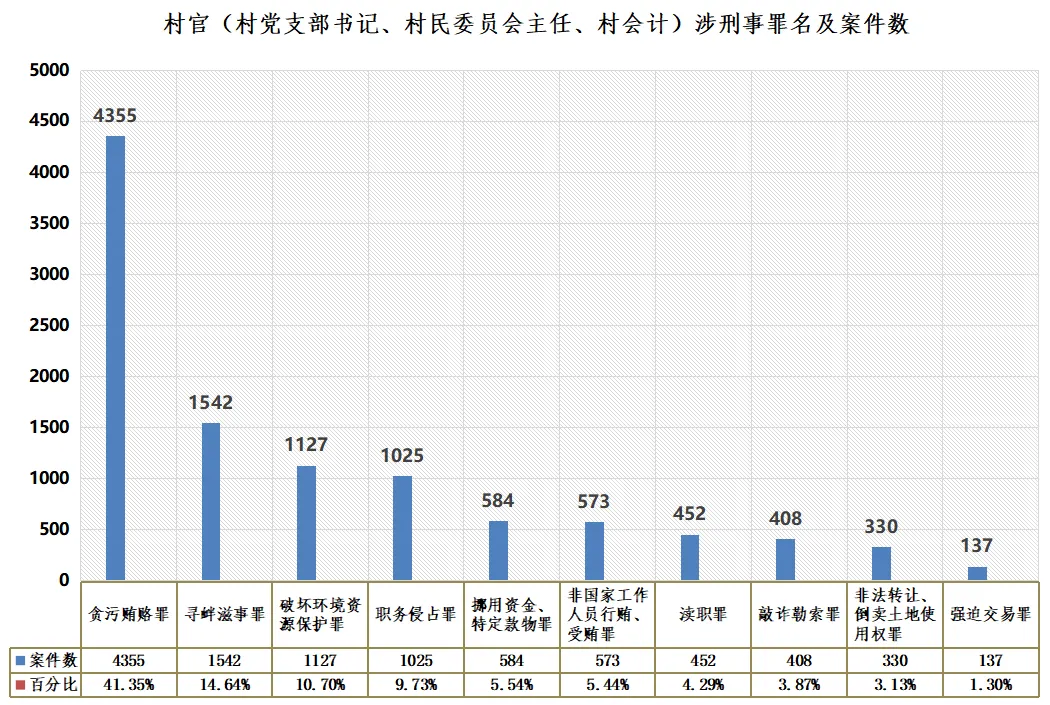
Over the past five years, statistics on top 10 charges for village officials (party secretaries, committee directors, village accountants) show: except for picking quarrels and provoking trouble, extortion, and forced transactions, the other 7 types are related to officials’ positions, accounting for 78%. Corruption and bribery crimes are the most severe, exceeding half of position-related crimes at 41%.
III. Analysis of Village Official Crime Phenomena
A. “Black-Red Mixed”
Two forms: “from red to black” — village officials becoming black society organization leaders; or “from black to red” — black society leaders packaged as village officials.
B. “Many People Make Things Easier”
Reliance on electoral origins means village officials have some mass base. When involved in crimes, many get implicated. This includes clan power influence and building interest groups.
C. “Pie Becomes Trap”
Government land acquisition, village reconstruction, and poverty alleviation projects bring compensation funds. Facing such “meat,” some village officials succumb to temptation, turning “pie” into prison “trap.”
IV. Causes of Village Official Crimes
A. Weak Legal Awareness
Village cadres receive relatively less integrity education and legal education, with weaker willpower to resist temptation or identify violations.
B. Weak Standard Awareness
Financial disclosure and democratic financial management systems are not fully implemented. Some treat village finances as “family finances,” lacking democratic management or financial disclosure.
C. Old “Guanxi” Thinking
Some village officials, after taking positions, believe repaying family is natural human sentiment, weakening servant consciousness and letting family interests cloud judgment.
D. Lag in Rural Legal Construction
- Absence of legal aid
- Lack of government support
- Defects in event resolution
E. Formal Supervision
Current village cadre management involves multiple departments with poor coordination, leading to supervision becoming mere formality.
V. Countermeasures and Suggestions
A. Improve Legal Awareness
Strengthen ideological and legal education for village cadres, enhance belief and party discipline education.
B. Enhance Standard Awareness
Strengthen and implement financial systems including bookkeeping, personnel arrangements, approval, and disclosure.
C. Remove Guanxi Thinking
Fully leverage deterrent and preventive effects of crime punishment.
D. Accelerate Legal Construction
Increase publicity, innovate methods, establish government legal aid committees, guide compliant event handling.
E. Implement Supervision
For party members, party organization and disciplinary supervision. For non-party members, implement supervision law provisions, establish county-level supervision committees.
Conclusion
Using power outside regulations, not coveting wealth outside vision, not committing minor evils outside bottom lines, not cultivating unhealthy hobbies — controlling desires and power — is the best firewall village officials can establish for themselves.
Village officials should conduct risk compliance as early as possible, self-examine whether their behaviors violate laws and regulations, and promptly remedy situations. When involved in criminal crimes, promptly seek professional legal help, fully utilizing the maximum 37 days from public security detention to procuratorate arrest approval for lawyers to help protect legitimate rights.