
In-Depth Interpretation of 2025 New Rules on Refusal to Execute: A Complete Guide from Public Prosecution Transfer to Private Prosecution
In-Depth Interpretation of 2025 New Rules on Refusal to Execute: A Complete Guide from Public Prosecution Transfer to Private Prosecution
Introduction: The '2025 Opinions on Handling Criminal Cases of Refusal to Execute Judgments and Rulings' (Fa Fa [2025] No. 8), newly issued by the Supreme People's Court, Supreme People's Procuratorate, and Ministry of Public Security, officially came into effect on July 1, 2025. This document directly addresses the 'difficulty in enforcement' issue in practice and systematically clarifies the specific division of labor and procedures among public security organs, procuratorates, and courts in handling cases of refusal to execute judgments and rulings (hereinafter referred to as 'refusal to execute crimes').
Introduction:
The “2025 Opinions on Handling Criminal Cases of Refusal to Execute Judgments and Rulings” (Fa Fa [2025] No. 8), newly issued by the Supreme People’s Court, Supreme People’s Procuratorate, and Ministry of Public Security (hereinafter referred to as the “Fa Fa [2025] No. 8 Opinions”), officially came into effect on July 1, 2025. This document directly addresses the “difficulty in enforcement” issue in practice and systematically clarifies the specific division of labor and procedures among public security organs, procuratorates, and courts in handling cases of refusal to execute judgments and rulings (hereinafter referred to as “refusal to execute crimes”).
As a lawyer, I deeply understand the pain of clients who obtain a judgment only to find it becomes an “unenforced legal document.” The issuance of the Fa Fa [2025] No. 8 Opinions provides applicants for enforcement and lawyers with a clearer action guide. This article aims to, from the perspective of legal practice and in combination with previous regulations, interpret the core key points and provide a practical reference for peers and rights holders.
I. Legal Framework: Laws, Regulations, and Judicial Interpretation System Regarding “Refusal to Execute Crimes”
Before applying the new Fa Fa [2025] No. 8 Opinions, it is necessary to clarify the existing laws, regulations, and judicial interpretations related to “refusal to execute crimes.” This is the foundation for providing professional legal opinions and persuading judicial organs.
1. Article 313 of the Criminal Law of the People’s Republic of China
And corresponding judicial interpretations: This is the fundamental legal basis for “refusal to execute crimes,” stipulating that “those who have the ability to execute but refuse to execute judgments and rulings of the people’s courts, if the circumstances are serious,” constitute a crime.
2. Criminal Procedure Law of the People’s Republic of China
This mainly involves procedural provisions for public prosecution and private prosecution cases, particularly Article 210 regarding the scope of cases accepted for private prosecution, which is the foundation for the “public prosecution to private prosecution” path in the Fa Fa [2025] No. 8 Opinions.
3. Civil/Administrative Procedure Law of the People’s Republic of China
This stipulates various coercive measures in enforcement procedures (such as inquiry, freezing, transfer, detention, fines, etc.). The implementation of these measures serves as important evidence for determining whether the person subject to enforcement “refuses to execute.”
4. Interpretations of the Supreme People’s Court and Supreme People’s Procuratorate on Issues Concerning the Application of Law in Hearing Criminal Cases of Refusal to Execute Judgments and Rulings (Fa Shi [2024] No. 13)
This judicial interpretation is the most important basis for current identification of “refusal to execute crimes.” It provides detailed examples of “refusal to execute, circumstances serious,” such as concealing and transferring property, fraudulent litigation, and violent resistance to law, providing clear guidance for lawyers to collect evidence. [Note: Fa Shi (2015) No. 16 has been invalidated.]
5. Opinions on Handling Criminal Cases of Refusal to Execute Judgments and Rulings (Fa Fa [2025] No. 8)
The latest Fa Fa [2025] No. 8 Opinions are not intended to replace the 2024 judicial interpretations but, based on them, focus on solving procedural coordination issues among public security organs, procuratorates, and courts. The aim is to unblock the “obstruction” in cases transitioning from enforcement procedures to criminal investigation, prosecution, and trial, and for the first time systematically clarify the relief channel for “public prosecution failure transitioning to private prosecution.”
II. How to Apply for Court Transfer to Public Security for Filing? The Lawyer’s “Critical Step”
Articles 3 and 4 of the Fa Fa [2025] No. 8 Opinions clarify the court’s responsibilities and material requirements for transfer to public security. In practice, courts are overwhelmed with cases, and enforcement judges find it difficult to conduct detailed reviews of criminal possibilities for each case. Therefore, applicants for enforcement or their attorneys should take the initiative, playing the roles of “whistleblower” and “evidence organizer.”
Core Steps:
1. Evidence First
In accordance with the “circumstances serious” provisions in the 2024 judicial interpretations, comprehensively collect evidence of crimes suspected to be committed by the person subject to enforcement. The key is to prove two points: “has the ability to execute” and “refuses to execute.”
-
Proving “Has the Ability”: Apply for court investigation orders or, based on statutory authority, investigate the bank statements, real estate registration, vehicle information, commercial equity holdings, and third-party claims of the person subject to enforcement. For concealed income (such as cash transactions, assets held by others), evidence can be preserved through commercial investigations, witness testimony, and other means.
-
Proving “Refuses to Execute”: Including but not limited to: refusing to report or falsely reporting after the court issues a property reporting order; arbitrarily transferring or damaging property after the court seals it; evidence of property transfer through false divorce, fraudulent litigation, etc.; transcripts of refusal to comply after summons or detention, etc.
2. Submit Written Application
Prepare a detailed “Application for Transfer to Public Security for Filing and Investigation Regarding [Name of Person Subject to Enforcement ***] Suspected of Refusing to Execute Judgments and Rulings.” The application should elaborate on the facts in detail, attach a complete evidence catalog and evidence materials, and clearly demonstrate that their behavior meets the filing standards stipulated in the Criminal Law and relevant judicial interpretations.
3. Effective Communication with the Judge
Submit the application and evidence materials to the enforcement judge, and proactively communicate with the judge, explaining the egregious nature of the case and the necessity of pursuing criminal liability to promote enforcement. According to Article 3 of the Fa Fa [2025] No. 8 Opinions, when the court discovers suspected crimes, it “shall” transfer. This provides a clear basis for applicants for enforcement and lawyers to request the court to take action.
III. The Court’s “Transfer Trigger”: Under What Circumstances Will the Transfer Procedure Be Initiated?
According to Article 4 of the Fa Fa [2025] No. 8 Opinions, the court’s decision on whether to transfer mainly depends on whether it has obtained preliminary evidence sufficient to prove criminal facts. The more comprehensive the materials submitted by the lawyer, the greater the likelihood the court will initiate the transfer procedure. Under the following circumstances, the court is more likely to transfer the case to public security:
1. Relatively Sufficient Evidence
The court, through its own investigation or materials provided by the applicant, has already obtained the five categories of core evidence listed in Article 4 of the Fa Fa [2025] No. 8 Opinions, and can initially form an evidence chain of “has ability, refuses to execute, circumstances serious” against the person subject to enforcement.
2. Conventional Enforcement Measures Exhausted Without Effect
The court has taken a series of coercive enforcement measures such as sealing, seizure, freezing, fines, and judicial detention, but the person subject to enforcement still stubbornly resists, and the enforcement procedure has reached an impasse.
3. Bad Social Impact
The person’s resistance to enforcement has caused egregious social impact, such as cases involving recovery of wages, child support, or elderly support, or the person subject to enforcement openly resists the law through violence or threats.
4. Superior Court Supervision or Public Opinion Pressure
The case is supervised by a higher court or has attracted widespread public attention. Pursuing criminal liability becomes a necessary means to maintain judicial authority.
IV. What to Do If Public Security Does Not File a Case? Understanding the Relief Path at a Glance
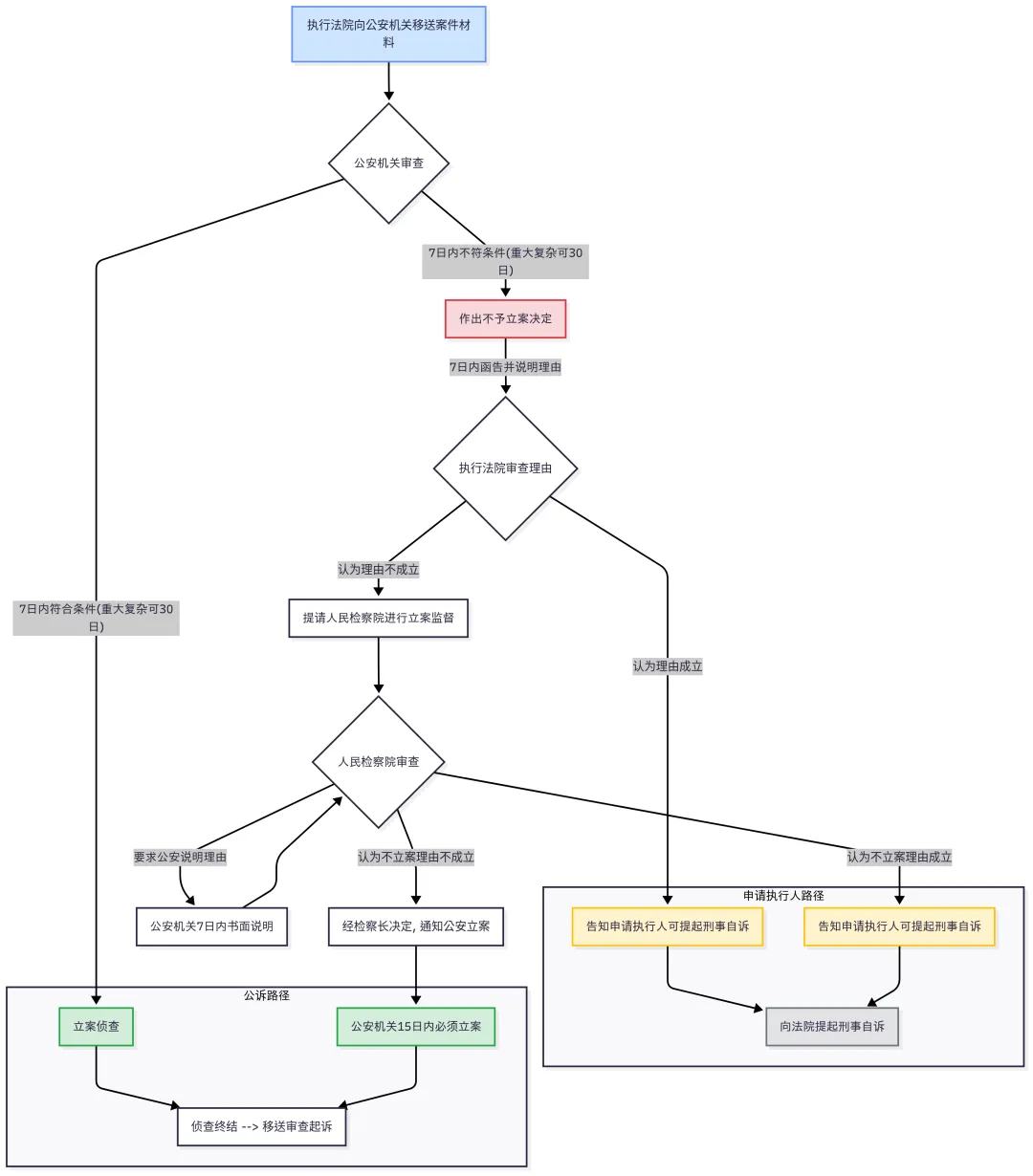
This is one of the biggest highlights of the Fa Fa [2025] No. 8 Opinions. It provides applicants for enforcement with a clear relief plan when public power intervention is obstructed. Previously, if public security did not file a case, the enforcement court and applicants were often at a loss. Articles 7, 8, and 12 of the Fa Fa [2025] No. 8 Opinions establish a complete closed loop of “court referral -> procuratorate supervision -> final relief.”
See the following flow chart for details:
V. The Ultimate Weapon: How to Initiate Private Prosecution?
When the public prosecution path is not feasible, the Fa Fa [2025] No. 8 Opinions retain the final relief measure for applicants for enforcement, namely private prosecution. This means applicants for enforcement will have the opportunity to transform from “plaintiffs” in civil cases to “private prosecutors” in criminal cases, bringing the person subject to enforcement to the criminal dock.
Special features and core points for initiating private prosecution:
1. Necessary Pre-Procedure
Articles 11 and 12 of the Fa Fa [2025] No. 8 Opinions clarify that initiating private prosecution must satisfy a core prerequisite: the applicant for enforcement has tried the public prosecution path but failed, including the following three circumstances:
-
Filed a complaint with public security, but public security refuses to accept materials, fails to respond within 30 days after acceptance, or decides not to file a case.
-
Or, after court transfer, public security decides not to file a case or fails to respond within 30 days.
-
Or, the procuratorate makes a decision not to prosecute.
2. Heavier Burden of Proof, but with Partial Support from the Enforcement Court
Unlike public prosecution cases where the procuratorate bears the main burden of proof, in private prosecution cases, the private prosecutor (i.e., the applicant for enforcement) needs to bear the main burden of proof to prove “the defendant is guilty.” This places higher demands on the private prosecutor’s evidence organization ability. However, Article 15 of the Fa Fa [2025] No. 8 Opinions provides an important convenience: private prosecutors can apply to the enforcement court to copy evidence that has been collected and preserved in the enforcement procedure. This greatly reduces the private prosecutor’s evidence collection burden.
3. Completeness of Submitted Materials
According to Article 13 of the Fa Fa [2025] No. 8 Opinions, when filing a private prosecution, in addition to the conventional private prosecution petition, identity proof, and enforcement basis, it is necessary to submit written materials proving that “the public prosecution path is impassable.” That is: materials proving that public security refused to accept complaint materials or failed to provide written response within 30 days, or the “Notice of Non-Filing” issued by public security, or the “Decision Not to Prosecute” issued by the procuratorate.
4. Flexibility of Reconciliation and Withdrawal of Prosecution
Article 17 of the Fa Fa [2025] No. 8 Opinions stipulates that private prosecution cases can be reconciled or withdrawn. This provides applicants for enforcement with greater room for negotiation. Under the pressure of criminal liability, it is possible that the person subject to enforcement will be willing to actively fulfill obligations in exchange for reconciliation, thereby achieving the ultimate goal of “promoting enforcement through criminal means.”
Conclusion
In summary, for lawyers and parties, the core value of the Fa Fa [2025] No. 8 Opinions lies in providing a complete, operational toolbox. It breaks down the barriers between civil enforcement and criminal liability, making “promoting enforcement through criminal means” truly feasible.
Now, when facing “deadbeat debtors” who refuse to execute, our weapons are clearer: from applying for court transfer, to requesting procuratorate supervision when public security does not file a case, to the final means—filing a private prosecution. Every step follows established procedures. Therefore, making good use of this toolbox, daring to initiate procedures, excelling in organizing evidence, and exerting sufficient pressure on the person subject to enforcement through criminal means represent a way to break through the current “difficulty in enforcement” situation. Of course, the ultimate implementation effect remains to be tested by history.
Source: Official media/online news