How Can Chinese Cross-Border E-commerce Break Through Against US Recent Tariff Policies?
How Can Chinese Cross-Border E-commerce Break Through Against US Recent Tariff Policies?
In recent years, China's cross-border e-commerce industry has flourished, becoming an important force driving international trade growth. However, with changes in international situation, recent US tariff policies have created severe challenges for Chinese cross-border e-commerce enterprises in the US market.
Introduction
In recent years, China’s cross-border e-commerce industry has flourished, becoming an important force driving international trade growth. However, with changes in international situation, recent US tariff policies have created severe challenges for Chinese cross-border e-commerce enterprises in the US market.
I. Core Content of US Tariff Policies
A. Cancellation of De Minimis Exemption
US de minimis policy originated in the 1930s, originally allowing duty-free entry for small packages under $5. On April 2, 2025, President Trump signed executive order canceling de minimis treatment for imports from mainland China and Hong Kong.
After cancellation:
- From May 2, 2025: imports from China require 30% or $25/item tariff
- After June 1, 2025: tariff increases to $50/item
B. Changes in Clearance Procedures
With de minimis cancellation, T86 clearance mode is eliminated, transitioning to T11/T01 modes, extending clearance time from 10-15 days to 15-25 days.
C. “Reciprocal Tariff” Implementation
April 2, 2025: baseline 10% tariff on all countries, with “reciprocal tariffs” of 11%-50% on approximately 60 countries effective April 9.
Key rates: China 34%, EU, Vietnam, Taiwan, Japan, India, South Korea etc. at various levels.
April 8: Trump raised China-specific reciprocal tariff to 84%. April 10: increased to 125%. Cumulative tariffs on Chinese goods reaching 145%.
II. Specific Impacts on Chinese E-commerce Enterprises in US Market
A. Cost Increases and Profit Compression
Tariff increases directly cause significant cost increases for Chinese e-commerce enterprises, including import costs, clearance costs, and logistics costs, compressing profit margins.
B. Price Adjustments and Declining Market Competitiveness
Many Chinese e-commerce enterprises have raised US market prices by 30% to cope with cost increases, weakening competitiveness.
C. Business Model Changes and Market Exit
Due to tariff policy impacts, many e-commerce enterprises can no longer maintain US market operations, directly choosing to exit US market.
D. Market Strategy Shifts
Facing US tariff policy adjustments, Chinese cross-border e-commerce enterprises are optimizing supply chains and operations, seeking new development paths.
III. Breakthrough Suggestions for Chinese E-commerce Enterprises
A. Leveraging Supportive Policies
Nine departments jointly issued “Opinions on Expanding Cross-Border E-commerce Exports and Promoting Overseas Warehouse Construction,” with main focuses on:
- Subject cultivation: support cross-border e-commerce empowering industrial belts
- Financial support: ease financing channels for cross-border e-commerce enterprises
- Infrastructure: promote high-quality development of overseas warehouses
- Regulatory service optimization: improve cross-border data management
- Standard and rule construction: accelerate standard building in cross-border e-commerce field
B. Understanding Industry Trends, Rapidly Expanding Domestic Sales Market
Commerce Ministry held symposiums helping foreign trade enterprises expand domestic sales channels. Major domestic retailers announced support measures:
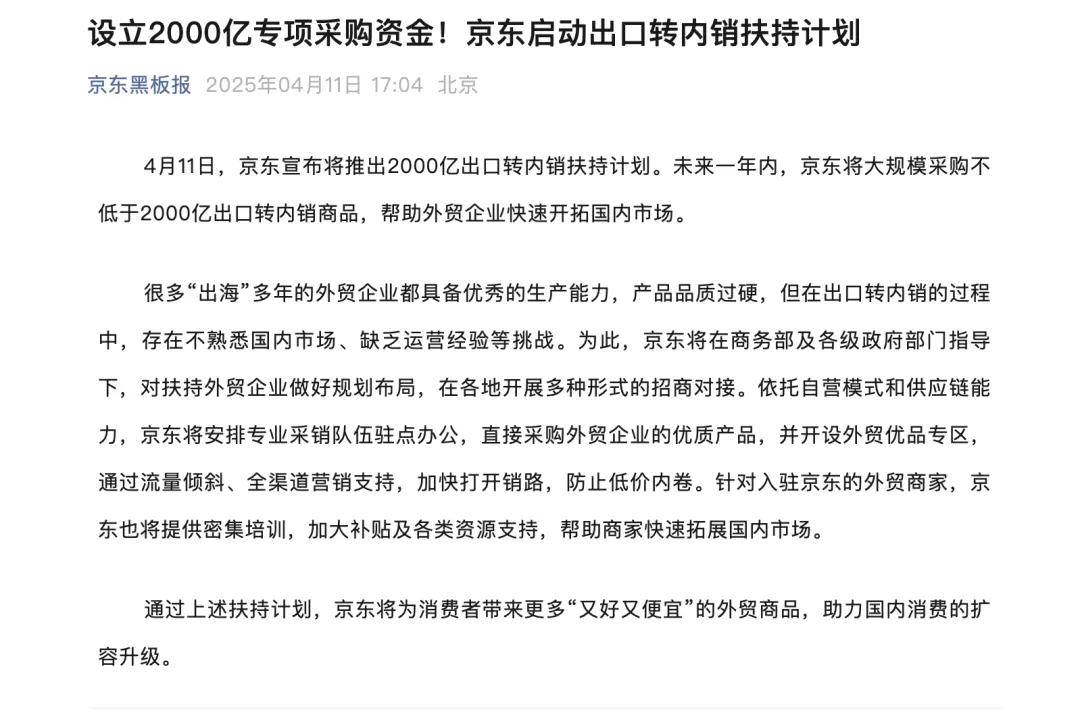
- JD.com: 200 billion yuan support for export-to-domestic sales
- Hema: opened settlement channels for foreign trade enterprises
- Yonghui Supermarket: 15-day rapid shelf placement
- CR Vanguard: four major measures helping domestic sales
C. Adjusting Pricing Strategies
- Negotiate cost sharing with US partners
- Implement differentiated pricing across markets
D. Market Diversification
Reduce reliance on US market, develop other international markets like Europe, Southeast Asia, Middle East.
E. Supply Chain Optimization
- Establish production bases in Southeast Asia to avoid tariff barriers
- Optimize supply chain management, seek quality suppliers
F. Product Innovation and Differentiation
- Develop products with Chinese characteristics
- Improve product quality, develop eco-friendly products
G. Technology Innovation and Efficiency Improvement
- Big data analysis applications
- AI technology applications like intelligent customer service
Through comprehensive use of these strategies, Chinese e-commerce enterprises can break through and achieve sustainable growth in the complex international environment.