
Hesai Technology Loses Lawsuit Against U.S. Government: Judicial Logic Raises Compliance Concerns for Global Enterprises
Hesai Technology Loses Lawsuit Against U.S. Government: Judicial Logic Raises Compliance Concerns for Global Enterprises
In July 2025, the U.S. District Court for the District of Columbia dismissed Hesai Technology's lawsuit against the U.S. Department of Defense, upholding the DoD's inclusion of Hesai on the 1260H "Chinese Military Companies" list, ruling that it does not violate the Administrative Procedure Act. The court found that LiDAR technology has dual-use (civil-military) applications, and the company is located in an officially designated "military-civil fusion" industrial park, which already satisfies the statutory criteria of being a "military-civil fusion contributor" and a "contributor to the Chinese defense industrial base." The DoD's determination was supported by substantial evidence, and the process did not cause substantive harm to Hesai. Hesai strongly objected to the ruling, emphasizing that its products are solely for civilian use with no military affiliation, and has filed an appeal to the federal circuit court. The ruling highlights the DoD's broad discretion in military-related determinations. Inclusion on the list can lead to severe consequences such as prohibition from U.S. defense contracts, OFAC sanctions risk, Military End User (MEU) designation, and reputational damage. The article warns that this standard of "substituting potential military use for actual military supply facts" may broadly affect multinational tech companies operating in China, and recommends that relevant enterprises closely monitor compliance developments and actively defend their rights through administrative appeals or litigation.

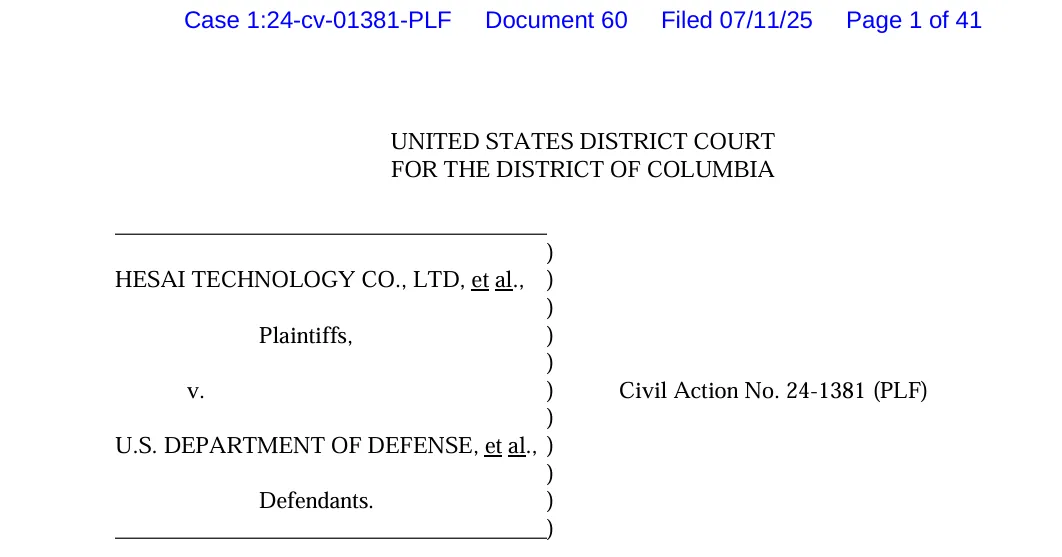
In July 2025, the U.S. District Court for the District of Columbia, in the case of Hesai Technology Co., Ltd. (“Hesai Technology”) v. the U.S. Department of Defense (“DoD”), denied Hesai Technology’s motion for summary judgment, granted the DoD’s cross-motion for summary judgment, and held that the DoD’s inclusion of Hesai Technology on the “Chinese Military Companies List” under Section 1260H of the National Defense Authorization Act for Fiscal Year 2021 (the “1260H List”) does not violate the Administrative Procedure Act (“APA”).[1]

Hesai Technology clearly expressed its opposition to this outcome in a press release on July 14, arguing that the DoD’s determination lacks factual and legal basis. CEO Li Yifan emphasized that the DoD has never found evidence that Hesai’s products are used for military purposes or have any direct or indirect connection with the Chinese military, consistent with Hesai’s long-standing position that its products are solely for civilian and commercial use. Hesai Technology pointed out that the court’s ruling was based on only two tenuous reasons: first, that the company’s R&D centers are located in areas designated as military-civil fusion industrial parks, such as the Chongqing Economic and Technological Development Zone and Shanghai Jiading Industrial Zone; and second, that LiDAR technology has theoretical military application potential. However, these reasons could equally apply to countless enterprises operating in China, including American and international companies, far from meeting the legal standard of actually contributing to the military. Hesai Technology has filed an appeal with the U.S. Federal Circuit Court of Appeals, vowing to defend its reputation through legal means.
If Hesai Technology loses the appeal, it would mean Hesai Technology is deemed to meet the criteria of a “military-civil fusion contributor” and “contributor to the Chinese defense industrial base,” which could result in numerous restrictions or prohibitions on its operations in the United States.
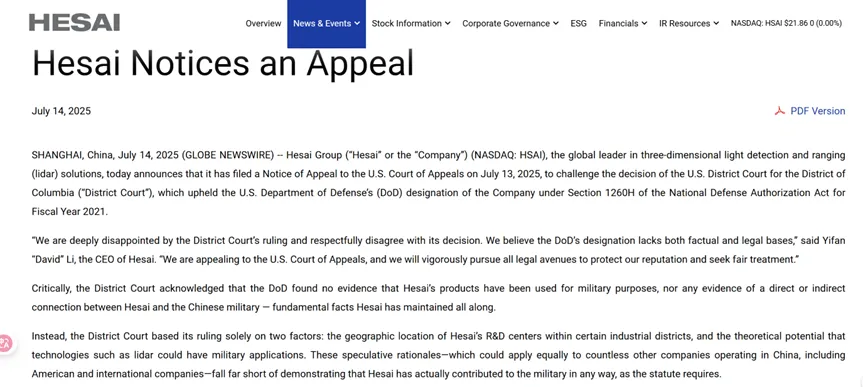
(Source: Hesai Group Official Website)
I. Introduction to Litigants and Case Timeline
(I) Litigants
- Hesai Technology
Hesai Group is a holding company incorporated under the laws of the Cayman Islands, headquartered in Shanghai, China, with its stock listed on NASDAQ. Hesai Group has branches in the United States, Germany, Japan, and South Korea, with business operations in over 40 countries worldwide. The plaintiff in this case, Hesai Technology, is a wholly-owned subsidiary of Hesai Group. Hesai Technology wholly owns Hesai Inc., which is registered in California with offices in Palo Alto, California, and Detroit, Michigan.
According to the Hesai Group’s official website, Hesai Group is a global leader in the LiDAR field, primarily engaged in the research, development, production, and sales of LiDAR products. Its products are widely used in passenger and commercial vehicles supporting Advanced Driver Assistance Systems (ADAS), as well as various robotic applications such as autonomous vehicles, delivery robots, and mobile robots. Hesai’s LiDAR products are adopted by many mainstream global automotive manufacturers.
- U.S. Department of Defense
The DoD is the federal department responsible for coordinating and supervising all agencies and functions of the government directly related to national security and the military. Pursuant to Section 1260H of the National Defense Authorization Act for Fiscal Year 2021, the Secretary of Defense is authorized and obligated to identify and list Chinese military companies annually. It can be said that the DoD is both the creator and gatekeeper of the 1260H List, as well as a key starting node in the U.S. “military-related” policy chain towards China.
(II) Case Timeline
November 2, 2023
The DoD issued a preliminary determination memorandum, finding that Hesai Technology meets the definition of a Chinese military company under Section 1260H of the NDAA FY2021, on the grounds that it is associated with China’s Ministry of Industry and Information Technology (MIIT) and qualifies as a “military-civil fusion contributor.”
January 31, 2024
The U.S. Department of Defense added Hesai Technology to the 1260H List[2].
March 8, 2024
Hesai Technology sent a detailed letter and CEO sworn declaration to the DoD, refuting the DoD’s determination.
May 13, 2024
Hesai Technology filed a lawsuit in the U.S. District Court for the District of Columbia, seeking a declaratory judgment that the DoD’s determination was unlawful and an injunction.
July 13, 2025
The U.S. District Court for the District of Columbia issued its ruling: denying Hesai Technology’s motion for summary judgment, upholding the DoD’s determination, and finding that Hesai Technology meets the criteria of a “military-civil fusion contributor” and a “contributor to the Chinese defense industrial base.”
July 14, 2025
Hesai Group published a press release on its official website, publicly opposing the court’s ruling, reiterating that its products are solely for civilian use, and announcing that it would defend its rights through legal means. Hesai Technology filed a notice of appeal with the U.S. Federal Circuit Court of Appeals on July 13[3].
II. Key Issues in Dispute and Court’s Views
According to the District of Columbia District Court’s opinion, it primarily assessed the summary judgment motions from two key issues: first, whether the DoD’s administrative action was arbitrary and capricious or contrary to law; and second, if there was any infringement on Hesai’s due process rights, whether such infringement resulted in substantive adverse consequences for Hesai. To analyze these two issues and reach a conclusion, the court further explored core disputed matters such as how to define “military-civil fusion contributor” and “contributor to the Chinese defense industrial base,” the definition of “dual-use,” and whether the DoD had sufficient key evidence. We attempt to summarize the views of Hesai Technology, the DoD, and the District Court on some noteworthy issues.
(I) Whether there is a problem with the DoD’s designation of Hesai Technology as a “military-civil fusion contributor” under Section 1260H?
Hesai Technology | 1. By expansively interpreting "contributing to the Chinese defense industrial base" as "any enterprise producing dual-use products," i.e., as long as a product "could potentially be used for military purposes," it constitutes a contribution regardless of actual supply to the military. This exceeds congressional authorization and violates the law. Moreover, the DoD's factual basis is weak and contradictory; for instance, the initial designation only mentioned Hesai's products being used in "passenger and commercial vehicles," without mentioning military use, and the DoD did not respond to or rebut materials provided by Hesai from March-April 2024 showing no military connection. 2. The DoD's designation of Hesai Technology as a "military-civil fusion contributor" is unlawful. Specifically: (1) There is no evidence that the MIIT "controls" Hesai Technology; merely having contact is insufficient to establish an "association" and constitutes ultra vires action; (2) Based on Hesai's receipt of Chinese government subsidies and participation in projects supervised by other ministries that have vaguely mentioned "military-civil fusion," the DoD concluded that Hesai knowingly accepted funding from China's military-industrial planning system, which is unlawful; (3) No criteria for identifying "military-civil fusion industrial parks" were provided; simply being located in such a park as grounds for finding "military-civil fusion" is clearly absurd; (4) The DoD erred in using unauthorized third-party resale information as evidence of "Hesai advertising on military platforms." |
DoD | Argued that the statutory language "contribute to" plainly encompasses actions that "support" or "have a share in producing" the Chinese defense industrial base, not requiring actual supply or intentional contribution. Entities producing products that are "dual-use" and have "important applications" for the military are considered sufficiently associated with the military. Therefore, the DoD's interpretation was reasonable and within its discretion. |
District Court | The court found the DoD's interpretation reasonable and consistent with the statutory purpose of identifying entities with military utility to China. The term "contribute to" does not require a direct transactional relationship; supporting the defense industrial base through the development of critical dual-use technologies suffices. The court also accepted the DoD's reliance on Hesai's location in military-civil fusion industrial parks as a relevant factor. |
(II) To what extent does Section 1260H require the DoD to prove an entity is sufficiently associated with the military to be designated a Chinese military company?
Hesai Technology | Argued that proof of a direct and sufficient connection between the entity and the Chinese military or defense industrial base is required, and the DoD failed to find any such connection. |
DoD | Argued that an entity producing products with "dual-use" capabilities and "important military applications" is sufficient to establish a sufficient association with the military. |
District Court | The court agreed with the DoD that the statute does not require proof of an actual transactional relationship with the military. The DoD's "contribute to" standard was deemed reasonable, and the court found that the DoD had substantial evidence for its determination. |
(III) Whether the DoD’s inclusion of Hesai Technology on the 1260H List violates the APA’s “arbitrary and capricious” standard or lacks a legal basis?
Hesai Technology | 1. Argued that the DoD's inclusion of it on the 1260H List, without clearly explaining how the cited evidence fits the statutory elements of Section 1260H, constitutes "arbitrary and capricious" conduct. Section 1260H contains several terms not defined by Congress. The DoD did not explain how it determined these definitions were satisfied, nor did it clarify what standard it applied, but merely cited the statutory text, listed scattered facts, and then declared the standard met, falling within the prohibited realm of agency "arbitrariness and capriciousness." 2. Moreover, the DoD interpreted the criteria for "entities making military-civil fusion contributions to the Chinese defense industrial base" too broadly, relied on weak factual grounds, and its evidence was contradictory. |
DoD | Argued that its determination was reasonable and supported by substantial evidence. The DoD explained the statutory interpretation and applied it to the facts, and therefore was not arbitrary and capricious. |
District Court | The court found that the DoD provided a reasoned explanation for its determination, adequately connecting the evidence to the statutory criteria. The DoD's decision was not arbitrary or capricious. |
(IV) Whether the DoD violated Hesai’s due process rights by failing to provide effective procedural safeguards?
Hesai Technology | Argued that it should have received adequate procedural safeguards before being added to the list, such as notice and a hearing opportunity, and that the DoD therefore violated its due process rights. |
DoD | Argued that its procedures were lawful, that Hesai had an opportunity to submit relevant materials, and that the decision had a sufficient basis. The DoD considered Hesai's submissions in its decision to re-list Hesai. |
District Court | The court assumed without deciding that Hesai had a protected property interest, but held that even if its due process rights were triggered, the process provided (notice and an opportunity to respond post-designation) was constitutionally adequate. Furthermore, Hesai failed to demonstrate any concrete harm from the alleged procedural deficiency. |
III. Introduction to the 1260H List
(I) What is the 1260H List?
The 1260H List originated from the technological competition between the U.S. and China. It is a “blacklist” established by the DoD pursuant to Section 1260H of the National Defense Authorization Act for Fiscal Year 2021, requiring the Secretary of Defense to publish annually, before December 31, 2030, a list of entities identified as Chinese military companies operating directly or indirectly in the United States or its territories[4]. Its purpose is to identify Chinese military enterprises operating directly or indirectly in the U.S. that are affiliated with the Chinese military.
Following amendments in Section 1346 of the National Defense Authorization Act for Fiscal Year 2025 regarding the public reporting of Chinese military companies within the U.S., the definition of “Chinese military company” was expanded. Under the amended text, any entity that sells goods, procures goods, or services to or from the U.S. or its territories falls within the scope of “operating in the U.S.,” without requiring a physical presence in the U.S. “Association” refers to close relationships, whether formal or informal[5].
“Chinese military companies” include entities with direct or indirect ties to the Chinese military and entities contributing to China’s military-civil fusion strategy. In this case, Hesai Technology was deemed to contribute to China’s military-civil fusion strategy and thus added to the 1260H List. Specifically, entities contributing to the military-civil fusion strategy include those engaged in the following activities:
(1) Strategic Support: Entities knowingly accepting funding for scientific research projects initiated by the Chinese government or the Communist Party through the military-industrial planning system, explicitly including “National Military-Civil Fusion Planning,” “单项冠军,” “小巨人,” and other officially designated projects. (2) Cooperative Enterprises: Entities with “associations” (including scientific research cooperation and projects) with the MIIT, SASAC, SASTIND, Ministry of State Security, PLA, Armed Police, Coast Guard, Border Control, Public Security, National Security, etc. (3) Policy-Oriented Operations: Entities receiving assistance, guidance, or policy direction from the State Administration for Science, Technology and Industry for National Defense. (4) State-Defined Defense Enterprises: Entities and their subsidiaries recognized as “military enterprises” by the State Council of China. (5) Enterprise Parks: Entities located in military-civil fusion industrial parks or receiving government support through such parks. (6) Licensed Military Production: Entities holding military production licenses (such as licenses for authorized weapons research, production, or quality management) issued by the government. (7) Military Equipment Advertising: Entities placing advertisements on national, provincial, or civilian military equipment procurement platforms. (8) Other Determinations: Entities deemed appropriate for designation by the Secretary of Defense.
Furthermore, the amendments in Section 1346 of the NDAA FY2025 introduced an equity penetration clause. This clause provides that if an entity itself meets the definition of a Chinese military company under Section 1260H(d)(2)(B), then its parent company or subsidiary (if it owns or is owned by the entity with a ≥50% equity control interest) may also be deemed a Chinese military company. This revision provides a stronger legal basis for the DoD to more effectively include such affiliated entities on the 1260H List and impose corresponding restrictions.
(II) What are the potential consequences of being included on the 1260H List?
1. Restrictions on U.S. Defense Contracts:
Entities and their affiliates on the 1260H List are prohibited from entering into, renewing, or extending contracts with the DoD for goods, services, or technology. Contracts with companies controlled by listed entities are also prohibited[6]. Additionally, the Defense Federal Acquisition Regulation Supplement currently prohibits the DoD from directly or indirectly procuring from any “Communist Chinese Military Companies” any items covered by the U.S. Munitions List or Commercial Control List Series 600[7]. Although the definition of “Communist Chinese Military Company” is not explicitly tied to the 1260H List applicable to “Chinese Military Companies,” the government may reference the 1260H List when determining whether an entity should be deemed a Communist Chinese Military Company.
2. Risk of Additional OFAC Designation:
Entities on the 1260H List face the risk of being added to the U.S. Treasury Department’s Office of Foreign Assets Control (“OFAC”) Non-SDN Chinese Military-Industrial Complex Companies List (“NS-CMIC List”).
3. Military End User (“MEU”) Designation Risk:
Being deemed a Chinese military company may increase the risk of the U.S. Department of Commerce’s Bureau of Industry and Security viewing the entity as a Military End User. If items subject to the Export Administration Regulations are involved, this could require companies seeking to transact with the entity to conduct detailed due diligence. Given these red flags, some business partners or financial institutions may be unwilling to engage in transactions involving Chinese companies on the 1260H List. If ultimately designated as a Military End User, the entity’s transactions involving EAR-controlled products would be restricted.
4. International Market Reputation Impact:
Inclusion on the list may negatively impact a company’s reputation in the international market, especially in the U.S. and its allied countries. Such reputational damage may make potential customers and business partners hesitant to cooperate.
5. Increased Compliance Costs:
Companies on the list may face higher compliance costs. Significant resources may need to be invested to address related challenges and develop comprehensive risk mitigation strategies to deal with the long-term effects of being listed.
IV. Conclusion
What is alarming about this case is that it reveals the broad discretionary power of the U.S. Department of Defense in relevant determinations, which may trigger a chain reaction. According to the court’s reasoning, even if an enterprise has not actually participated in military activities, it could be labeled a military company simply because it is located in a specific industrial park or because its civilian technology has potential military applications. This standard of substituting possibility for facts not only blurs the line between civilian and military activities but may also trap a large number of multinational enterprises in compliance pitfalls—for instance, technology companies with R&D centers in China or international manufacturers cooperating with specific Chinese industrial parks could be sanctioned for similar reasons. Such rulings may exacerbate the trust crisis between U.S. and Chinese enterprises, disrupt the normal functioning of global industrial chains, and even force companies to adopt overly conservative strategies in site selection and technology R&D, ultimately harming market innovation and fair competition.
For enterprises included on the 1260H List, it is recommended that they, like Hesai Technology, apply for removal through the administrative process clarified by the DoD in the Federal Register for entities seeking removal from the 1260H List, or choose to resolve the issue through litigation to defend their rights.
Reference Notes:
[1]https://www.govinfo.gov/content/pkg/USCOURTS-dcd-1_24-cv-01381/pdf/USCOURTS-dcd-1_24-cv-01381-1.pdf
[2]https://media.defense.gov/2024/Jan/31/2003384819/-1/-1/0/1260H-LIST.PDF
[3]https://investor.hesaitech.com/news-releases/news-release-details/hesai-notices-appeal
[4]https://www.congress.gov/bill/116th-congress/house-bill/6395
[5] https://www.congress.gov/bill/118th-congress/house-bill/5009/text
[6]Section 805 of the FY 2024 NDAA (H.R. 2670) https://www.congress.gov/bill/118th-congress/house-bill/2670
Intern Shen Zidan contributed to this article.