
US Anti-Dumping/Countervailing Duty Investigation on Laos, Indonesia, and India Solar Products: How Should Enterprises Respond?
US Anti-Dumping/Countervailing Duty Investigation on Laos, Indonesia, and India Solar Products: How Should Enterprises Respond?
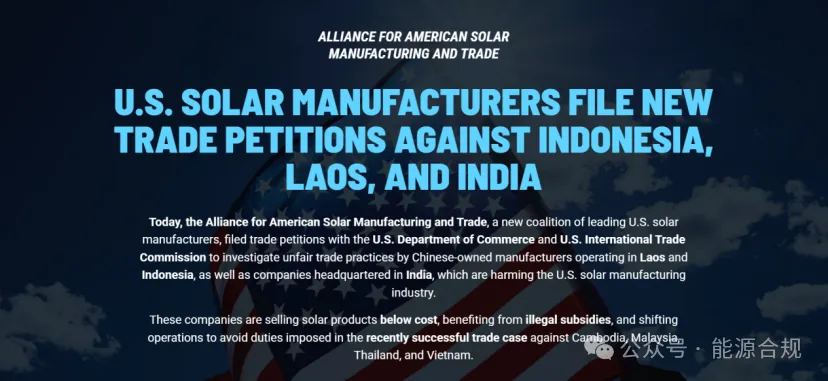
On July 16, 2025, the American Alliance for Solar Manufacturing and Trade (AASMT) submitted anti-dumping and countervailing duty (AD/CVD) petitions against imports of solar products from Indonesia, Laos, and India to the US Department of Commerce.
I. Event Background
On July 16, 2025, the American Alliance for Solar Manufacturing and Trade (AASMT) submitted AD/CVD petitions against imports of solar products from Indonesia, Laos, and India to the US Department of Commerce.
The author notes this is the second time AASMT has filed such petitions in the solar sector. On April 24, 2024, AASMT petitioned for AD/CVD investigations on Vietnam, Cambodia, Thailand, and Malaysia solar modules, resulting in high tariffs on products from those countries and significantly increased trade costs for Chinese enterprises, which relocated production to Indonesia, Laos and other countries not yet targeted by US “double anti” investigations.
Background: Chinese enterprises relocated to Southeast Asia to avoid US tariffs, followed by Indian companies following suit. AASMT views this capacity transfer as bypassing US trade remedy measures, causing harm to US domestic solar manufacturing, prompting these petitions.
II. Key Petition Information
A. Countries Targeted
Indonesia, Laos, and India. Alleged dumping margins: Indonesia 89.65%, India 213.96%, Laos 245.79%-249.09%.
B. Investigation Period
- Anti-dumping (Case numbers: Indonesia A-560-847, India A-533-938, Laos A-553-003): July 2024 - June 2025
- Countervailing (Case numbers: Indonesia C-560-848, India C-533-939, Laos C-553-004): January - December 2024
C. Product Scope
Covered merchandise includes crystalline silicon photovoltaic cells, and modules, laminates, and panels consisting of crystalline silicon photovoltaic cells. Exclusions include thin film photovoltaic products and small off-grid panels.
III. US DOC Investigation Procedures and Timeline
A. Procedures
- DOC issues questionnaires to exporters/producers
- Largest exporters selected as mandatory respondents
- Preliminary determination typically 140-190 days after filing
- Final determination 75-135 days after preliminary
- ITC injury investigation runs parallel
B. Timeline
Anti-dumping investigation expected timeline:
- Case filing: July 17, 2025
- DOC initiation: August 6, 2025
- ITC preliminary: August 31, 2025
- DOC preliminary (190 days): February 12, 2026
- DOC final (135 days): July 4, 2026
- ITC final: August 18, 2026
IV. How Should Chinese Enterprises Respond?
A. Actively Participate in Proceedings
Chinese solar module manufacturers with production capacity in Indonesia, Laos, and India must actively respond. If not participating, importers may face high tariffs and abandon purchasing, causing loss of US market.
B. Conduct Advance Compliance Layout
Enhance cross-border compliance awareness, embed AD/CVD compliance requirements into procurement, production, and export processes. Strengthen trade friction early warning, dynamically track regulation changes.
C. Seek Professional Legal Support
Engage professional lawyers for comprehensive legal services including case evaluation, questionnaire response, and subsequent procedures like administrative reviews, sunset reviews, and new exporter reviews.
V. Conclusion
The upcoming US double anti investigation on Indonesian, Lao, and Indian solar products presents enormous challenges for Chinese solar module manufacturers. Facing US “encirclement and suppression,” Chinese manufacturers need to take multi-pronged approaches: build firewalls through compliance awareness, restructure supply chains when necessary, and actively use legal means to protect legitimate rights when investigations occur.
As long as enterprises actively respond, prepare in advance, and convert risk awareness into normalized management, they can survive and thrive in the complex international trade environment.