
Risk Analysis and Legal Changes from the Perspective of International Trade
Risk Analysis and Legal Changes from the Perspective of International Trade
Attorney ZHANG Huimin systematically reviews the transaction models, commercial and regulatory participants, typical import/export processes and corresponding legal risks of international trade, and comprehensively analyzes the multi-layered legal sources consisting of international trade practices, international conventions, standard contracts, and domestic laws of various countries. It focuses on the latest developments in China's international trade legal system, including the complete abolition of foreign trade operation registration to deepen institutional opening up, aligning data compliance and rules with digital trade trends, constructing countermeasure legal frameworks such as export controls and anti-foreign sanctions, and unifying foreign-related adjudication standards through publishing typical cases. The article aims to provide international trade participants with practical references for risk identification, compliance management, and legal response.
Introduction
Statistics from the General Administration of Customs of China for 2023 indicate that China’s import and export scale reached a new high: “In 2023, China’s total import and export value was RMB 41.76 trillion, a year-on-year increase of 0.2%. Among them, exports were RMB 23.77 trillion, and imports were RMB 17.99 trillion.” At the same time, events such as trade protectionism, geopolitical conflicts, the blockage of Red Sea shipping routes, high energy prices caused by the Ukraine crisis, and the tightening of US monetary policy have significantly impacted international trade policies and order. It can be said that 2024 presents both opportunities and challenges for international trade.
Based on the service experience and insights gained from the author’s law firm’s long-term representation of large international trading companies, this article aims to share some observations to help international trade participants and enthusiasts understand international trade risks and make more valuable judgments.
I. Transaction Models and Participants
International trade refers to the cross-border import and export of goods, technology, and international service trade conducted between countries or regions worldwide. Due to the diverse transaction subjects, multiple elements, cumbersome procedures, and involvement of different national policies, regulations, and cultural differences, international trade transaction models are varied. Taking common CFR as an example, its basic transaction model is as follows:
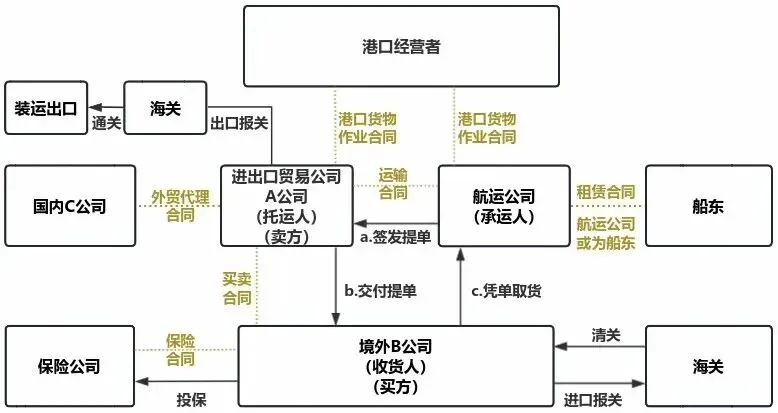
From the above diagram, it can be seen that in international trade transactions, the most common trade roles are mainly divided into two categories: trade participants, who participate in international trade as commercial entities, such as import and export trading companies, freight forwarders, shipping agents, shipping companies, shipowners, insurance companies, port operators, etc.; and regulatory participants, which are authorities performing import and export trade supervision and management duties, such as customs and port administrative departments.
Category | Name | Introduction |
Trade | Import and Export Trading Company | The core participant in the import and export trade process, responsible for signing contracts with foreign customers, handling export customs declaration, etc. |
II. Import/Export Procedures and Risks
Mastering the import/export procedures and common legal risks in international trade can help enterprises improve transaction efficiency, avoid potential risks, and ensure transaction security. It is a core essential for enterprises participating in international market competition.
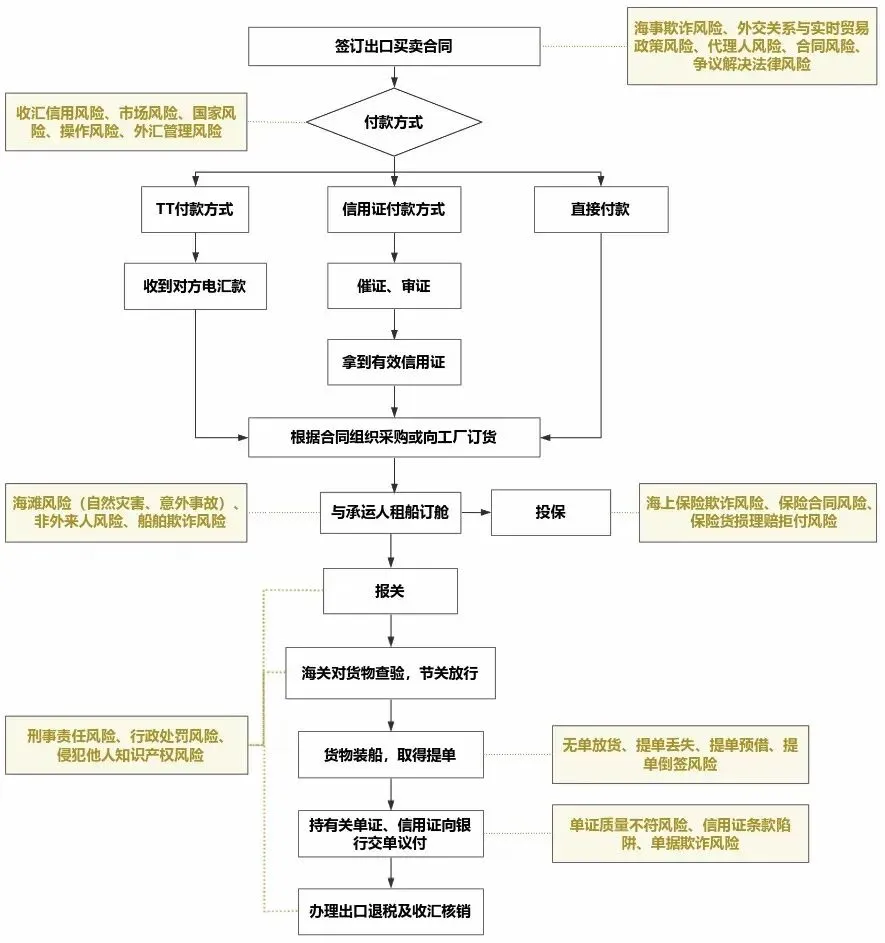
Different trade terms entail different responsible parties for transportation, insurance, and import/export procedures, resulting in different import/export procedures. Taking common CIF as an example, its basic export procedure and legal risks are as follows:
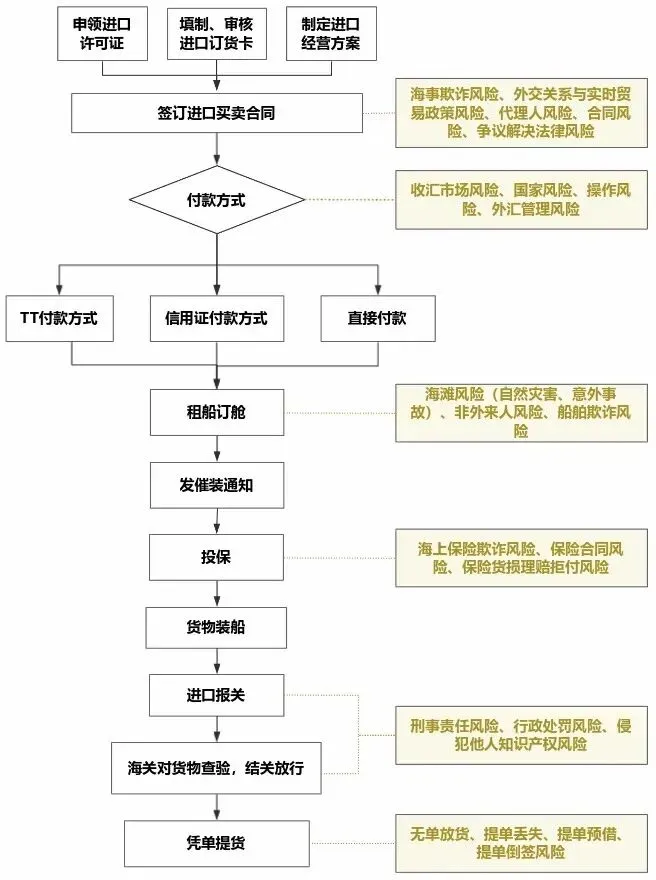
Taking common FOB as an example, its basic import procedure and legal risks are as follows:
III. Legal System
International trade legal sources are the basic elements constituting the international trade legal system. Legal sources in contemporary international trade take multiple forms, each with varying degrees of binding force and scope of application. Common ones include: international trade practices, international conventions and regional treaties, standard contracts formulated by multinational corporations and trade associations, and domestic legal provisions of various countries concerning trade.
1. International Trade Practices
International trade practices are not the result of legislative action and do not have universal legal binding force. They are trade conditions agreed upon by the parties in a contract in accordance with trade habits and have gradually become widely accepted and used in trade practice.
Among international trade practices, the “Incoterms 2020” are the most widely used and influential international practice for trade terms worldwide, serving as the foundational international通行 rules for international trade. Initially formulated by the International Chamber of Commerce (ICC) in the 1920s, they have since been revised eight times: 1953, 1967, 1976, 1980, 1990, 2000, 2010, and 2020. They detail the responsibilities of buyers and sellers regarding costs, risks, and the transportation, insurance, and compliance of goods.
Trade Term Name | Followed by Location | Place of Delivery | Risk Transfer | Transport |
2. International Conventions and Regional Treaties
The binding force of international conventions and regional treaties is limited to their contracting states, typically reached by governments through international negotiation and consultation. Combined with relevant judicial cases, common international trade conventions and regional treaties in China include:
Field | Name | Effective Date | Basic Content |
3. Standard Contracts Formulated by Multinational Corporations and Trade Associations
Standardized contract texts formulated by multinational corporations, trade organizations, or professional associations, widely used in specific industries or fields, aim to provide a unified set of terms and conditions to promote efficiency and reliability in commercial transactions. Common standard contracts in international trade include:
Name | Service Field | Basic Content |
GENCON 2022 | Maritime Transport | General voyage charter party contract standard form, widely used in the international shipping industry. |
4. Legal Provisions
Many countries engaged in international trade activities have formulated their own foreign trade laws. Enterprises engaged in import and export business should comply with the foreign trade laws of the relevant countries. China’s main foreign-related trade laws and regulations include:
Name | Effective Date | Level of Validity |
However, it is important to note that when import/export goods involve high-risk industries, sanctioned regions, or sensitive areas, besides paying attention to the laws and regulations of the relevant countries and regions, continuous attention must also be paid to industry and national trade policies, export controls, economic sanctions and counter-sanctions measures, national security laws, data compliance, tariffs, and trade barriers, to effectively reduce potential risks and ensure smooth trade.
IV. New Developments in China’s International Trade Legal System
In recent years, to adapt to the new situations and needs of international trade, China has achieved rapid and stable development and significant accomplishments in building its international trade legal system by promoting trade facilitation, optimizing trade structure, strengthening alignment with international trade rules, and unifying adjudication standards.
1. Abolition of Foreign Trade Operation Registration, Relaxation of Restrictions on Foreign Trade Operation Access
Foreign trade operation rights are the qualifications and rights for enterprises to engage in import and export business. Before the reform and opening up in 1978, China’s foreign trade operation rights were monopolized by the state, and foreign trade had to be conducted through the Ministry of Foreign Trade and Economic Cooperation and its local bureaus and subordinate foreign trade companies, similar to how the protagonist Bao in the recently popular TV series “Blossoms Shanghai” had to conduct foreign trade business through the foreign trade headquarters on the Bund.
In 1994, China promulgated its first “Foreign Trade Law of the People’s Republic of China,” adopting a licensing system for foreign trade operations. In 2001, China joined the WTO and amended the Foreign Trade Law, changing to an approval system for foreign trade operation management. On December 30, 2022, the Foreign Trade Law was amended, abolishing the foreign trade operation registration system and completely liberalizing foreign trade operation权限.
The abolition of foreign trade operation registration further expanded the scope of foreign trade business entities, representing an institutional opening up aligning with international common rules after China’s WTO accession, and reflecting China’s continuous promotion of便利 and liberalization of foreign trade operations.
2. Increasing Significance of Digital Trade Rules
According to WTO statistics: “In 2022, global digitally deliverable services exports reached USD 4.1 trillion, a year-on-year increase of 3.4%, accounting for 56.8% of global services exports.” According to the “China Digital Trade Development Report 2022” released by the Ministry of Commerce on November 23, 2023: “In 2022, China’s digitally deliverable services imports and exports reached USD 372.71 billion, a year-on-year increase of 3.4%, reaching a new record high.”
It can be seen that digital trade demonstrates strong resilience and potential and is an important engine for international trade growth. To this end, the international trade legal system is continuously evolving to adapt to this new trade form.
Internationally, to promote the liberalization and facilitation of digital trade and reduce digital trade barriers and obstacles, the international rule system for digital trade is gradually taking shape: at the multilateral level, free trade agreements such as the CPTPP, RCEP, USMCA, and DEPA have been signed; at the bilateral level, relevant rules are also gradually improving, such as the UKSDEA, KSDPA, EUSDPA, and UKUADTA.
China is also actively promoting legislation related to digital trade, such as the formulation and improvement of a series of data regulations including the Data Security Law, the Personal Information Protection Law, and the Measures for Data Cross-Border Security Assessment. At the same time, China actively participates in the construction of international digital trade rules and engages in cooperation and exchange in the field of digital trade with other countries and regions: on September 16, 2021, China formally applied to join the CPTPP; on August 18, 2022, the DEPA Joint Committee decided to establish a working group for China’s accession to DEPA, fully advancing negotiations; in January 2024, the Ministry of Foreign Affairs submitted to the United Nations “China’s Positions on Global Digital Governance Issues,” etc.
The increasing status of digital trade rules in the international trade legal system will promote the compatibility of Chinese legislation with data opening and sharing rules, bringing new changes to China’s laws and regulations on foreign trade, e-commerce, and data.
3. Further Improvement of the Countermeasure Legal System
Export controls and economic sanctions are hot topics in the international trade field. From chips, lithography machines, and artificial intelligence to semiconductors, developed countries such as the US and Europe frequently impose economic sanctions on Chinese entities using export control laws and policies under the pretext of national security.
To safeguard national and enterprise interests and maintain global trade order, China has gradually improved countermeasures at the domestic legal level by formulating a series of countermeasure laws and regulations, such as the Foreign Relations Law, the Export Control Law, the Anti-Foreign Sanctions Law, the Provisions on the Unreliable Entity List, and the Measures for Blocking the Improper Extraterritorial Application of Foreign Laws and Measures.
At the same time, China’s Ministry of Foreign Affairs used a Ministry of Foreign Affairs order for the first time to issue countermeasures and added a “Counter-Sanctions List and Measures” section on its official website.
In response to frequent economic sanctions and trade restrictions by the US and Europe, China has shifted from vague responses to establishing departmental rule-level blocking measures, successfully constructing a basic countermeasure legal framework.
However, with the complex changes in the international economic and trade environment, how to further optimize and improve the targeting and effectiveness of the countermeasure legal system is a major challenge facing China.
4. Gradual Unification of Adjudication Standards, Transparent and Predictable Legal Environment
Among the significant progress China has made in building its international trade legal system, the most obvious sign is the gradual unification of adjudication standards. China’s foreign-related judicial teams actively explore foreign-related trade dispute focal points and unify international trade dispute adjudication standards through measures such as issuing judicial interpretations, summarizing practical trial experience, and publishing typical cases.
(1) Accurate determination that releasing goods first and collecting bills of lading later does not constitute delivery without bills of lading. In international maritime cargo transportation, especially short-sea shipping, because bills of lading must go through links such as application for negotiation, issuing bank document review and payment, and consignee payment against documents under letters of credit, the circulation speed of bills of lading often lags behind the speed of cargo transportation. To ensure ships are not delayed and cargo is not congested at the port, carriers often deliver goods to the consignee against a letter of indemnity and later collect the original bill of lading from the consignee. In the case of Evergreen Bank Co., Ltd. Shanghai Branch v. Samfu Shipping Co., Ltd. for maritime cargo transport contract dispute heard by Nanjing Maritime Court, it was clarified that the carrier’s release of goods against the consignee’s letter of indemnity and subsequent recovery of the original bill of lading is a correction of the delivery without bill of lading conduct, does not constitute the tort of delivery without bill of lading, and does not bear liability for damages for delivery without bill of lading. This ruling provides a useful supplement to the rules on delivery without bill of lading, facilitating the accelerated circulation of maritime bills of lading and ensuring the stable development of international trade.
(2) Clarification that the two-year period under Article 35 of the Montreal Convention is a statute of limitations. Article 35 of the Montreal Convention provides: “The right to damages shall be extinguished if an action is not brought within a period of two years from the date of arrival at the destination, or from the date on which the aircraft ought to have arrived, or from the date on which the carriage stopped.” However, whether this two-year period is a limitation period or a statute of limitations is not uniformly determined in judicial practice across countries. Judgments such as (2021) Hu 01 Min Zhong No. 1618 by the Shanghai First Intermediate People’s Court and (2021) Yue 03 Min Zhong No. 30373 by the Shenzhen Intermediate People’s Court, considering the purpose and宗旨 of the Convention and based on textual and systematic interpretation of its terms, determined that the two-year period stipulated in this article is a statute of limitations and should be subject to the provisions of lex fori on the interruption of limitation, reflecting the judicial stance of Chinese courts in adhering to treaty obligations and striving to achieve the purpose and宗旨 of the Convention, which has important guiding significance for similar case handling.
(3) Confirmation of the consignee’s right to take delivery under a railway bill of lading. The operation of China-Europe Railway Express trains has significantly increased economic and trade exchanges between Asia and Europe. However, the countries along the China-Europe Railway Express route are Contracting States to two major conventions, the SMGS and the COTIF. Under both conventions, railway consignment notes can only be used to take delivery based on the consignee’s identity, not against the document alone. Against this background, market participants use contracts to agree that the railway bill of lading is the sole document for taking delivery, facilitating transportation, sale, and financing activities. In the judgment of Chongqing Free Trade Zone People’s Court (2019) Yu 0192 Min Chu No. 10868, the parties agreed that the contracting carrier would issue the international railway consignment note (bill of lading) and explicitly stated that the holder has the right to take delivery. The transfer of the document was deemed a transfer of the right to take delivery, constituting a special form of delivery by indication, which is recognition of the railway consignment note and its transaction model within the existing legal framework.
In addition to the above cases, the scope of the gradual unification of China’s adjudication standards covers various fields such as international sales of goods, foreign investment, maritime transport, international arbitration, and international commercial dispute resolution, providing useful references for enterprises engaged in international trade to use the rule of law to protect their legitimate rights and interests.