
New Smuggling Trends and Criminal Risk Prevention After Hainan's Customs Closure
New Smuggling Trends and Criminal Risk Prevention After Hainan's Customs Closure
On December 18, 2025, the entire island of Hainan Free Trade Port will officially begin closed customs operation. After the closure, the "first-line liberalization, second-line control" policy will be implemented. The list of zero-tariff items will significantly increase to nearly 6,600. Processed products with 30% value-added will be exempt from tariffs when sold to the mainland. The scope of beneficiaries will be comprehensively expanded, import restrictions will be relaxed, and bonded maintenance will be opened. While improving trade facilitation, the new policies will also give rise to new smuggling risks, mainly including intensified "daigou and arbitrage" of zero-tariff goods, falsely reporting processing value-added ratios to obtain tariff exemptions, misreporting or concealing prohibited/restricted goods, illegally smuggling zero-tariff goods out of the island, and using "three-no" vessels or cruise ships/yachts for smuggling. Individuals should enhance their awareness of prevention and refrain from lending duty-free quotas or participating in "daigou and arbitrage." Enterprises need to establish sound compliance and internal control mechanisms, strictly account for processing value-added data, dynamically track lists of prohibited/restricted items, ensure traceability of goods' trajectories, carefully choose transportation means, and appropriately handle customs audits by utilizing lenient policies such as voluntary disclosure.
Introduction
On December 18, 2025, the full island customs closure operation of Hainan Free Trade Port will officially commence. The island-wide customs closure is a landmark project in the construction of Hainan Free Trade Port and an important measure for further opening up, carrying milestone significance!
Recently, the Ministry of Commerce, the Ministry of Finance, the General Administration of Customs, and the State Administration of Taxation have successively issued various policies for Hainan after the customs closure in the form of notices and announcements, involving tax collection and management, tariff lists, and lists of prohibited and restricted goods and articles.
After the customs closure, the implementation of new policies such as the surge in “zero-tariff” goods lists and “30% processing value-added exemption from tariffs at the second line” will, on the one hand, make trade more liberalized and convenient. However, on the other hand, they may also give rise to new smuggling patterns. Below, the author will elaborate from the perspectives of a brief review of the new policies, analysis of new smuggling trends, and criminal risk control guidelines.

I. Highlights of the July 23 Hainan Customs Closure Regulations
After Hainan’s customs closure, a policy system characterized by “‘first-line’ liberalization, ‘second-line’ control, and island-wide freedom” will be implemented.
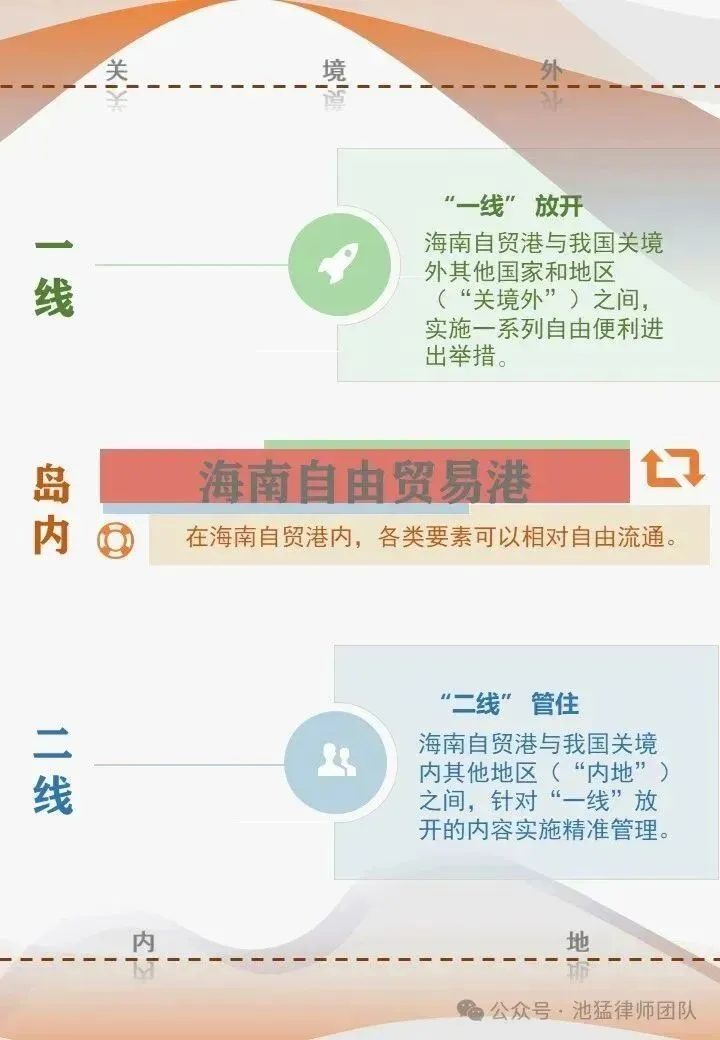
First, customs clearance becomes more convenient!
8 “first-line” ports. For ports like Yangpu Port, except for goods subject to inspection, quarantine, or license management, compliant goods will be directly released. 10 “second-line” ports such as Haikou Nangang and Haikou Xinhaigang will be established, adopting various innovative convenient passage measures for goods entering the mainland.
Second, zero-tariff goods surge!
For first-line imported zero-tariff goods, the number of tariff headings will significantly increase from the current approximately 1,900 to nearly 6,600, meaning 74% of goods will be tariff-free! Even more effective is that goods processed and value-added by 30% within the island can be sold to the mainland without paying import tariffs!
Third, the scope of beneficiaries expands!
After the customs closure operation, imported “zero-tariff” goods and their processed products will no longer be limited to enterprise self-use. They can circulate freely among beneficiaries on the island, exempt from supplementary import taxes. Before the closure, only independent legal person enterprises and institutions registered in Hainan could enjoy this benefit. The new policy basically covers all types of enterprises, institutions, and private non-enterprise units in the island with actual import needs.
Fourth, import restrictions are relaxed!
For “first-line” imports, open arrangements have been made for some of the existing prohibited and restricted import goods nationwide. Import licenses for 60 categories of goods have been cancelled, making imports freer.
Fifth, bonded maintenance is opened!
Under the existing policy, products under 38 commodity codes are allowed to undergo bonded maintenance in Hainan. This means machine parts can be imported directly to Hainan for on-site maintenance, saving significant tariff and other costs associated with shipping to the mainland for repairs, greatly benefiting relevant enterprises.
II. New Smuggling Trends After Customs Closure
New Risk 1: The temptation of zero-tariff price differences!
The number of zero-tariff items surges from 1,900 to nearly 6,600!
But a surge in zero-tariff goods does not mean smuggling will disappear!
“Duty-free shopping arbitrage” smuggling refers to the act of organizing and using others’ shopping qualifications and quotas for profit to purchase outlying-island duty-free goods and resell them. Such smuggling has already accounted for over half of smuggling cases in Hainan. With more zero-tariff items, the price difference temptation is greater! “Arbitrage” smuggling may become even more rampant!
New Risk 2: Processing value-added tariff exemption? Beware of “Falsification!”
The policy of “30% processing value-added exemption from tariffs for goods sold to the mainland” saves island-based processing enterprises significant tariff costs. The high profit margins will inevitably tempt some to resort to dishonest practices, such as “underreporting” imported material costs while “inflating” finished product sales prices, thereby falsely reporting the value-added ratio to fraudulently obtain tax exemption!
This is a special form of smuggling likely to emerge after Hainan’s customs closure, with stronger concealment. How customs will supervise and how enterprises can prevent this needs further exploration in practice.
New Risk 3: Prohibited/restricted goods disguised to enter the second line!
The “List of Prohibited and Restricted Import and Export Goods and Articles of Hainan Free Trade Port” has been published. However, some goods (such as cultural relics, wild animal and plant products, etc.) may still be smuggled through misreporting of names or concealment.
After the cancellation of import licenses for 60 categories of used mechanical and electrical products, special attention must be paid to preventing enterprises from importing them through the first line under the guise of “self-use” and then illegally reselling them to the mainland!
The 38 categories of goods allowed for bonded maintenance are prohibited from circulating within the territory, and they may also be used for illegal circulation.
New Risk 4: Smuggling zero-tariff goods out of the island!
Zero-tariff goods can circulate freely within the island, but they require tax payment when entering the mainland through the “second line.”
Consequently, smuggling phenomena may arise, such as concealing goods in hidden compartments of logistics vehicles, falsely declaring goods as “non-controlled” in maritime transport, tampering with transportation information on logistics platforms, or even direct misrepresentation of logistics information by consignors and carriers.
New Risk 5: The particularity of smuggling by means of transport!
Hainan’s island coastline is long. Many “three-no” vessels (ships without a name, without ship certificates, and without a port of registry) frequently roam between the sea and non-customs locations, with scattered mooring points. If such vessels are used for transporting goods, their lack of legal registration information and opaque routes make them easy carriers for smuggling activities.
Additionally, Sanya, as a hub for cruise ships and yachts, has many vessels and people. For example, in 2024 alone, yachts went out to sea 127,900 times, receiving 900,900 tourists. If cruise ships or yachts are used to conceal duty-free or prohibited/restricted items, both carriers and passengers may bear legal liability for assisting or committing smuggling.
III. Smuggling Risk Prevention Guidance After Customs Closure
In response to the new smuggling trends after Hainan’s customs closure, the key prevention and control points, differentiated by “before” and “after” the event and from the perspectives of enterprises and individuals, are as follows:
Fully understand Hainan’s outlying-island duty-free policies, “processing value-added tariff exemption” provisions, and “zero-tariff” application conditions to enhance awareness and ability to prevent smuggling risks.
(II) For individuals, focus on preventing “arbitrage” smuggling risks.
Increase awareness of “arbitrage” smuggling to avoid being induced or exploited by smugglers. If you do not need to purchase duty-free goods or have unused duty-free quotas, do not casually lend or sell your duty-free quota, and do not disclose your itinerary information (such as tickets) to others, to avoid potential complicity in smuggling offenses.
(III) For enterprises, establishing a sound compliance and internal control mechanism is key.
① Preventing processing value-added falsification risks.
For goods benefiting from “30% processing value-added tariff exemption,” establish independent ledgers, truthfully account for raw material costs, processing fees, and finished product selling prices, ensuring the value-added ratio is authentic and verifiable. Regularly check the consistency between customs declaration data and financial vouchers, keeping records for future reference.
② Preventing misreporting of prohibited/restricted goods risks.
Dynamically track the list of prohibited/restricted goods,杜绝 misreporting and concealment. Used mechanical and electrical products are for self-use only, with supporting documents retained. Bonded maintenance goods should be stored separately to ensure they are not illegally resold or enter the domestic market.
③ Preventing illegal out-island movement of zero-tariff goods risks.
Thoroughly understand the application conditions for “zero-tariff” preferential policies, ensuring full traceability of goods’ trajectories. Cooperate with legitimate logistics enterprises, clearly stipulate responsibility for the authenticity of transportation information, and do not assist in tampering with data or concealing goods.
④ Preventing smuggling risks through transportation means.
First, carefully choose transportation carriers and avoid business dealings with “three-no” vessels. Second, when cruise ships or yachts are involved, carriers should strengthen anti-smuggling training for internal personnel on the one hand, and on the other hand, take appropriate measures to stop smuggling or other illegal activities upon discovery by passengers, and promptly report to relevant authorities.
(IV) Properly responding to existing smuggling risks.
If enterprises or individuals encounter customs audits, administrative penalty notices, or even criminal charges such as smuggling, they must not panic or resist. Make good use of customs provisions such as “no penalty for first offense,” “exemption from punishment for minor circumstances,” and “voluntary disclosure.” If necessary, seek professional assistance to avoid escalation of risks and aggravation of liability.