
Trends and Practice of Criminal Compliance Non-Prosecution
Trends and Practice of Criminal Compliance Non-Prosecution
The corporate criminal compliance non-prosecution system, originating in the United States, has now deeply aligned with China's high-quality development needs. Currently, this system shows four major trends: the applicable procedures extend to all stages of criminal proceedings; regional coverage continues to improve; the scope of application expands from organizational crimes to individual crimes closely related to production and business activities; and case types extend from minor offenses to major cases. Practical operations follow core steps including: initiation of procedures, submission of compliance commitments and plans, selection of third-party organizations and determination of timelines, enterprise self-inspection with third-party review and competent authority verification, hearing and acceptance, and issuance of non-prosecution decisions. As judicial practice continues to deepen, the scope of application of this system is continuously expanding, with the potential for full national coverage.
The corporate criminal compliance non-prosecution system is an “imported product,” originating in the United States in the 1990s. The establishment of a criminal compliance system is, on one hand, a need to proactively adapt to international trends, and on the other hand, an endogenous need for China’s entry into a stage of high-quality development. How to effectively promote and develop the criminal compliance non-prosecution system? In recent years, under the impetus of the Supreme People’s Procuratorate (SPP), the construction of China’s corporate criminal compliance system has achieved fruitful results in just a few years.
I. Background of Criminal Compliance Non-Prosecution
Currently, the development of the corporate criminal compliance non-prosecution system is conventionally divided into four stages:
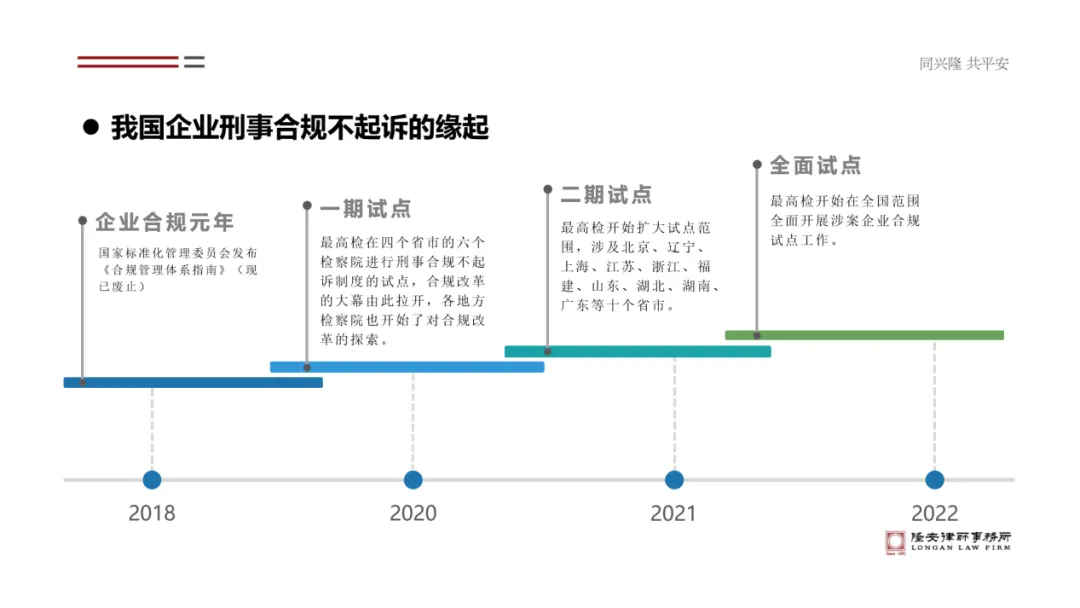
According to the SPP’s White Paper on Criminal Prosecution Work (2023) (《刑事检察工作白皮书(2023)》), as of the end of 2023, a total of 9,016 compliance cases had been handled nationwide, of which 6,687 applied the third-party mechanism. Non-prosecution decisions were made for 3,736 enterprises and 7,787 persons that had passed compliance rectification, while 138 enterprises failed the supervision evaluation and were prosecuted along with their responsible persons.
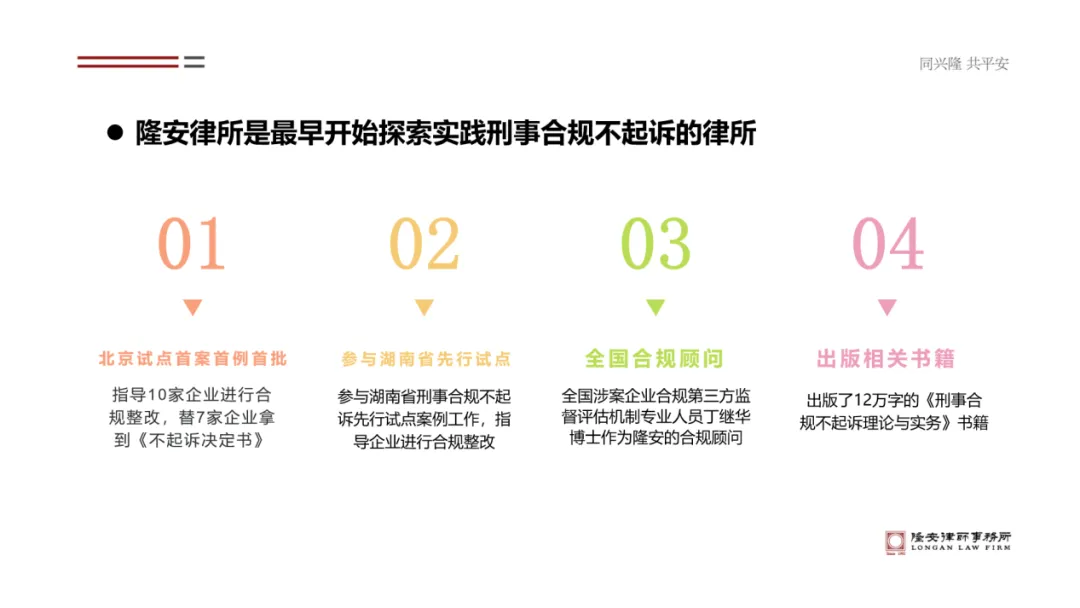
Long An Law Firm was among the earliest in the country to explore and practice criminal compliance non-prosecution, mainly reflected in four aspects:
-
Lawyers Liu Xiaoming and Yang Xiaobo from Long An Beijing served as members of the third-party organization for the SPP’s first batch of first cases in the Beijing criminal compliance non-prosecution pilot. Starting in 2021, the SPP commissioned the Beijing Xicheng District Procuratorate to initiate research on “criminal compliance non-prosecution.” Long An’s compliance team participated in this research and practical work, ultimately guiding 10 enterprises through compliance rectification and obtaining Non-Prosecution Decisions for 7 enterprises;
-
Participated in the pioneering pilot case work of criminal compliance non-prosecution in Hunan Province, guiding enterprises through compliance rectification;
-
Engaged Dr. Ding Jihua, a professional from the national-level involved enterprise compliance supervision and evaluation mechanism, as Long An’s compliance advisor;
-
Pioneered the publication of the book Theory and Practice of Criminal Compliance Non-Prosecution (《刑事合规不起诉理论与实务》).
II. Trends in Criminal Compliance Non-Prosecution
Currently, the trends in criminal compliance non-prosecution are mainly reflected in the following four aspects:
Trend 1: Expansion of the scope of applicable procedures for the involved enterprise compliance reform.
Criminal compliance non-prosecution has expanded from the original procuratorial review and prosecution stage to all stages of criminal proceedings. According to Article 1, Item 2 of the Notice on Further Clarifying Matters Concerning the Third-Party Supervision and Evaluation Mechanism for Involved Enterprise Compliance (《关于进一步明确涉案企业合规第三方监督评估机制有关事项的通知》) issued on December 31, 2023: “When people’s courts and people’s procuratorates handle enterprise-related crime cases, the third-party mechanism may be applied to cases that meet the conditions.” According to local policies and practical needs, the third-party mechanism can also be explored for application in the investigation stage, as well as in civil, commercial, administrative, and enforcement fields.
Trend 2: Increase in the number of regions with full criminal compliance coverage.
The head of the SPP’s Fourth Procuratorial Department stated in a press interview on the release of typical cases of involved enterprise compliance (fourth batch) that the coverage rate of grassroots procuratorates handling compliance cases continues to improve. Thirteen provinces, autonomous regions, and municipalities directly under the central government — including Beijing, Tianjin, Hebei, Liaoning, Jilin, Shanghai, Jiangsu, Anhui, Shandong, Hubei, Guangxi, Chongqing, and Guizhou — have achieved full coverage in compliance case handling.
Trend 3: Not limited to organizational crimes; applicable as long as “closely related to production and business activities.”
The purpose of criminal compliance is to save real enterprises. Currently, a common view has formed that only organizational crimes can apply to criminal compliance. However, according to Article 3 of the Guiding Opinions on Establishing a Third-Party Supervision and Evaluation Mechanism for Involved Enterprise Compliance (Trial) (《关于建立涉案企业合规第三方监督评估机制的指导意见(试行)》): “The third-party mechanism applies to cases involving economic crimes, duty-related crimes, etc., committed by companies, enterprises, and other market entities in their production and business activities. This includes both organizational crime cases committed by companies and enterprises, and criminal cases committed by actual controllers, management personnel, key technical personnel, etc., that are closely related to production and business activities.” Therefore, the involved enterprise compliance reform is not limited to organizational crime cases; individual crimes related to enterprise production and operations can also be subject to criminal compliance.
Trend 4: Application of compliance non-prosecution is not limited to cases with a statutory maximum sentence of three years or less.
What statutory maximum sentence threshold applies to criminal compliance non-prosecution? The SPP’s initial position on this issue was: “The scope of application for compliance non-prosecution should be limited to minor criminal cases where the directly responsible persons may be sentenced to fixed-term imprisonment of three years or less. It should not be expanded to cases where the sentence may be five years or less, let alone seven years or less, or even ten years or less.” As practice deepens, in March 2024, the Director of the SPP’s Fourth Procuratorial Department, Zhang Xiaojin, stated in an interview with The Beijing News: “At the current stage, we focus on gradually expanding the types of applicable cases from the earlier stage where minor offenses with a statutory maximum of three years or less were the main type, to cases with a statutory maximum of three years or more, as well as representative and influential major organizational crime cases. We particularly focus on handling enterprise compliance cases involving large enterprises, state-owned enterprises, multinational corporations, and listed companies, to continuously enrich the types of applicable cases and provide more and richer practical samples for establishing the involved enterprise compliance system.”
Question: Does “cases with a statutory maximum of three years or more” include cases with a maximum of 10 years or more?
The answer is: yes. However, generally, enterprises and entrepreneurial individuals will be handled in separate cases. That is, the enterprise may receive non-prosecution while the individual continues to be prosecuted. Example: Typical Case 2 of the Four Enterprise Compliance Reform Pilot Cases Published by the Supreme People’s Procuratorate: Shanghai Company A, Company B, and Guan Moumou Fraudulent Issuance of Special VAT Invoices Case (《最高人民检察院发布四个企业合规改革试点典型案例之二:上海市A公司、B公司、关某某虚开增值税专用发票案》). The involved units fraudulently issued 219 special VAT invoices with a total tax-inclusive amount of over RMB 28.87 million. Even after the enterprise and its responsible person paid the back taxes after the incident, the cases were handled separately: the enterprise underwent compliance non-prosecution, while the responsible person Guan was sentenced to three years’ imprisonment, suspended for five years.
III. Practical Procedure of Enterprise Criminal Compliance Non-Prosecution — Taking the First Criminal Compliance Non-Prosecution Case in Zhangzhou City Handled by Our Team
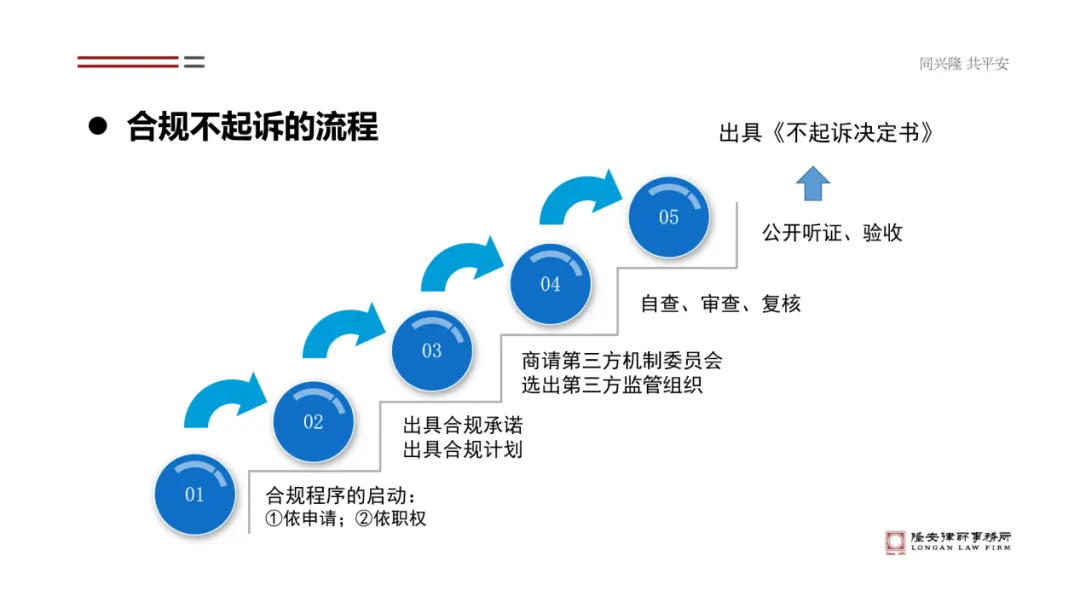
Based on our case-handling practice, the procedure for enterprise criminal compliance non-prosecution can be broadly summarized in five steps: Initiation of compliance procedures — Submission of compliance commitments and plans — Selection of third-party supervision and evaluation organization and determination of rectification period — Enterprise self-inspection, third-party review, and competent authority verification — Hearing, acceptance, and final issuance of the Non-Prosecution Decision by the procuratorate.
Case Summary:
An Australian-invested enterprise (all shareholders are Australian citizens) had disputes among shareholders. One shareholder reported the company to the tax authorities. After investigation: Between 2013 and 2017, without any actual transactions, the enterprise purchased 84 special VAT invoices from others for tax deduction purposes, with a total tax amount of RMB 1,276,008.74, suspected of the crime of fraudulent issuance of special VAT invoices.
Practical Procedure:
After taking over the case, we first used a settlement agreement to resolve the shareholder disputes and assessed whether this case could apply to criminal compliance non-prosecution. Subsequently, through continuous communication with the procuratorial authorities handling the case, we clearly submitted an application for criminal compliance non-prosecution. Since this was the first case in Zhangzhou, occurring in 2021, at an early stage when the sentencing range was 3-10 years, we proceeded with exploration. Ultimately, we successfully obtained the Non-Prosecution Decision.
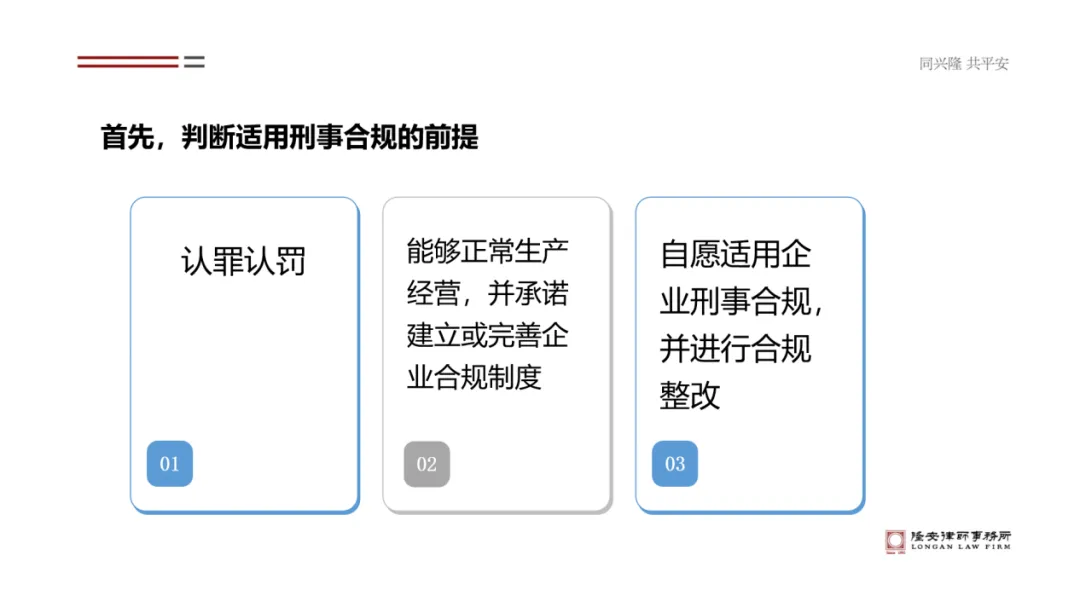
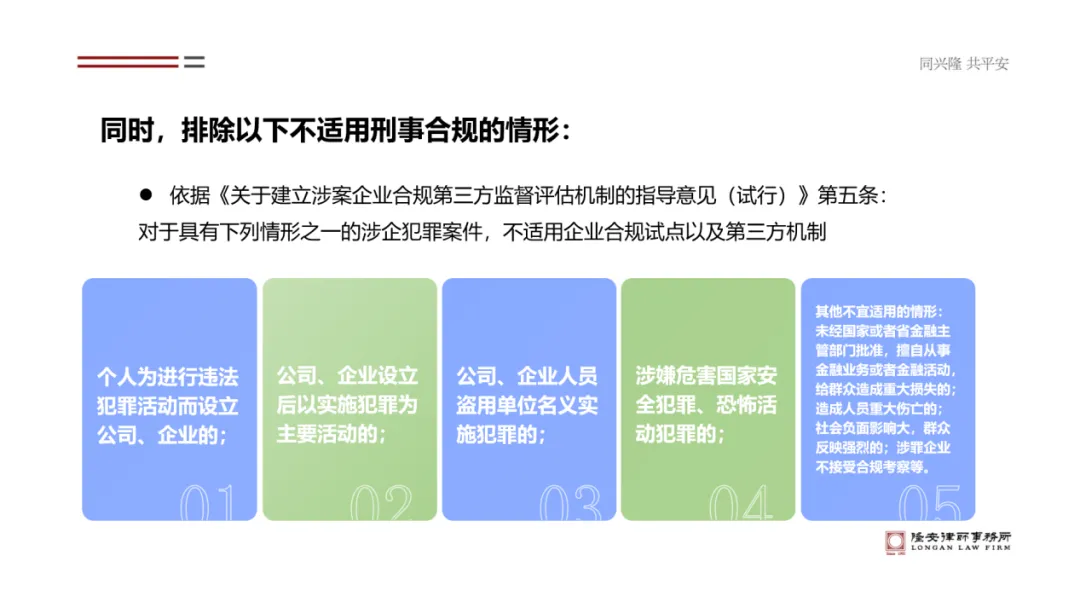
Finally, determine whether the crime was involved in production and business activities. Once all the above conditions are met, we can proceed with the five steps of criminal compliance non-prosecution:
Step 1: Initiation of Compliance Procedures
1. Application-Based Initiation:
When an involved enterprise applies to initiate the compliance non-prosecution procedure, the procuratorate’s first step is to determine whether there are conditions for rectification. This generally applies to small enterprises.
First, the procuratorate generally understands the situation by visiting relevant competent authorities and the local township government. It may also request the local third-party supervision and evaluation mechanism management committee to commission a legal team to conduct due diligence on the involved enterprise and comprehensively determine whether the enterprise has rectification capacity based on the lawyer’s report. Of course, the procuratorate may also commission this independently. Second, initiating the compliance non-prosecution procedure must be reported level by level to the provincial procuratorate for approval. If the provincial procuratorate does not approve, the procedure cannot be initiated.
2. Ex Officio Initiation:
If the procuratorate believes that the involved enterprise has rectification conditions, it may directly inquire whether the enterprise wishes to undergo compliance rectification by issuing a compliance rectification letter of intent. When the enterprise agrees to rectify, the procuratorate can then report level by level to the provincial procuratorate for approval to initiate the compliance non-prosecution procedure. This generally applies to large and medium-sized enterprises, as such enterprises typically have rectification conditions and do not require separate background investigations.
Whether initiated by application or ex officio, after the procuratorate determines that the involved enterprise has rectification conditions and receives approval from the provincial procuratorate, it issues a compliance rectification letter of intent to the involved enterprise, informing it to submit a compliance commitment within a specified time.
Step 2: The Involved Enterprise Issues a Compliance Commitment and Plan
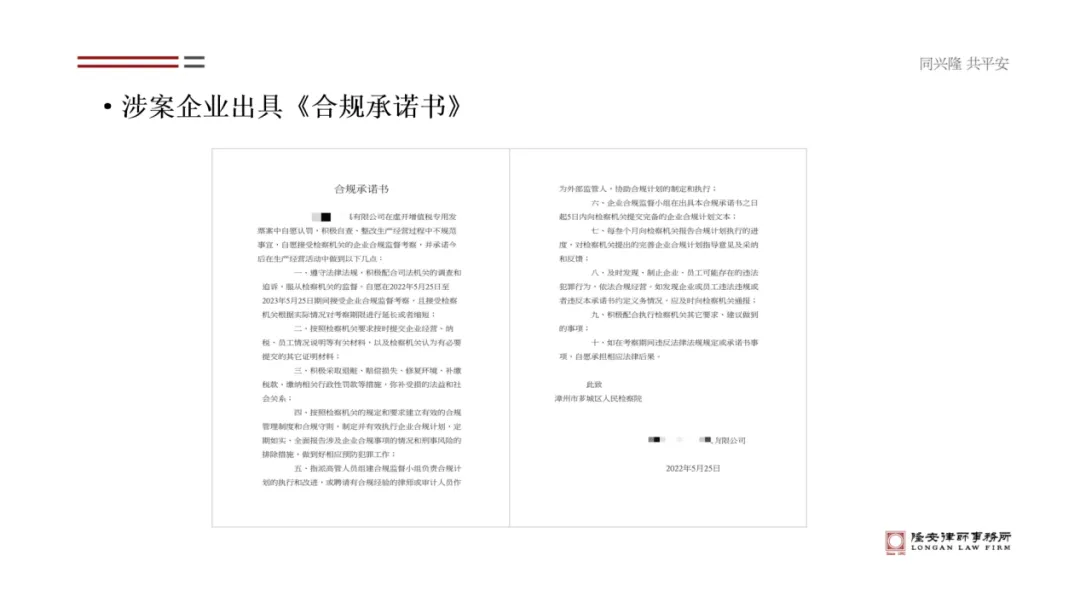
If the involved enterprise intends to undergo compliance rectification, it must first issue a compliance commitment. The compliance commitment does not need to be very specific; specific content can be reflected separately in the compliance plan.
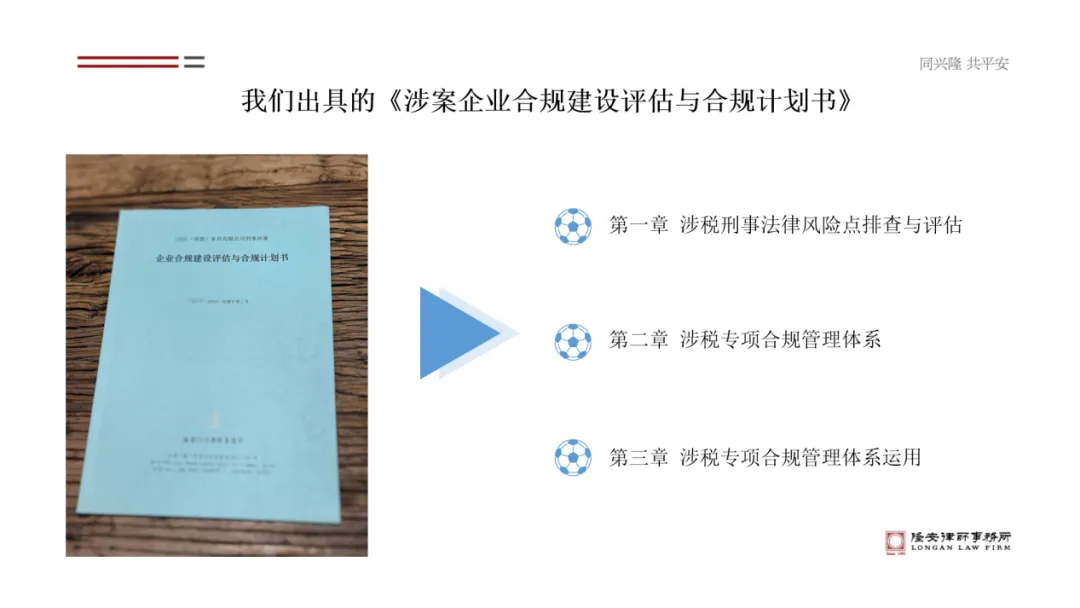
The essence of the compliance plan is the involved enterprise’s rectification plan. After issuing the compliance commitment, the enterprise must further submit a compliance plan. The compliance plan generally contains a specialized compliance plan and a simplified version of the compliance management system.
It should be noted that the compliance plan submitted by the involved enterprise is not necessarily the final compliance plan to be implemented. The third-party supervision and evaluation organization and the involved enterprise generally modify the compliance plan through discussions.
In practice, the compliance commitment and compliance plan are generally prepared by lawyers assisting the enterprise. Below are the Compliance Commitment and Compliance Plan we helped prepare for the involved enterprise in the first criminal compliance non-prosecution case in Zhangzhou.
Step 3: Selection of a Third-Party Supervision and Evaluation Organization Through the Third-Party Supervision and Evaluation Mechanism Management Committee, and Determination of the Rectification Period
First, why is a third-party supervision and evaluation mechanism management committee necessary?
Simply put, let professionals do professional work. Enterprise compliance rectification involves many professional issues. The procuratorate alone cannot assess the rectification status of the involved enterprise. It requires the cooperation of relevant competent authorities, industry associations, federations of industry and commerce, and external professionals for joint supervision and collaboration. In particular, compliance acceptance requires confirmation by professionals.
Second, what is the composition of the third-party supervision and evaluation organization?
The third-party supervision and evaluation organization is a temporary working group appointed by the third-party supervision and evaluation mechanism management committee to inspect and accept the rectification of a specific involved enterprise in a specific case. It is selected by the procuratorate through consultation with the committee for individual cases.
In practice, the composition of the third-party supervision and evaluation organization generally includes business骨干 from relevant competent authorities and external professionals. External professionals include lawyers, tax accountants, and members of the competent authority’s expert database. For business骨干 from relevant competent authorities, which specific persons are selected to participate in the compliance inspection is decided by the competent authority itself. For external professionals, a two-way selection can be made. According to regulations, the list of third-party organization members must be filed with the people’s procuratorate handling the case. If the procuratorate or the involved enterprise, individual, or other relevant entities or persons raise objections to the selected third-party organization members, the third-party mechanism management committee shall investigate and verify the situation and make adjustments accordingly.
After the third-party supervision and evaluation organization is selected through the management committee, it should hold discussions with the involved enterprise and the procuratorate. One of the key points of the discussions is to determine the rectification period. In practice, rectification generally takes 5 to 15 months.
Step 4: Enterprise Self-Inspection, Third-Party Review, and Competent Authority Verification
In corporate criminal compliance non-prosecution, the inspection of the involved enterprise generally adheres to the principle of “three inspections”: enterprise self-inspection — external third-party supervisor review — relevant competent authority verification.
(1) In the enterprise self-inspection stage, the involved enterprise should submit a self-inspection report promptly.
(2) In practice, the external third-party supervisor generally first reviews the enterprise’s compliance rectification status.
The review content mainly addresses issues discovered during the inspection. If the review is not passed, the enterprise needs to conduct self-inspection again.
(3) When the third-party supervisor finds no issues after inspection, the relevant competent authority will conduct verification.
Step 5: Hearing and Acceptance
When the relevant competent authority, after verification, finds no significant issues through multiple inspections of the involved enterprise, it can be determined that the enterprise’s rectification is basically complete and a hearing for acceptance can be held.
The involved enterprise may submit a hearing application to the procuratorate. Upon receiving the application, the procuratorate shall consult with the third-party supervision and evaluation organization to determine the time and place of the hearing and arrange the hearing. The procuratorate shall conduct the hearing in accordance with the hearing procedures stipulated in the Provisions on the Hearing Work of the People’s Procuratorate in Reviewing Cases (《人民检察院审查案件听证工作规定》). The general procedures include:
-
The prosecutor handling the case introduces the case situation and issues requiring hearing;
-
The parties and other participants explain their positions on the issues requiring hearing;
-
Hearing officers question the parties or other participants;
-
The presiding officer announces a recess for hearing officers to discuss the hearing matters;
-
The presiding officer announces the resumption of the hearing, and hearing officers or their representatives may express opinions based on the case situation;
-
The parties make final statements;
-
The presiding officer summarizes the hearing.
After the hearing, what happens next? There are two scenarios:
First scenario: If the involved enterprise passes the acceptance, it may receive lenient treatment. For cases where administrative penalties are required after the conclusion of the criminal proceedings for the involved enterprise, the procuratorate shall transfer a copy of the compliance inspection report to the corresponding administrative authority and, as appropriate, issue a procuratorial recommendation suggesting that the administrative authority reduce or exempt the penalty for the involved enterprise. The administrative authority should, in principle, reduce or exempt the penalty for the involved enterprise.
Second scenario: If the involved enterprise does not pass the acceptance, the procuratorate must still report level by level to the provincial procuratorate, which will decide on the handling opinion. Based on this opinion, the handling procuratorate will deal with the involved enterprise according to law.
Finally, when the involved enterprise successfully passes the hearing and acceptance, the procuratorate issues the Non-Prosecution Decision.
The above is the complete practical procedure for corporate criminal compliance non-prosecution. From a trend perspective, the scope of application of corporate criminal compliance non-prosecution is becoming increasingly broad, ultimately expected to achieve full coverage.