Technical Secrets vs. Patents: Where Should Enterprise Intellectual Property Protection Go?
Technical Secrets vs. Patents: Where Should Enterprise Intellectual Property Protection Go?
With rapid growth in patent applications, patents are no longer foreign to enterprises. Enterprises can timely transform R&D achievements into patent rights. Some enterprises have become 'invisible champions' in certain segments through accumulated technical strength.
Introduction
With rapid growth in patent applications, patents are no longer foreign to enterprises. Enterprises can timely transform R&D achievements into patent rights. Some enterprises have become “invisible champions” in certain segments through accumulated technical strength. With more cases involving technical secrets in recent years, where should enterprises’ intellectual property protection strategies go?
I. Concepts of Trade Secrets and Technical Secrets
Article 9(4) of the Anti-Unfair Competition Law defines trade secrets as “commercial information such as technical information and business information not known to the public, having commercial value, and for which the rights holder has taken corresponding confidentiality measures.” Trade secrets have secrecy, value, and confidentiality.
Technical secrets are an important type of trade secret. Technical secrets focus on technical fields, involving specific technical solutions and process methods.
II. Patent Application, Grant, Confirmation, and Rights Protection
Patent lifecycle includes four stages:
Application: Transform technical solutions solving technical problems into patent application documents, submit to National Intellectual Property Administration.
Grant: After examination confirming invention creation meets conditions including novelty, creativity, and practicality, patent right is granted.
Confirmation: Post-grant, any unit or individual may request patent administrative department to declare patent right invalid if it does not meet Patent Law provisions.
Rights Protection: Patent holders can use legal means like civil litigation and administrative complaints to stop infringement.
III. Comparative Analysis of Technical Secrets and Patents
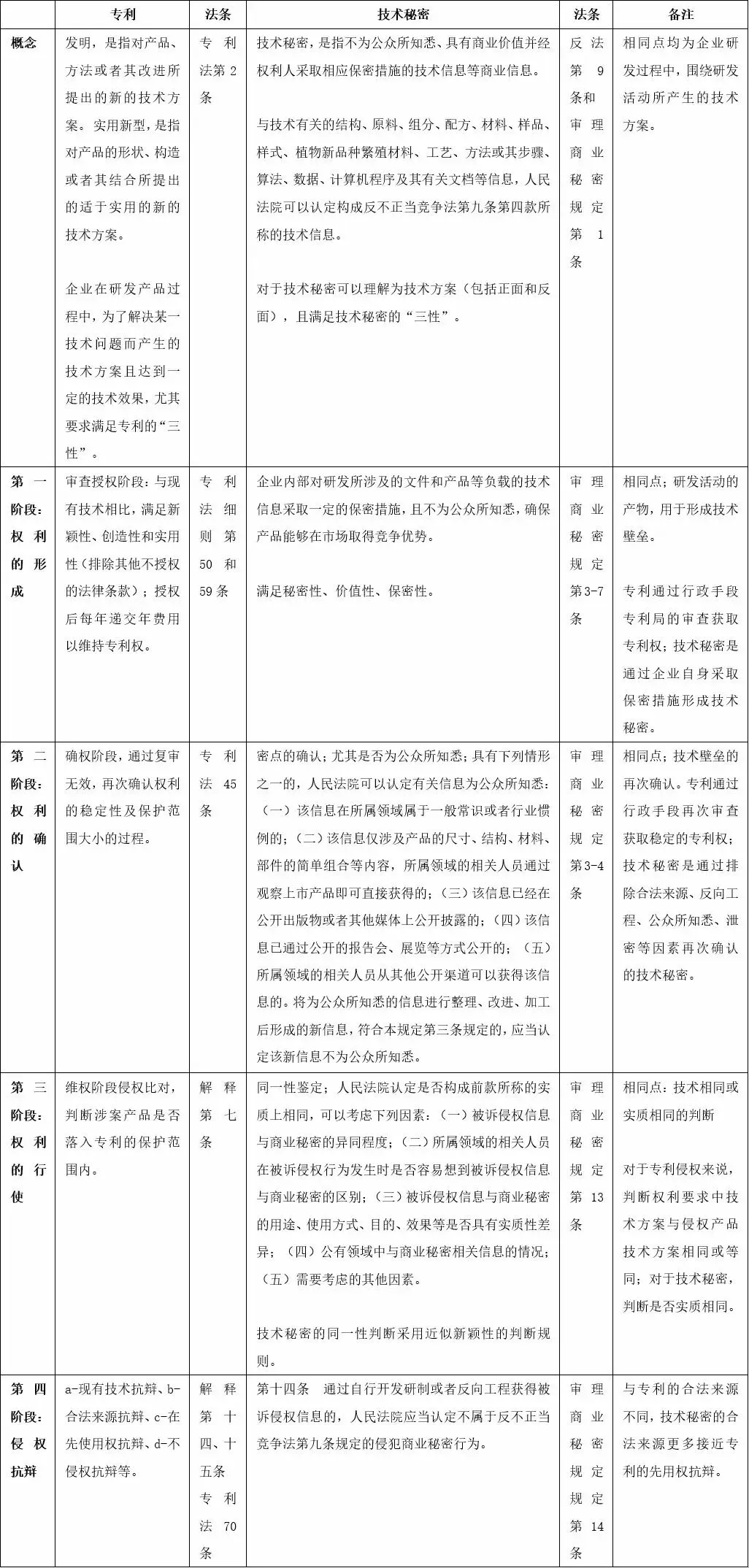
Stage 1: Rights Formation
Patents require clear, sufficient technical solutions meeting three conditions (practicality, novelty, creativity). Patents exchange technical solution publication for protection, enjoying exclusive rights for certain periods.
Technical secrets require meeting three conditions (secrecy, value, confidentiality). They require enterprises to implement confidentiality measures. Protection has no fixed duration.
Stage 2: Rights Confirmation
For patents, confirmation is at Patent Administrative Department’s Review and Invalidation Department. For technical secrets, confirmation is at courts, examining the three conditions especially secrecy and confidentiality.
Stage 3: Rights Exercise
For patents, determine whether accused products fall within patent protection scope based on comprehensive coverage principle. For technical secrets, determine whether technical solutions are substantially identical.
Stage 4: Infringement Defense
For patents: existing technology defense, legitimate source defense, prior use defense, non-infringement defense. For technical secrets: legitimate source defense, technical secret identity defense.
IV. Conclusion
Technical secrets and patents have many similarities and differences. This article summarizes their differences and connections in concepts, three conditions, existing technology vs. public knowledge, comprehensive coverage vs. identity, existing technology defense vs. reverse engineering.
Compared to patent protection, technical secrets give more initiative to enterprises with stronger controllability. With emergence of segment industry leaders, technical secrets become more important. Analysis helps enterprises choose strategies for core technologies between patent and technical secret protection, better protecting innovation achievements.