
Analysis of the Division of Precious Metals and Jewelry in Divorce Disputes
Analysis of the Division of Precious Metals and Jewelry in Divorce Disputes
I. Introduction: Setting aside the rising price of gold, precious gemstones such as jade and pearls have become popular choices for daily wear, collection, and investment. The core considerations for whether precious metals and jewelry can be divided as marital property in divorce disputes primarily involve two aspects: first, determining the timing of acquisition; second, whether the items possess significant personal exclusivity. Based on this, this article explores the division of precious items acquired before and after marriage in divorce disputes, using the establishment of the marriage relationship (i.e., marriage time) as the dividing point.
I. Introduction
Setting aside the rising price of gold, precious gemstones such as jade and pearls have become popular choices for daily wear, collection, and investment. Regarding whether precious metals and jewelry can be divided as marital property in divorce disputes, the core considerations primarily involve two aspects: first, determining the timing of acquisition of the precious items; second, whether the items possess significant personal exclusivity. Based on this, this article explores the division of precious items acquired before and after marriage in divorce disputes, using the establishment of the marriage relationship (i.e., marriage time) as the dividing point.
II. Precious Items Acquired Before Marriage
A. Purchased by One Party or Given as a Gift by Others Before the Marriage
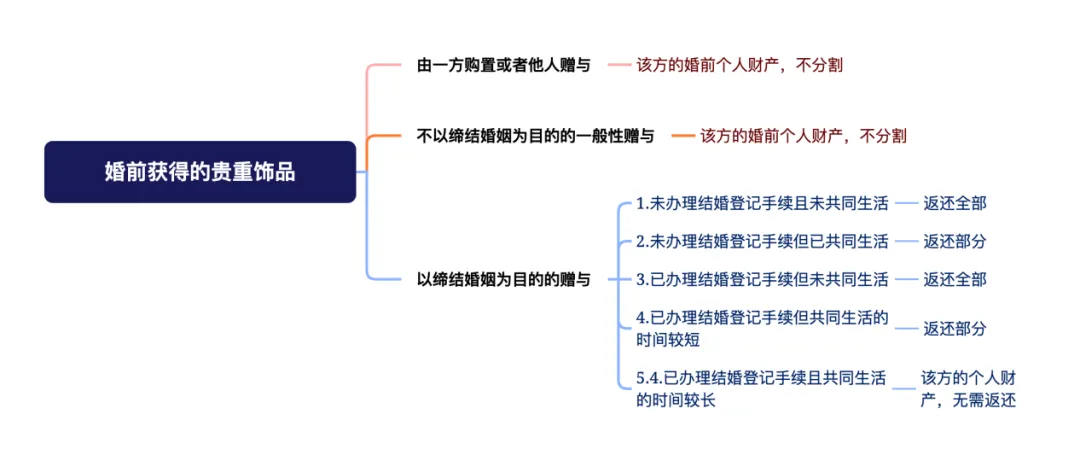
Precious items purchased by one party through payment or received as a gift from others before the establishment of the marriage relationship, in accordance with relevant legal provisions and the principles of property acquisition under civil law, shall, absent any other agreement, be regarded as the party’s premarital personal property. According to Article 1063 of the Civil Code of the People’s Republic of China (hereinafter referred to as the “Civil Code”), such items shall not be included in the scope of marital property division upon divorce.
B. General Gifts Not Given for the Purpose of Entering into Marriage
During a romantic relationship, if one party gifts precious items to the other party without attaching the precondition of entering into marriage, and such gifts are not considered traditional betrothal gifts (cai li), such gifts shall be characterized as general gift-giving. According to Articles 657 and 158 of the Civil Code, when one party (the donor) delivers precious items to the other party (the donee) and the donee has received them, the ownership of the precious items acquired by that party before marriage shall be regarded as that party’s premarital personal property, separate from marital community property, and shall not be subject to division upon divorce.
C. Gifts Given for the Purpose of Entering into Marriage
Precious items purchased as betrothal gifts may be handled with reference to relevant legal provisions on betrothal gifts (cai li). Legislators consider joint life, whether marriage registration has been completed, and whether the provision of betrothal gifts has caused difficulties for the donor’s livelihood as factors in determining the proportion of betrothal gifts to be returned. In judicial practice, when determining the proportion of betrothal gifts to be returned, the longer the joint life, the lower the return proportion; conversely, if there has been no joint life, the donee of the betrothal gifts shall in principle return the full amount. Consideration is also given to practical circumstances such as which party actively后悔 (regretted the marriage), whether there is fault, and whether there are children or pregnancy. According to current legal provisions, gifts given for the purpose of entering into marriage can be divided into the following four situations:
1. Marriage Registration Not Completed and No Joint Life
This constitutes a breach of promise (marriage agreement) property dispute. When one party gifts precious items to the other party for the purpose of entering into marriage, it constitutes a conditional gift. Since neither party has completed marriage registration nor engaged in joint life, the conditions have not been satisfied. According to Article 158 of the Civil Code, the donee shall return the precious metals and jewelry given as betrothal gifts to the donor.
2. Marriage Registration Not Completed But Joint Life Has Occurred
This also constitutes a breach of promise property dispute. Since the parties have engaged in joint life, it would be inappropriate to require the return of all precious items given as betrothal gifts. According to Article 6 of the Supreme People’s Court’s Provisions on the Trial of Betrothal Gift Dispute Cases (hereinafter referred to as the “Betrothal Gift Dispute Provisions”), if one party requests the return of precious items given as betrothal gifts, a partial return shall be made. The court shall, based on the actual use of the betrothal gifts and dowry circumstances, comprehensively consider facts such as joint life and pregnancy situations, faults of both parties, etc., and determine whether to return and the specific proportion based on local customs.
3. Marriage Registration Completed But No Joint Life
This situation falls under Item (2), Paragraph 1 of Article 5 of the Interpretation of the Supreme People’s Court on the Application of the Civil Code of the People’s Republic of China Regarding Marriage and Family Matters (I). If the parties have only completed marriage registration but there is absolutely no substantive content of joint life, the donee shall return all precious items given as betrothal gifts.
4. Marriage Registration Completed But Short Duration of Joint Life
If the parties have completed marriage registration and engaged in joint life, but the duration of joint life was short, according to Article 5 of the Betrothal Gift Dispute Provisions, if the betrothal gift amount is excessively high, the people’s court may, based on the actual use of the betrothal gifts and dowry circumstances, comprehensively consider facts such as the gift amount, joint life and pregnancy situations, faults of both parties, etc., and determine whether to return and the specific proportion based on local customs.
For illustrative purposes, in the case of Dong and Zhu regarding betrothal gift return [1], Dong and Zhu registered their marriage in September 2020. Dong transferred two payments to Zhu’s bank account in the month of marriage: one of 800,000 RMB marked as “cai li” (betrothal gift); another of 260,000 RMB marked as “wu jin” (five gold items). Later, due to disputes over wedding preparations and other matters, the parties divorced by agreement in November 2020, with the marriage lasting less than three months. The court held that in addition to the 800,000 RMB clearly marked as cai li, the 260,000 RMB marked as “wu jin” also conforms to the general understanding of betrothal gifts in wedding customs and shall also be characterized as cai li. Furthermore, whether for situations where marriage registration has or has not been completed, when determining whether to return betrothal gifts and the specific proportion, the duration of joint life is an important consideration. In this case, the parties’ marriage lasted a short time; after marriage registration, they were still in the process of preparing for the wedding, and the parties had not formed consistent plans regarding future work, residence, and life, nor had they formed a complete family community and stable living situation. Therefore, it is inappropriate to characterize this as having engaged in joint life. However, considering the impact of marriage registration and brief cohabitation on the female party, the parties’ joint consumption, the high amount of betrothal gifts, and other factors, the judgment moderately returned most of the betrothal gifts, which can properly balance the interests of both parties.
5. Marriage Registration Completed and Long Duration of Joint Life
If the marriage has lasted a long time and the parties have formed a complete family community and stable living situation, the purpose of the betrothal gift—entering into marriage—has already been fulfilled, and the gift conditions have been satisfied. The precious items received by the donee as betrothal gifts shall legally be regarded as that party’s personal property. Therefore, upon divorce, precious items given as “betrothal gifts” shall not be subject to division as community property.

III. Precious Items Acquired After Marriage
The division of precious items purchased after marriage upon divorce primarily involves considering whether there are circumstances that should characterize them as personal property. Among these, what constitutes “daily necessities exclusively used by one party” is currently not clearly defined by law. In judicial practice, courts generally make a comprehensive evaluation of the economic conditions and family income levels of both parties after marriage, combined with the purchase timing and the time of emotional breakdown, to comprehensively analyze and weigh whether the precious items belong to “daily necessities exclusively used by one party” or marital community property.
A. Purchased Solely by One Party After Marriage or Given as a Gift by Others
If precious items are purchased after marriage using that party’s personal property, since they are substitutes (replacements) for the party’s personal property, regardless of their value, they shall generally be characterized as that party’s personal property; if given as a gift by others and the donee is explicitly designated as that one party alone, according to Article 1063 of the Civil Code, they shall be characterized as that party’s personal property.
B. Purchased Using Marital Community Property
For precious jewelry worn daily by one party, given their strong personal attachment and non-investment nature, they conform to the characteristics of “daily necessities exclusively used by one party” and generally tend to be characterized as that party’s personal property. However, in divorce disputes, if the jewelry has a high value, the court may make an appropriate consideration and order that party to provide corresponding cash compensation to the other party. For example, in the case of property disputes after divorce between Huang and Li [2], the court held that Li acknowledged in court that a 999.9 gold necklace worth HKD 15,426, a fine gold bracelet worth HKD 4,853, and a fine gold bracelet worth HKD 5,058 were in his possession for safekeeping. Since the above jewelry was purchased during the marriage, it shall be characterized as marital community property and subject to division. However, if that party can provide sufficient evidence proving that the jewelry was explicitly gifted to that party alone by the other party, the court will generally characterize the jewelry as that party’s personal property.
C. Large Quantities of Precious Items Purchased After Marriage
If the precious items purchased are in large quantities and have high value, clearly possessing investment attributes, according to Article 1062 of the Civil Code, they shall generally be characterized as marital community property, and based on the principle of fairness, shall be subject to division upon divorce.
IV. Conclusion
In divorce disputes, the ownership of precious items is not a matter of blanket determination; rather, courts need to examine the timing of purchase of such property based on specific case circumstances, deeply investigate the family’s economic conditions and source of funds after marriage, while also focusing on factors such as the quantity and price of the precious items and whether they possess personal exclusivity. This process aims to ensure fairness and reasonableness in the division of marital property and protect the legitimate rights and interests of both parties.
Legal Provisions (scroll up/down to view more):
Civil Code of the People’s Republic of China
Article 158: Civil juristic acts may be subject to conditions, except where the nature of such acts precludes conditions. Civil juristic acts subject to conditions for effectiveness shall become effective when such conditions are fulfilled. Civil juristic acts subject to conditions for termination shall become ineffective when such conditions are fulfilled.
Article 224: The creation and transfer of ownership of movable property shall take effect upon delivery, unless otherwise provided by law.
Article 595: A sales contract is a contract whereby the seller transfers ownership of the subject matter to the buyer and the buyer pays the price.
Article 657: A donation contract is a contract whereby the donor gratuitously gives his property to the donee and the donee expresses acceptance of the donation.
Article 1062: The following property acquired by spouses during the existence of a marriage shall be the spouses’ community property, owned jointly by the spouses:
(1) Wages, bonuses, and remuneration for labor services;
(2) Income from production, business operations, and investments;
(3) Income from intellectual property;
(4) Property inherited or received as a gift, except as provided in Item (3) of Article 1063 of this Code;
(5) Other property that should belong to the community.
Spouses shall have equal rights to dispose of community property.
Article 1063: The following property shall be the personal property of one spouse:
(1) Premarital property of that party;
(2) Compensation or indemnification obtained by that party for personal injury;
(3) Property specified in a will or donation contract as belonging to only one party;
(4) Daily necessities exclusively used by that party;
(5) Other property that should belong to that party.
Interpretation of the Supreme People’s Court on the Application of the Civil Code of the People’s Republic of China Regarding Marriage and Family Matters (I)
Article 5: If a party requests the return of betrothal gifts given according to customs, and the circumstances specified in any of the following items are verified, the people’s court shall support such request:
(1) Neither party has completed marriage registration procedures;
(2) Both parties have completed marriage registration procedures but have not engaged in joint life;
(3) Premarital gifts given caused difficulty in livelihood for the donor.
The provisions of Items (2) and (3) of the preceding paragraph shall apply only when divorce is a condition.
Provisions of the Supreme People’s Court on the Trial of Betrothal Gift Dispute Cases
Article 5: If both parties have completed marriage registration and engaged in joint life, and one party requests the return of betrothal gifts given according to customs upon divorce, the people’s court shall generally not support such request. However, if the duration of joint life is short and the betrothal gift amount is excessively high, the people’s court may, based on the actual use of the betrothal gifts and dowry circumstances, comprehensively consider facts such as the gift amount, joint life and pregnancy situations, faults of both parties, etc., and determine whether to return and the specific proportion based on local customs.
When the people’s court determines whether the betrothal gift amount is excessively high, comprehensive consideration shall be given to factors such as the per capita disposable income of the donor’s location, the donor family’s economic circumstances, and local customs.
Article 6: If both parties have not completed marriage registration but have engaged in joint life, and one party requests the return of betrothal gifts given according to customs, the people’s court shall determine whether to return and the specific proportion based on the actual use of the betrothal gifts and dowry circumstances, comprehensively considering facts such as joint life and pregnancy situations, faults of both parties, etc., in light of local customs.
Reference Cases:
[1] See Civil Judgment of Suzhou Intermediate People’s Court, Jiangsu Province, (2021) Su 05 Min Zhong No. 10300.
[2] See Civil Judgment of Yuexiu District People’s Court, Guangzhou City, Guangdong Province, (2021) Yue 0104 Min Chu No. 38170.
Note:
The “precious metals and jewelry” mentioned in this article refer to accessories and crafts made from precious materials such as gold, silver, platinum and diamonds, gemstones (such as jade and emerald), pearls, and crystal through processing and setting methods. Gold bars, having clear investment attributes, are not within the scope of this article’s discussion.