
Practical Analysis of Patent Freedom to Operate (FTO) and Key Considerations
Practical Analysis of Patent Freedom to Operate (FTO) and Key Considerations
FTO (Freedom to Operate) analysis is an important non-litigation tool for enterprises to identify patent infringement risks and prevent intellectual property disputes. This article defines the core concept of FTO and its legal significance in avoiding punitive damages, and points out its wide application across various business scenarios including product R&D, launch, IPO, production line introduction, and market expansion. It further details the standard FTO operation procedure, covering five major steps: technical research, patent search, screening, infringement comparison, and strategy formulation. The article also emphasizes the comprehensive professional capability requirements from technical, patent, legal, and economic dimensions. It concludes that FTO is an effective risk management tool for businesses, but its specific defensive effect in domestic patent litigation still awaits further judicial practice.
Abstract:
With economic development and technological progress, enterprises have researched and developed various products. While bringing profits, these products also bring varying degrees of intellectual property disputes, and intellectual property dispute cases are increasing year by year. FTO plays a role in “preventive treatment” for patent disputes. This article provides a detailed review, discussing the application scenarios, procedures, and considerations of FTO non-litigation projects, to better safeguard enterprise products.
Keywords: Intellectual Property Disputes, FTO, Preventive Treatment
I. Overview of FTO
In daily work, we often encounter terms such as “patent warning,” “infringement analysis,” “patent risk analysis,” “IP due diligence,” “non-infringement analysis,” “patent design-around,” “patent freedom to operate,” “FTO,” “IP compliance,” etc. What is the relationship between these concepts, and what is the concept of FTO?
Freedom to operate (FTO) is the ability to proceed with research, development and commercialization of a product, while fully accounting for any potential risks of infringing activity, i.e., whether a product can be made, used, sold, offered for sale, or exported, with a minimal risk of infringing the unlicensed intellectual property rights (IPR) or tangible property rights (TPR) of others[1].
Freedom to Operate (FTO) analysis is a method for identifying infringement risks, including infringing third-party rights or being infringed by third parties, to enable the organization to deploy innovation and related IP in any relevant manner (e.g., product commercialization, licensing)[2].
Patent warning refers to collecting and analyzing patent information in the industry’s technical field and related fields, as well as domestic and international market information, to understand competitor behavior, and timely inform relevant government departments, industry organizations, and enterprises in the industry of possible precursors to patent disputes, possible harm, and recommended countermeasures; simultaneously publish information about infringement of patent rights and recommend industry organizations and enterprises take countermeasures[3].
FTO is a foreign term, sometimes called “right to use.” To understand its essence, we must return to its origin.
US Patent Law Section 284, Paragraph 2: Upon finding that a patent infringement has occurred, the court may increase the damages up to three times the amount found or assessed. Thus, Section 284, Paragraph 2 serves as the legal basis for punitive damages for patent infringement.
Current US patent law does not specify the threshold and scope for punitive damages. As the system evolved legislatively and through judicial application, it transitioned from mandatory application to using the party’s subjective fault as the standard. The standard has gone through three stages: “reasonable duty of care” standard, “objective recklessness” standard, and “subjective fault” standard[4]. Another description: first stage, “affirmative duty of care” and “attorney opinion” rules; second stage, “objective recklessness” standard; third stage, “subjective fault” standard[5].
In determining whether willful infringement exists, the jury considers all facts surrounding the alleged infringement, including but not limited to: (a) whether the accused infringer intentionally copied the claimed invention or patent-protected product; (b) whether the accused infringer exercised due care to avoid patent infringement (evidence of design-around); (c) whether the accused infringer relied on legal advice from counsel; (d) whether the accused infringer raised substantive defenses to infringement; (e) whether the patent is undergoing or has undergone reexamination.
Affirmative duty of care: As long as a potential patent infringer is aware of the existence of a patent, they have a duty to investigate to ensure they will not infringe others’ patent rights, or if the patent in question is invalid, failure to conduct necessary investigation may result in bearing adverse risks.
Attorney opinion rule: If a potential patent infringer actually knows of the existence of others’ relevant patent rights, they have an “affirmative duty of care” to exercise due diligence to “determine” whether their own conduct constitutes patent infringement. Such “determination” obligations include, but are not limited to, seeking reliable legal advice from professional attorneys before commencing any potentially infringing activity. Under the “attorney opinion” rule, if an infringing defendant reasonably relied on an attorney’s legal opinion that their conduct did not constitute patent infringement, courts consider this as a reference factor in determining whether the defendant lacked subjective fault in infringement. The Federal Circuit stated that if a defendant fails to produce an attorney opinion, it implies “either the defendant did not seek an attorney’s opinion or received an opinion that the relevant conduct might be infringing”[4].
In summary, FTO is a means of defending against punitive damages in patent infringement cases. FTO is a foreign term whose core meaning is limited to the scope of patent risk analysis. The main purpose of FTO is to demonstrate non-willful infringement to avoid potential punitive damages. A patent freedom to operate report is a due diligence investigation and legal opinion on whether the technology implemented by an enterprise infringes others’ patent rights, producing an analysis report on whether infringement exists. In the specific FTO search and analysis process, “infringement analysis,” “patent risk analysis,” and “non-infringement analysis” must be considered; for later risk mitigation, “patent design-around” should be considered. “IP due diligence” and “IP compliance” have broader scope, not limited to patents.
II. FTO Application Scenarios
FTO itself is a “health check” for enterprise patent risks. Therefore, FTO analysis projects can be carried out during product R&D stages (including pre-R&D, ongoing R&D, post-R&D) and launch stages (including pre-launch, post-launch), with a wide range of application scenarios. Examples include:
During Appotronics’ STAR Market IPO, Delta initiated a “patent狙击” against Appotronics. After Memsensing submitted its STAR Market IPO application to the Shanghai Stock Exchange, Goertek initiated a “patent狙击” against Memsensing[6].
As disclosed by a group, its lithium battery Phase III production project all采用 imported equipment, introducing multiple highly automated production lines, achieving full automation, digitalization, and intelligence in the lithium battery production process, reaching the industry’s most advanced level[7].
During enterprise IPO processes or when introducing major production line equipment, to规避 unknown patent risks and disputes (contracts may stipulate patent risks, but disputes cannot be excluded), enterprises can conduct FTO analysis projects to prepare in advance.
FTO analysis projects have comprehensive application scenarios. Besides IPOs and production line introductions, enterprises changing tracks to another industry, entering new technical fields; enterprises shifting from domestic to international markets, entering new countries; enterprises discovering plagiarism by competitors, wishing to sue competitors while fearing being sued themselves—in all these scenarios, enterprises can conduct FTO analysis projects to better inform their business decisions.
III. FTO Operation Procedure
According to ISO56005 international standards[2], the steps for Freedom to Operate (FTO) analysis: a) Collect information about innovation within the organization through disclosure forms. Understanding the technical scope, nature, and objectives of the innovation and specific markets is crucial. Ensure clear IP ownership of inventions, as hidden ownership may raise ownership disputes later. b) Determine search strategies for relevant solutions or IP rights that the innovation might infringe, based on territorial principles, and identify relevant keywords and/or patent classifications to help discover any relevant rights others may have. c) Integrate and analyze information, review research findings, and assess information from the perspective of identifying obstacles and other aspects that may become issues in the future. d) Conduct a legal FTO assessment based on appropriate legal considerations, taking into account business risks and solutions related to FTO. Consider the IP owner’s profile and related risk levels (e.g., some companies are considered aggressive), IP rights status, potential expiration dates, and other IP rights information affecting risk analysis. e) Aggregate potential IP issues and their solutions, including partnerships, invalidation, licensing, design-around.
Based on the above information, combined with available resources, make decisions (deploy, stop, delay, or alternative plans) regarding innovation and related IP. Organizations cannot obtain absolute assurance of freedom to operate, but minimizing risk can save important organizational resources.
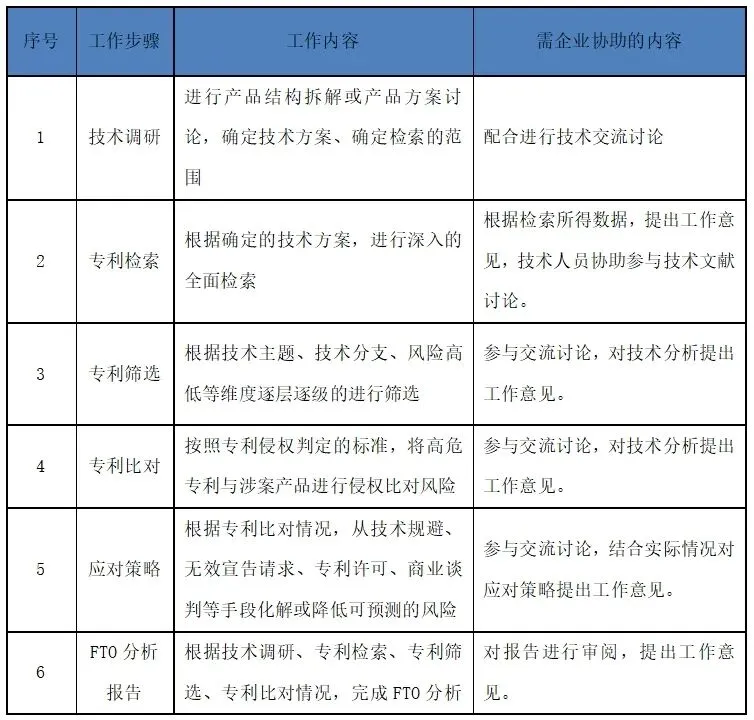
ISO56005 outlines the FTO operation procedure. In actual operation, further细化 is needed. Based on practical experience with numerous cases, the author discusses the specific operation procedure:
Step 1: Detailed Technical Research
Conduct a detailed understanding of the target product. If conditions permit, perform technical decomposition with the assistance of R&D personnel and document it. Comprehensively and deeply understand the technical方案 and梳理 multiple technical approaches. The accuracy of understanding technical方案 affects subsequent steps including search, screening, and comparison to varying degrees.
Define the target product’s sales regions, such as China, the United States, or Europe, etc. Defining sales regions essentially fixes the search scope.
In addition to the above research, comprehensively investigate the target product’s technical development path,梳理 competitors, familiarize yourself with competitors’ products, and investigate litigation related to the target product—all beneficial to FTO work.
Step 2: Comprehensive and In-depth Search
After determining the target product’s technical方案 and the specific search scope in Step 1, search work can commence. Regarding search databases, search strategy formulation, allocation of searchers, verification of search effectiveness, and how to ensure “completeness” and “accuracy” of the search—it is best to engage professional searchers for comprehensive and in-depth searching.
Comprehensive and in-depth searching is the guarantee of FTO effectiveness. Whether comprehensive and in-depth searching can be achieved tests the professional searcher. Theoretically, all relevant valid patents of the specific country should be retrieved. Considering evidence collection for later invalidation and potential later grant of patents under examination, all documents should be considered within permissible conditions.
Step 3: Accurate Patent Screening
Based on the comprehensive and in-depth search in Step 2, screen the retrieved relevant patents. The screening process involves sifting, like panning for gold—separating the genuine from the false. It is recommended to tag and annotate layer by layer based on dimensions such as technical theme, technical branch, and risk level.
Step 4: Precise Infringement Comparison
Based on the accurate patent screening in Step 3, for high-risk patents under different themes and branches, conduct infringement comparison between high-risk patents and the product in question according to patent infringement determination standards. This step is最好 performed by attorneys with patent litigation experience to ensure the accuracy of infringement comparison results.
Step 5: Feasible Response Strategies
Based on the conclusions from the infringement comparison analysis in Step 4, adopt different strategies. Assuming infringement risks exist, choose technical design-around, invalidation petitions, patent licensing, business negotiations, and other means to resolve or mitigate predictable risks.
The above five-step operation procedure is summarized as follows:
IV. FTO Operation Considerations
FTO projects have high requirements for project personnel. Below, we discuss from four dimensions: technical, patent, legal, and economic.
From a technical perspective, an FTO project generally involves products that are or will be commercialized. The technology凝聚 in products varies infinitely, requiring personnel to have both breadth and depth in technical knowledge, able to use technology as an entry point to understand products, understand R&D personnel, and understand patent technical方案.
From a patent perspective, the project personnel’s basic patent knowledge must be comprehensive and accurate, without inaccurate understanding of any point affecting judgment—for example, the relationship between priority establishment and prior art. Basic patent knowledge is quite extensive; personnel must have solid fundamentals. Patent search skills combine search technique with search ability—mastering basic search theory and如何使用 different commercial databases at best provides search technique. Improving search ability relies on大量 case practice in different scenarios (patent examination search, patent invalidation search, common knowledge search, etc.). Patent analysis skills involve accurately identifying and judging technical方案 disclosed in patent documents, avoiding situations where documents appear to be target documents but are not, or vice versa. Patent search and analysis skills can be assessed according to the ten-thousand-hour rule.
From a legal perspective, all assumed risks are determined based on infringement comparison analysis conclusions. Therefore, ensuring the accuracy of infringement comparison results is particularly important. Later response strategies, including filing patent invalidation requests, prior art defenses, non-infringement defenses, and cross-examination of damages evidence, all require some patent litigation experience. For example, not only should the scope of protection of granted claims be considered, but also the scope of protection of claims that can be amended. The literal boundary of the protection scope of visible granted claims is clear, and the public’s duty of care is relatively明確. However, various amendment approaches within the “further limitation” scope, although narrowing rather than expanding the protection scope, introduce uncertainty in amendment that poses significant challenges to the public’s duty of care. In patent risk due diligence, the public’s understanding of the protection scope of the patent in question should be based on the protection scope determined by the pre-amendment claims, following amendment principles and methods established in the confirmation procedure, to reasonably anticipate the protection scope that could be确认 through amending the patent in question, thereby avoiding infringement of the patent in question when implementing a technical方案[8].
From an economic perspective, multi-angle analysis of enterprise business operations based on IP risks is necessary. For example, the contribution rate of risk patents to the product in question, the proportion of the product in question to revenue, the impact of patent risks on enterprise IPO processes, and pricing of intangible assets in specific patent licensing or cross-licensing processes.
The above four dimensions are not independent but mutually reinforcing. For example, the accuracy of understanding technical方案 directly affects patent search and patent infringement comparison, requiring FTO analysis personnel to continuously advance in all four dimensions.
V. Summary
FTO analysis is a relatively complex project that can be operated according to certain steps and procedures, conducting health checks and diagnoses of enterprise product patent risks to minimize risks and save resources for enterprises. However, whether FTO can serve as evidence of non-willful infringement in domestic patent litigation still lacks specific cases and requires further confirmation in practice. However, FTO can serve as a defense of legitimate source in trade secret infringement litigation.
References (scroll for more):
[1] University of New Hampshire. FTO [P/OL]. (2011-2-17)[2011-2-17]. https://www.wipo.int/edocs/mdocs/mdocs/en/wipo_ip_wk_ge_11/wipo_ip_wk_ge_11_ref_3_kowalski.pdf.
[2] ISO Technical Committee on Innovation Management. Innovation Management - Intellectual Property Management Guidelines: ISO56005[S]. Beijing: China Standards Press, 2023.
[3] Huazhi Zhongchuang (Beijing) Investment Management Co., Ltd. High-Value Patent (Combination) Cultivation and Evaluation Standards: Q/JHZZC 001-2019[S]. Beijing: China Standards Press, 2019.
[4] Lu Minghui. Research on the Application of Punitive Damages for Patent Infringement [D]. Shandong: Shandong University of Political Science and Law, 2022.
[5] Hu Huiwen. On the Punitive Damages System for Patent Infringement [D]. Shandong: Shandong University, 2016.
[6] STAR Market Telegraph. Appotronics: Company Sues Delta for Malicious Litigation [N/OL]. (2021-12-20)[2021-12-20]. https://www.chinastarmarket.cn/detail/898506.
[7] Juda LARGE. Tianneng Expands Lithium Battery Production Line by 3 Billion RMB, Surpassing MIIT’s New Production Threshold [N/OL]. (2023-10-24)[2023-10-24]. http://www.juda.cn/news/255513.html.
[8] Guo Shuai. The Impact of “Further Limitation” of Claims on Patent Application, Confirmation, and Enforcement Stages and Response Strategies [J/OL]. (2023-4-13)[2023-4-13]. WeChat public account IP House.