
Research on Judicial Rules of "Fake Outsourcing" from a Big Data Perspective
Research on Judicial Rules of "Fake Outsourcing" from a Big Data Perspective
Based on big data analysis of a large number of labor outsourcing dispute cases, this article points out that when enterprises adopt labor outsourcing to规避 employment risks, they are often deemed by courts as "fake outsourcing, real dispatch" due to improper management. Judicial adjudication abandons the外观主义 of contract names and adopts "subordination" and "substantive control" as core审查 standards, focusing on the attribution of management and command authority, the independence of the contractor's business, the method of remuneration payment, and the subject matter of the contract (work results vs. labor). Once substantively determined to have the characteristics of labor dispatch, the employing unit will be treated as a labor dispatch entity according to law and bear joint and several compensation liability. Enterprises should strictly distinguish the boundary between genuine and fake outsourcing, strengthen the contractor's independent management and work result delivery orientation, and achieve cost reduction and efficiency increase in a legal and compliant manner.

Introduction:
Cost reduction, efficiency improvement, and risk control have always been core to corporate governance. Labor dispatch has long become a means for many enterprises to transfer employment risks. However, due to the strict provisions on the number, positions, and liability of dispatched labor in the Labor Contract Law of the People’s Republic of China and various departmental regulations and documents concerning labor dispatch, enterprises cannot completely distance themselves from liability through labor dispatch. Therefore, many enterprises have begun to explore labor outsourcing as a way to transfer employment risks. However, in practice, most enterprises are eager to “pursue profit” while neglecting “risk avoidance,” implementing operations with half-baked understanding. When disputes arise, courts characterize these arrangements as “fake outsourcing, real dispatch,” ultimately causing enterprises to lose both in “profit pursuit” and “risk avoidance.” Based on big data, this article analyzes practical judgments involving “fake outsourcing,” sorts out adjudication opinions, clarifies the boundary between genuine and fake outsourcing, and pierces the veil of fake outsourcing to help enterprises employ workers legally and compliantly, reducing costs and increasing efficiency.
Big Data Analysis
Using the Alpha database, with “labor dispute” as the cause of action and “labor outsourcing” as the keyword, this article searched for labor outsourcing dispute cases concluded by courts nationwide from 2017 to 2022. A total of 5,732 first-instance and second-instance judgments were retrieved as samples. Reviewing these cases reveals the following characteristics of judicial cases concerning labor outsourcing:
01. From the Perspective of Case Volume
From 2019 to 2021, the number of labor outsourcing cases remained at a high level. The increase in labor outsourcing disputes also indicates that labor outsourcing, as a new form of employment, has been chosen by many enterprises in recent years. During the labor dispatch热潮, because China’s provisions on labor dispatch were issued earlier, enterprises increasingly realized that labor dispatch could not circumvent all employment risks or absolve all liability. Due to the lack of explicit provisions on labor outsourcing in China, the judicial field of labor outsourcing is relatively模糊, prompting enterprises to转而 adopt labor outsourcing as an employment method. At the same time, enhanced risk awareness among enterprise managers has also driven enterprises to pursue and explore more convenient and efficient employment methods.
However, since 2020, the growth of cases has shown a declining trend, reflecting that judicial practice has formed relatively clear adjudicative attitudes toward this issue, and the弊端 that this employment method cannot fully circumvent employment risks have become increasingly apparent.
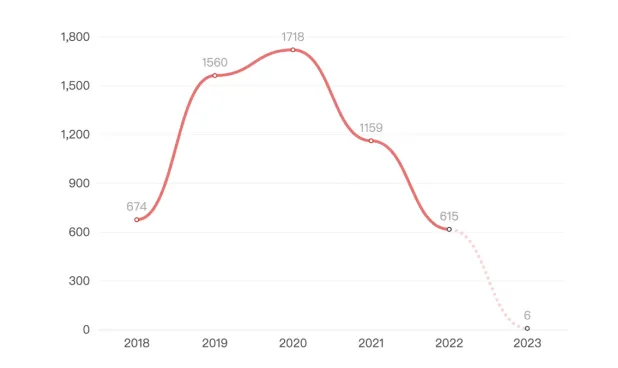
(Data sourced from Alpha)

02. From the Perspective of Industry Sources
These cases are mostly concentrated in manufacturing, leasing, and business services. Due to high employment pressure, high corporate management costs, and relatively smaller profit margins compared to other industries in these two sectors, low-cost, low-risk employment is their primary consideration.
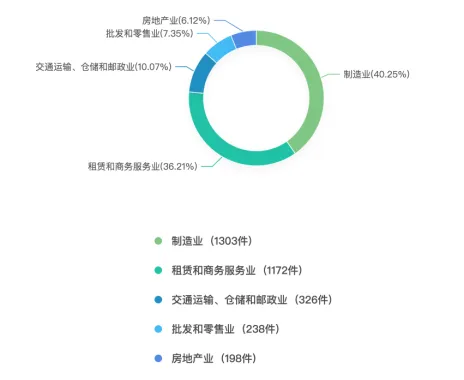
(Data sourced from Alpha)
03. From the Perspective of Trial Procedure
The proportion of second-instance cases is relatively high, indirectly reflecting intense conflicts between plaintiffs and defendants in these cases. Additionally, due to the lack of clear legal provisions on this issue, multiple opinions exist in practice, which is also one reason for the high second-instance rate.
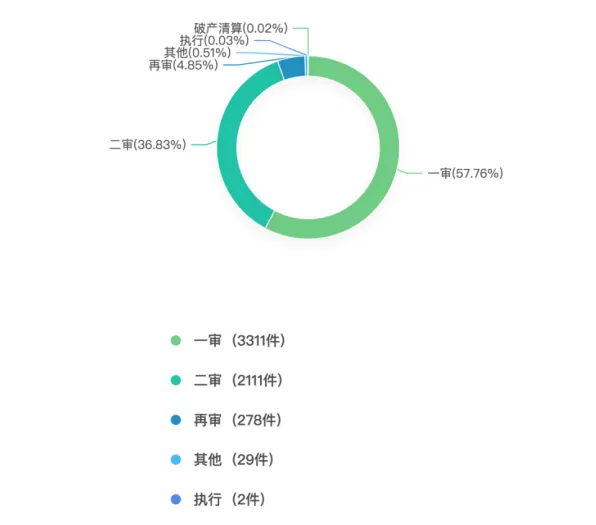
(Data sourced from Alpha)
04. From the Perspective of Second-Instance Modification Rate
Regarding second-instance judgments, cases where the original judgment was upheld account for 86.36%, while cases where the second-instance judgment modified the original account for 12.41%. This indicates that courts have formed relatively unified views on this issue internally, making the study of court judgments highly referential for handling such cases. The main points of contention in second-instance cases are: whether a labor relationship exists, i.e., the period of labor relationship existence; and the responsibility for payment of labor remuneration, economic compensation for termination of labor contracts, and work-related injury insurance benefits.
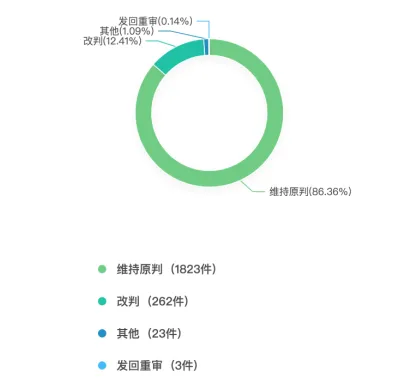
(Data sourced from Alpha)
05. Proportion of Judgments Deeming “Fake Outsourcing”
In labor outsourcing cases, judgments deeming “fake outsourcing” account for only 1.8%. Moreover, in all judgments deeming “fake outsourcing,” the point of contention was the legal characterization of whether the subject matter was labor outsourcing or labor dispatch, with no disputes over定性 of outsourcing labor versus other legal relationships.可见, the points of contention in such cases are relatively clear and单一, and case handling is not complex.
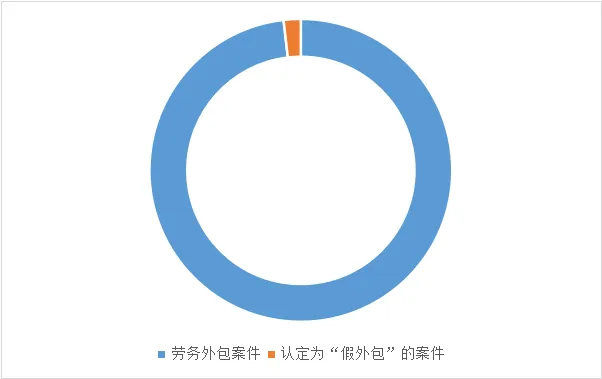
(Data sourced from Alpha)
Adjudication Opinions
Through studying judgments in such cases, the following judicial views are summarized:
(I) In labor relationships under labor contracts, substantive审查 based on subordination should be the standard, avoiding the influence of外观主义 on substantive legal relationship determination.
Where a contract is named a labor contract but contains substantive elements of a labor relationship, the existence of a labor relationship shall be determined by comprehensively assessing such subordination elements as the contracting parties, work content, remuneration payment method, and the employing entity’s control over the work process.
To reduce human resource costs, enterprises often sign agreements with practitioners in the name of “service agreements” or “cooperation agreements.” When determining whether a contract is a service agreement or a labor contract, courts should not simply rely on the name of the agreement but should conduct substantive审查 based on subordination elements, going beyond the agreement name to determine the actual employment relationship established between the parties. Among these,
the most核心 and difficult to determine is whether a subordination relationship exists.
In judicial practice, two aspects can be specifically considered:
1. Whether the employing entity has management provisions such as reward and punishment measures, entry and exit procedures, and business training to约束 practitioners. The above facts can directly serve as the basis for establishing a subordination relationship. However, with the development of network technology, the means by which employing entities control and manage practitioners have become more隐蔽 and complex, requiring comprehensive determination in conjunction with other facts;
2. The continuity of work, working hours, nature of wages, and whether the practitioner holds other兼职 jobs. These facts indicate to some extent the closeness of the relationship between the practitioner and the employing entity, and the degree of management接受, serving as auxiliary proof of subordination.
(See: Gu Moumou v. Zhejiang Waijie Deke Human Resources Service Co., Ltd., Hangzhou Youxing Technology Co., Ltd., et al., labor dispute case)
(II) Where an enterprise “contracts out” its business to another entity with labor dispatch qualifications, but workers of the “contracting” entity are managed and directed by the “contracting-out” enterprise, this shall be deemed labor dispatch.
Regarding whether management and direction by the “contracting-out” enterprise are accepted, the following should be examined:
1. Attribution of management and command authority: i.e., under whose management and direction the worker performs labor. This is the most core element. First, labor process management: whether matters related to working hours, rest periods, promotion, demotion, daily assessment, and punishment are managed by the contracting-out party or the contracting party. Second, labor discipline management: whether the right to manage labor discipline to maintain and ensure production and operation order belongs to the contracting-out party or the contracting party—i.e., whether workers need to comply with the contracting-out enterprise’s labor discipline or rules and regulations, including遵守 of daily work discipline (such as leave procedures, penalties for lateness and early departure), disciplinary penalties, and handling of labor relationships in cases of serious violation of rules. Third, business management: whether business volume, implementation methods, work content, and other business-related matters are managed by the contracting-out party or the contracting party. However, management by the contracting-out party based on safety production or work result quality control needs, as agreed in the contract, regarding safety production and product quality, is outside the scope of the above management command authority review.
2. Review of business independence: i.e., whether the contracting party is truly independent from the contracting-out party in executing the business. In genuine business outsourcing, the contracting company bears the costs of business processing itself; the contracting company has not only labor conditions but also production materials such as machinery, materials, professional knowledge, technology, and experience; the contracting party’s business scope should be related to its contracted business, and work locations are generally determined or controlled by the contracting party. In labor dispatch, the main work content of the dispatch entity is dispatching workers, so the dispatch entity has fewer technology and equipment requirements.
3. Review of payment method. First, review the party making payment. In business outsourcing legal relationships, the contracting-out party has no labor contract with workers and bears no obligation to pay remuneration. Workers’ remuneration is directly paid by the contracting party based on business performance. In labor dispatch legal relationships, overtime wages, performance bonuses, and other labor remuneration are paid by the actual employing unit. Some employing units may entrust the dispatch entity to pay on their behalf, but this does not affect the worker’s right to require the employing unit to bear such payment liability. Second, review the salary basis and payment method. In business outsourcing, the purpose is to deliver specific results or complete specific services, so workers’ remuneration is generally paid based on business completion, usually after contract performance, or flexibly based on business implementation. In labor dispatch relationships, the dispatch agreement targets labor resources, with salary calculation based on piecework or time rates, relatively fixed amounts, and generally regular periodic payment.
4. Review of contract subject matter. The purpose of a businesscontract is to complete specific business or deliver specific work results, common forms including agency, customization, processing contracting, etc., with the subject matter typically being goods, business, or projects. In labor dispatch relationships, the subject matter typically is labor. Notably, when using this standard for review,
not only the written agreement between enterprises should be examined, but also the actual contract performance circumstances.
(See: Huang Moujia v. Suzhou Guofeng Enterprise Outsourcing Service Co., Ltd., Nanjing Guoxuan Battery Co., Ltd., labor dispatch contract dispute case)
(III) Where platform enterprises or their cooperating labor outsourcing enterprises outsource specific labor to non-specific practitioners on a voluntary basis, without restricting whether practitioners participate in labor or when to provide labor, and without prohibiting practitioners from being employed by other platforms, and practitioners claim confirmation of a labor relationship, the People’s Court shall not support such claim.
Determination of the existence of a labor relationship should primarily consider:
-
The employer and worker meet the主体 qualifications prescribed by laws and regulations;
-
The various rules and regulations formulated by the employer according to law apply to the worker, and the worker is subject to the labor management of the employer and performs compensated labor arranged by the employer;
-
The labor provided by the worker is an integral part of the employer’s business.
(See: A Service Outsourcing Company v. Liu Mou, labor relationship dispute case)
Definition of “Fake Outsourcing, Real Dispatch”
“Fake outsourcing, real dispatch” means that although a company signs a labor outsourcing agreement with a contracting company, it actually employs workers according to the labor dispatch model—i.e., borrowing the name of labor outsourcing while thinking it has transferred risks, but in reality implementing labor dispatch, with actual control and management over workers, and conforming to the characteristics of labor dispatch. It should be deemed labor dispatch. If dispatched workers’ welfare benefits occur or the employing unit causes damage to dispatched workers, the employing unit shall bear joint and several compensation liability.
Boundary Between Genuine and Fake Outsourcing
(I) Differences Between Labor Outsourcing and Labor Dispatch
1. Different Subject Matters
The subject matter of business outsourcing is work results. The contractor completes business entrusted by the contracting-out party using its own equipment, technology, and labor, and delivers work results to the contracting-out party. The subject matter of labor dispatch is the workers’ labor.
2. Different Employment Management Subjects
The relationship between the contracting-out party and the contracting party is one of contract for work. The contracting-out party has no direct legal relationship with workers. The contracting party independently directs and commands workers to complete the entrusted business and provides necessary technical guidance. In labor dispatch, the employing unit directly exercises command and direction authority over dispatched workers.
3. Different Market Access Methods
The contracting party should have the corresponding business scope. The contractor should be a legal person, economic organization, or institution lawfully established with a business scope corresponding to the contracted business, such as production, processing, design, maintenance. The dispatch company must have the business scope of labor dispatch and a “Labor Dispatch Business Permit.” Entities operating labor dispatch business must apply to the labor administrative department for administrative licensing but need not have production, processing, design, or maintenance business scope.
4. Different Job Scope
Business outsourcing mainly targets部分 business or functional work of the contracting-out party. Labor dispatch can only be implemented in temporary, auxiliary, or替代 positions.
5. Different Legal Liability
In the legal nature between contracting-out and contracting parties, the contract for work primarily ensures civil rights and obligations such as delivery of business results and payment of remuneration between the contracting and contracting-out parties, applying the relevant provisions of the Civil Code on contracts for work. Under labor outsourcing, there are two sets of legal relationships: one is the contract for work relationship between the contracting-out party and the contracting party; the other is the contract for work relationship between the contracting party and workers. The contracting-out party has no direct legal relationship with workers. When damage is caused to workers, according to the relativity of contracts, liability can only be pursued against the contracting party based on the contract for work—the contracting-out party is not a proper defendant. In labor dispatch, the relationship between the employing unit and workers is governed by labor laws and regulations, not the civil and commercial principle of contract relativity. The employing unit bears labor safety guarantee obligations and obligations to pay overtime wages, performance wages, etc. If damage is caused to dispatched workers and the employing unit is at fault, it bears joint liability with the labor dispatch unit.
(II) Piercing the Veil of Fake Labor Outsourcing
In situations where labor outsourcing is in name but labor dispatch in substance, labor outsourcing is deemed a false expression of intent. The relationship between the parties is determined according to the true legal relationship, and shall be deemed a labor dispatch relationship. The employing unit shall bear relevant主体 liability. If damage is caused to dispatched workers, the labor dispatch unit and the employing unit bear joint and several compensation liability.
Conclusion
Enterprises can reduce employment costs and increase employment efficiency through legal and compliant labor outsourcing. However, when labor outsourcing conforms to the characteristics of labor dispatch, it is easily deemed labor dispatch. Therefore, when designing labor outsourcing plans, enterprises should clearly distinguish the boundary between genuine and fake outsourcing, avoiding labor outsourcing being clothed in the appearance of labor dispatch and thus being deemed labor dispatch.