
Contribution Liability of "Promoters" in Limited Liability Companies
Contribution Liability of "Promoters" in Limited Liability Companies
Attorney XIE Xin analyzes the concept and contribution liability of "promoters" (i.e., shareholders at the time of incorporation) in limited liability companies, pointing out that current judicial interpretations have expanded the joint liability of promoters for capital contributions to shareholders at the time of incorporation of limited liability companies. The article focuses on clarifying four major practical difficulties: First, clarifying that "failure to perform or fully perform capital contribution obligations" refers to failure to pay the full amount of the capital contribution agreed in the articles of association on time. Non-payment before the contribution deadline does not constitute this circumstance. Second, defining that "accelerated maturity of capital contributions" only applies to statutory or specific circumstances such as bankruptcy or dissolution, with the liable subject limited to current shareholders, and generally does not trigger the joint liability of other promoters. Third, analyzing the liability of original promoters after equity transfer—transferring after the contribution deadline has passed requires liability; for transfers before the deadline, the mainstream view is that the contribution obligation transfers with the equity, unless there is malicious debt evasion. Fourth, clarifying the liability boundaries after company capital reduction/increase—for capital reduction without properly notifying creditors, promoters are liable to the extent of their pre-reduction subscribed capital; for capital increase defects, liability only arises for debts incurred after registration, and other promoters generally do not bear joint liability. This article, through relevant legal provisions and typical cases, provides clear thinking for judicial adjudication.
This article addresses the concept and corresponding contribution liability of the “promoter” status in limited liability companies. Through sorting and analyzing legal provisions and cases, it summarizes and explains several understanding differences or identification difficulties existing in practice, providing views and ideas in the hope of benefiting readers.
The concept of “promoter” in the current Company Law legislation is only found in the relevant provisions on joint stock limited companies, referring to those who, in accordance with relevant legal provisions, conclude a promoter agreement, file a company incorporation application, subscribe for company shares, and bear responsibility for the company’s incorporation. However, Article 1 of Judicial Interpretation (III) of the Company Law extends this concept to limited liability companies. When referring to “promoters” of a limited liability company, it specifically means “shareholders at the time of the company’s incorporation.” Article 13(3) extends the joint contribution liability that originally applied to “promoters” of joint stock limited companies due to their special status to shareholders at the time of incorporation of limited liability companies.
Before the promulgation of Judicial Interpretation (III) of the Company Law, the provisions on promoters’ joint contribution liability were found in Articles 93 and 30 of the Company Law and Article 22(2) of Judicial Interpretation (II) of the Company Law. Article 93 of the Company Law provides that promoters of a joint stock limited company bear joint liability for making up shortfalls in monetary/non-monetary capital contributions. For limited liability companies, Article 30 of the Company Law only provides that shareholders making non-monetary capital contributions at the time of incorporation bear responsibility for making up shortfalls arising from defects in such non-monetary property contributions, and other shareholders at the time of incorporation bear joint liability for making up such shortfalls. However, there is no corresponding provision for monetary capital contributions. Article 22 of Judicial Interpretation (II) of the Company Law provides that when a company undergoes bankruptcy liquidation, other shareholders or promoters at the time of incorporation shall bear joint and several liability for the company’s unsatisfied debts to the extent of the unpaid capital contributions. Here, “shareholders at the time of incorporation” and “promoters” respectively refer to shareholders at the time of incorporation of limited liability companies and joint stock limited companies, but they bear the same type of obligation. Judicial Interpretation (III) of the Company Law has actually expanded the scope of liable subjects by integrating the concept of “promoters” and the corresponding joint contribution liability.
Under the current legal framework, the contribution liability that “promoters” of a limited liability company may bear includes: (1) paying capital contributions in full to the company; (2) bearing liability for breach of contract to shareholders who have paid their capital contributions in full and on time in the event of failure to pay capital contributions on time and in full; (3) bearing supplementary liability to the company’s creditors for debts that the company cannot satisfy; (4) bearing joint liability when there are shareholders who have failed to fulfill their capital contribution obligations. Items (1), (2), and (3) apply where the “promoter” itself is a shareholder who has failed to fulfill its capital contribution obligation, while item (4) applies where there are other shareholders at the time of incorporation who have failed to fulfill their capital contribution obligations.
The determination of contribution liability is mainly determined in law by two factors: first, whether the contribution period stipulated in the articles of association has expired; second, whether there are circumstances of accelerated maturity of capital contributions. However, since companies often undergo changes such as equity transfers, capital increases, and capital reductions during their存续, the subject and scope of contribution liability become more complex in judicial determination. This article aims to clarify four practical issues through the sorting and explanation of relevant legal provisions and cases: First, how to understand “failure to perform or fully perform capital contribution obligations”? Second, how does “accelerated maturity of capital contributions” apply? Third, after an equity transfer, does the former shareholder (promoter) still bear contribution liability? Fourth, the scope of contribution liability of promoters after company capital reduction/increase.
I. How to Understand “Failure to Perform or Fully Perform Capital Contribution Obligations”?
Judicial Interpretation (III) of the Company Law uses “failure to perform or fully perform capital contribution obligations” as the prerequisite for a shareholder to bear contribution liability. How to understand “failure to perform or fully perform capital contribution obligations” determines whether the relevant provisions can be correctly applied. The 2013 revision of the Company Law changed most companies’ registered capital from a “paid-in” system to a “subscription” system. Company shareholders can independently agree on the amount, method, and期限 of subscribed capital contributions in the articles of association. Before the subscription period expires, shareholders enjoy the benefit of the期限 for capital contribution. Therefore, for companies applying the “subscription” system, “failure to perform or fully perform capital contribution obligations” as referred to in Judicial Interpretation (III) of the Company Law, i.e., “failure to fulfill capital contribution obligations,” should be understood as “failure to pay the full amount of the subscribed capital contribution agreed in the company’s articles of association on time and in full.” This specifically includes: false capital contribution, insufficient capital contribution, fictitious capital contribution, and抽逃 capital contribution. However, before the subscription period expires, if a shareholder has not fully paid in its capital contribution share, it should not be deemed as “failure to perform or fully perform capital contribution obligations.” In such circumstances, the application conditions of Articles 13 and 18 of Judicial Interpretation (III) of the Company Law are not satisfied [see (2021) Yue 03 Min Zhong No. 30835].
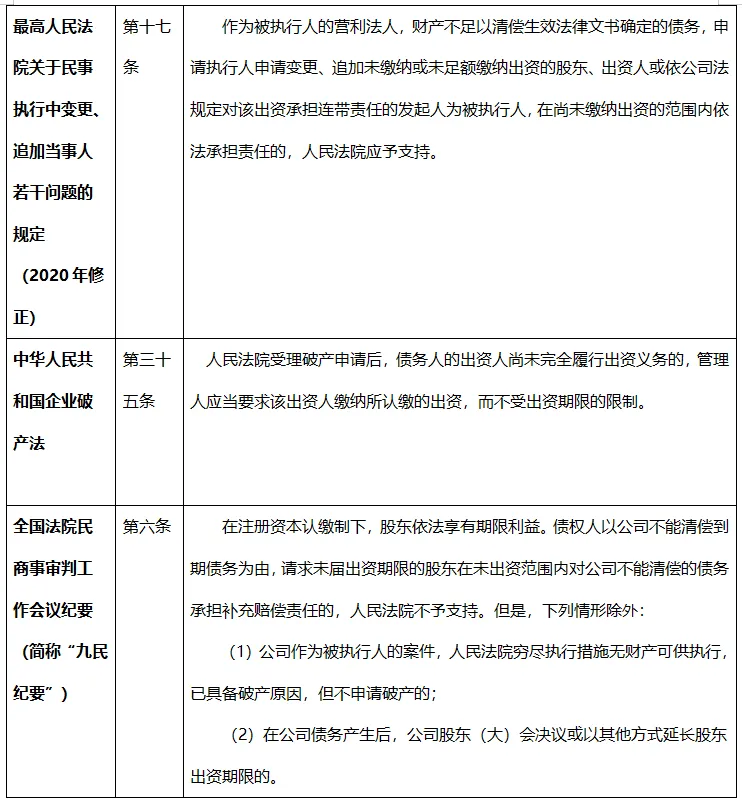
Similarly, “shareholders who have not paid or have not fully paid their capital contributions” under Article 17 of the “Provisions of the Supreme People’s Court on Several Issues Concerning Changes and Additions of Parties in Civil Enforcement” are limited to “shareholders who have not paid the full amount of their subscribed capital contributions on time,” excluding “shareholders whose subscription period has not yet expired and who have not fully paid their subscribed capital contribution shares” [see (2020) Zui Gao Fa Min Shen No. 4443].
In practice, some parties believe that as long as there is a situation where a shareholder has not fully paid its capital contribution, creditors have the right to invoke Article 13 of Judicial Interpretation (III) of the Company Law to claim supplementary liability from the shareholder who has not fully paid its capital contribution and joint liability from other promoters, regardless of whether the shareholder’s contribution period has expired. Some judgments have also adopted this view. This approach fails to correctly understand the true meaning of “failure to perform or fully perform capital contribution obligations” and constitutes an incorrect application of the law.
II. How Does “Accelerated Maturity of Capital Contributions” Apply?
There are two situations in laws and judicial interpretations where “accelerated maturity of capital contributions” applies. Article 35 of the Enterprise Bankruptcy Law: “After the people’s court accepts a bankruptcy application, where the debtor’s capital contributor has not fully performed its capital contribution obligation, the administrator shall require that capital contributor to pay the subscribed capital contribution, without being limited by the contribution period.” Article 22(1) of Judicial Interpretation (II) of the Company Law: “When a company is dissolved, the capital contributions not yet paid by shareholders shall all be included in the liquidation assets. Capital contributions not yet paid by shareholders include contributions that are due but unpaid, as well as contributions that are分期 payable but whose payment period has not yet expired under Articles 26 and 81 of the Company Law.” The entry of a company into bankruptcy proceedings and the conduct of settlement liquidation are two statutory circumstances for applying “accelerated maturity of capital contributions.” The effect is that shareholders lose the benefit of the contribution period and must fulfill their capital contribution obligations before the period agreed in the articles of association expires.
Article 6 of the “Minutes of the National Courts Civil and Commercial Adjudication Work Conference” (hereinafter “Minutes”) published in 2019 proposed two additional special circumstances where accelerated maturity of capital contributions can also apply as guidance: (1) In cases where the company is the person subject to enforcement, where the people’s court has exhausted enforcement measures but the company has no property available for execution and already meets the conditions for bankruptcy but has not applied for bankruptcy; (2) Where, after the company’s debt arises, the company’s shareholders’ (general) meeting resolves or otherwise extends the shareholders’ capital contribution period.
Two points should be noted when applying “accelerated maturity of capital contributions” to claim shareholders’ contribution liability:
First, after an equity transfer, the subject of “accelerated maturity of capital contributions” is the “current shareholder” and should not be arbitrarily expanded to former shareholders [see (2021) Yue 0115 Min Chu No. 5937, (2020) Jing 0105 Min Chu No. 59345]. Second, “accelerated maturity of capital contributions” is a contribution liability arising from legal provisions, different from the contribution liability arising from “failure to pay the full amount of the subscribed capital contribution stipulated in the company’s articles of association on time.” The provisions of Article 13 of Judicial Interpretation (III) of the Company Law should not apply to situations of “accelerated maturity of capital contributions” [see (2021) Hu 0120 Min Chu No. 13420].
A question arising from the second point is: Under the circumstances of “accelerated maturity of capital contributions,” can the joint contribution liability of “promoters” be claimed? Article 178(3) of the Civil Code provides that “joint liability shall be imposed by law or agreed by the parties.” Among the four circumstances for applying “accelerated maturity of capital contributions,” only Article 22(2) of Judicial Interpretation (II) of the Company Law, in the context of “dissolution and liquidation,” explicitly provides for the joint liability of “other shareholders or promoters at the time of incorporation.” Neither Article 35 of the Enterprise Bankruptcy Law nor Article 6 of the Minutes mention the joint liability of “promoters.” Therefore, under the other three circumstances of “accelerated maturity of capital contributions,” the resulting contribution liability should be limited to “paying capital contributions in full to the company in advance” or “bearing supplementary liability to the company’s creditors for debts that the company cannot satisfy,” while claiming joint contribution liability from other “promoters” currently lacks legal basis.
III. Whether Promoters as Former Shareholders Still Bear
Contribution Liability After Equity Transfer
Situation 1: The contribution period has expired. If a promoter transfers equity without fulfilling its capital contribution obligation after the contribution period has expired, according to Articles 13 and 18 of Judicial Interpretation (III) of the Company Law, the transferor bears contribution liability, and other promoters bear joint contribution liability. If the transferee knew or should have known about this, they shall bear joint liability. See the diagram below for details:
Situation 2: The contribution period has not expired. If a promoter transfers all equity without having fully paid its capital contribution before the contribution period expires, there are inconsistent standards in judicial practice regarding whether the promoter (as the transferor) still bears contribution liability.
Mainstream view: In the absence of “malicious” equity transfer to evade debts, where the contribution period has not expired, a shareholder transferring equity without fully paying its capital contribution does not violate the company’s articles of association or legal provisions and does not constitute a failure to fulfill the capital contribution obligation after the contribution period has expired. After the equity transfer, the contribution obligation transfers accordingly, and the former shareholder should no longer bear contribution liability to the company.
[See (2020) Chuan 0193 Min Chu No. 11968, (2021) Yue 03 Min Zhong No. 30835, (2020) Jing 0105 Min Chu No. 59345, (2021) Hu 0115 Min Chu No. 9398]
Case
Scroll down to view the case
(2020) Jing 0105 Min Chu No. 59345 Zhang Yuan v. Wang Rui et al. Dispute over Liability for Damage to Company Creditors by Shareholders
Basic Facts and Claims: Zhang Yuan held a claim of RMB 697,560 against Blue Dream Company based on the (2018) Jing 0105 Min Chu No. 28323 civil judgment (second-instance judgment on June 11, 2018, affirming the original judgment). Upon enforcement, Blue Dream Company had no property available for execution. Zhang Yuan believed that Wang Rui, Yu Zhentao, Yu Zhenhai, and Zhang Shuangxi, as shareholders of Blue Dream Company, failed to fulfill their capital contribution obligations, and during the trial of the above case, Blue Dream Company shareholder Yu Zhenhai transferred his equity to Zhang Shuangxi while changing the legal representative and registered address, constituting malicious debt evasion. Zhang Yuan sued, requesting: (1) Wang Rui, within the range of RMB 100,000 capital contribution, Yu Zhentao, within RMB 100,000, Yu Zhenhai, within RMB 900,000, and Zhang Shuangxi, within RMB 1,000,000, to bear supplementary liability for the penalty of RMB 697,560 and delayed performance interest determined by the (2018) Jing 0105 Min Chu No. 28323 judgment to be paid by Blue Dream Company to Zhang Yuan; (2) Wang Rui, Yu Zhentao, Yu Zhenhai, and Zhang Shuangxi to bear joint and several liability for the above debts.
The court found: Blue Dream Company was established on November 4, 2016, with a registered capital of RMB 1 million. The shareholders and capital contributions were: Wang Rui subscribed RMB 100,000, with the contribution period ending October 17, 2035; Yu Zhenhai subscribed RMB 900,000, with the contribution period ending October 17, 2035. Blue Dream Company underwent three shareholder registration changes on February 4, 2017, and May 24, 2018. After the first change, the shareholders and contributions were: Yu Zhenhai RMB 900,000, Yu Zhentao RMB 100,000. After the second change: Zhang Shuangxi, subscribed RMB 1 million, contribution period December 31, 2022. Blue Dream Company currently remains in存续 status.
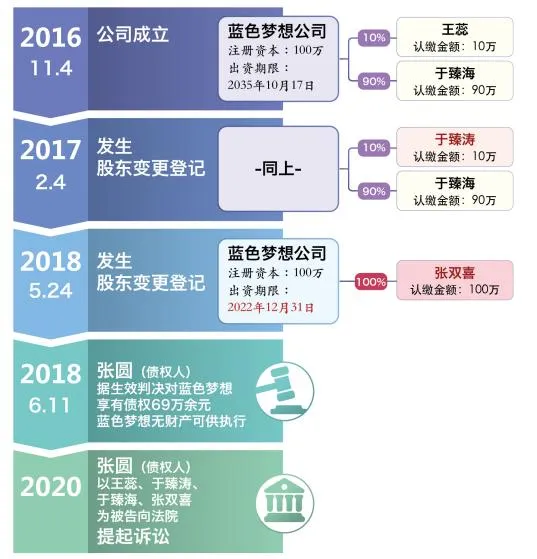
Disputed Focus: Whether former shareholders Yu Zhenhai, Yu Zhentao, and Wang Rui of Blue Dream Company need to bear supplementary liability within the range of unpaid capital contributions for Blue Dream Company’s debts.
Adjudicative View: While Yu Zhenhai, Yu Zhentao, and Wang Rui served as shareholders of Blue Dream Company, the company did not experience the situation under Article 6 of the Minutes—“where the company, as the person subject to enforcement, has exhausted enforcement measures but has no property available for execution, already meets the conditions for bankruptcy but has not applied for bankruptcy.” Moreover, the contribution periods for Yu Zhenhai, Yu Zhentao, and Wang Rui were all October 17, 2035. When Yu Zhenhai transferred equity to Zhang Shuangxi, his contribution period had not yet expired. This did not meet the circumstances of “failure to perform or fully perform capital contribution obligations” under Article 13(3), (4), and Article 18(1) of Judicial Interpretation (III) of the Company Law. Therefore, Zhang Yuan’s request for Yu Zhenhai, Yu Zhentao, and Wang Rui to bear supplementary liability for Blue Dream Company’s debts lacked legal basis and was not supported by this court.
Case Analysis: The court in this case adhered to the principle that under the registered capital subscription system, shareholders enjoy the benefit of the contribution period according to law. It held that failure to pay capital contributions before the contribution period expires does not constitute “failure to perform or fully perform capital contribution obligations,” correctly interpreting and applying Articles 13 and 18 of Judicial Interpretation (III) of the Company Law. Regarding the application of “accelerated maturity of capital contributions,” the court strictly defined the scope of liable subjects, reflecting the general principle that “accelerated maturity of capital contributions” only applies to current shareholders and does not retroactively affect former shareholders.
Based on the above, since former shareholders Yu Zhenhai, Yu Zhentao, and Wang Rui did not have “failure to perform or fully perform capital contribution obligations” during their tenure as shareholders, and no “accelerated maturity of capital contributions” occurred, the court ultimately determined that the former shareholders of Blue Dream Company did not need to bear contribution liability. This judgment essentially reflects the view that “after an equity transfer, the former shareholder’s contribution obligation transfers accordingly, and the former shareholder no longer needs to bear contribution liability to the company.”
Minority view: Capital contribution is a statutory obligation and mandatory responsibility of shareholders. If a shareholder transfers equity before the contribution period expires, the obligation to perform the capital contribution does not automatically transfer with the equity. A shareholder transferring equity before the contribution period expires is deemed as “anticipatory breach” of the contribution obligation and should bear contribution liability.
[See (2021) Chuan 01 Min Zhong No. 15200, (2019) Xiang 01 Min Zhong No. 9052]
Case
Scroll down to view the case
(2021) Chuan 01 Min Zhong No. 15200 Yang Xiaodong, Sichuan Xiang’an Transportation Co., Ltd., et al. Shareholder Capital Contribution Dispute
Basic Facts and Claims: Xiang’an Company was registered and established on March 11, 2011, with shareholders Yang Xiaodong and Dong Lifeng, registered capital of RMB 1 million fully paid in. On October 20, 2016, Xiang’an Company passed a shareholders’ resolution to increase registered capital to RMB 8 million. The newly increased registered capital of RMB 7 million was subscribed by Yang Xiaodong, with the contribution method being monetary and the subscription period ending October 28, 2048. The company’s articles of association were amended accordingly. On May 19, 2017, Yang Xiaodong transferred all his equity in Xiang’an Company (RMB 7.8 million) to Yang Anguo (father-son relationship) and signed an “Equity Transfer Agreement.” The equity transfer was approved by a shareholders’ resolution.
On October 30, 2015, a vehicle carrying goods for Xiang’an Company was involved in a traffic accident. Ping An Insurance Sichuan Branch paid insurance compensation of RMB 2.4 million to the consignor on May 25, 2016. On March 23, 2018, Ping An Insurance Sichuan Branch filed a subrogation claim. On June 15, 2018, the first-instance court issued judgment (2018) Chuan 0114 Min Chu No. 2616, ordering Xiang’an Company to pay Ping An Insurance Sichuan Branch RMB 2.4 million for cargo transportation losses within the effective period of the judgment. On January 5, 2021, Ping An Insurance Sichuan Branch applied to the court for bankruptcy liquidation of Xiang’an Company on the grounds that Xiang’an Company could not pay its due debts and its assets were insufficient to cover all debts. On January 27, 2021, the first-instance court issued a civil ruling (2021) Chuan 0114 Po Shen No. 1, accepting the bankruptcy liquidation application against Xiang’an Company.
Xiang’an Company, on the grounds that the company had entered bankruptcy liquidation proceedings and the subscription period for equity capital contributions had accelerated, sued, requesting: (1) Yang Xiaodong to immediately pay RMB 7 million in capital contributions to Xiang’an Company; (2) Yang Anguo to bear joint liability for Yang Xiaodong’s payment of RMB 7 million in capital contributions.
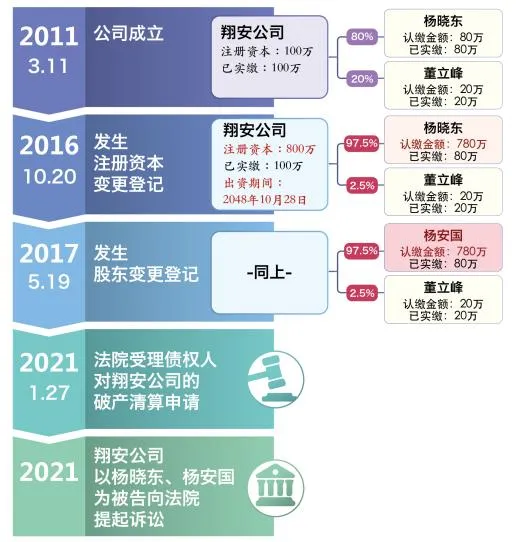
Disputed Focus: Whether Yang Xiaodong should fulfill his capital contribution obligation to Xiang’an Company after the equity transfer, given that the contribution period had not expired at the time of transfer.
Adjudicative View: The original shareholder’s capital contribution obligation is not免除 by equity transfer. When the subscribed contribution period expires or accelerates, the original shareholder must still fulfill the statutory obligation to contribute to the company.
(1) The original shareholder’s obligation to contribute to the company is a statutory obligation that must be fulfilled and cannot be deemed to transfer with the equity transfer contract as with contractual obligations.
(2) Before the subscribed contribution period expires, the original shareholder still bears the obligation to contribute to the company, merely enjoying the benefit of the period. Transferring equity before fulfilling the capital contribution obligation constitutes anticipatory breach of the company and should bear corresponding liability for breach, which includes the obligation to continue performing the capital contribution.
(3) When the subscribed contribution period expires or accelerates, the company has the right to require the original shareholder to fulfill the capital contribution obligation, even if the equity was transferred before the period expired.
(4) According to Article 22(2) of Judicial Interpretation (II) of the Company Law and Article 13(3) of Judicial Interpretation (III), when the subscribed contribution period expires or accelerates, other promoter shareholders shall bear joint liability for the capital contribution obligation of that shareholder. By the rule of “a fortiori,” the original shareholder corresponding to the unpaid capital contribution equity should be even more obliged to fulfill the capital contribution obligation.
(5) The original shareholder bears civil liability for ensuring the company’s capital adequacy, and the capital contribution obligation cannot be免除 by equity transfer. Otherwise, this would encourage original shareholders to transfer equity to civil subjects lacking performance capacity to evade legal liability, harming social credit systems and market order, and damaging the interests of the company and its creditors.
Case Analysis: The court in this case ordered Xiang’an Company’s promoter (original shareholder) Yang Xiaodong to directly bear the capital contribution obligation to the company even after transferring his equity. To support the judgment, the judge provided detailed explanations through the theories of “capital contribution as a statutory obligation,” “capital adequacy liability,” “anticipatory breach,” “a fortiori of other promoters’ joint contribution liability,” and “malicious equity transfer.” In practice, there are other judgments based on the view that “the promoter’s subscribed capital contribution obligation forms a credit guarantee for creditors of the company, and this guarantee obligation is included in the capital contribution obligation and transfers with the equity. However, if the transfer does not obtain creditor consent, the transferor should bear joint contribution liability” to determine the former shareholder’s contribution liability after equity transfer [see (2021) Lu 01 Min Zhong No. 2656].
Through sorting such judgments, we found that cases where courts determined that promoters (as former shareholders) still need to bear contribution liability after transferring equity before the contribution period expires often involve suspicion of “malicious” equity transfer to evade debts to varying degrees. Examples include: the transferee shareholder having weak ability to perform the capital contribution obligation, the equity transfer occurring during the company’s involvement in litigation/enforcement, the former shareholder transferring equity at a significantly low price, or the transferee shareholder not actually paying consideration. Possibly based on considerations of substantive justice and侧重 protecting the company or its creditors, the courts adopted the above view. However, because this view does not align with common social experience and may increase uncertainty and risk in commercial conduct, it should not become the mainstream view.
IV. Scope of Promoters’ Contribution Liability After Company Capital Reduction/Increase
Where a limited liability company undergoes capital reduction or increase, the determination of promoters’ contribution liability and the method of bearing such liability should follow general standards. However, in the following two situations, there are special characteristics regarding the scope of liability, which are further explained below with case examples.
(I) Where the company fails to properly notify creditors during capital reduction, promoters shall still bear liability within the range of their subscribed capital before the reduction for debts incurred before the reduction.
In the case (2021) Hu 0151 Min Chu No. 554, Li Sihua v. Shanghai Hongtao Construction Development Co., Ltd., Chen Jianguo (Dispute over Liability for Damage to Company Creditors by Shareholders), Hongtao Chizhou Company underwent capital reduction after forming a debt relationship with Li Sihua, but the company did not notify creditor Li Sihua of the capital reduction. Later, because the company’s assets were insufficient to pay due debts and the promoters had not paid their capital contributions on time, Li Sihua sued the promoters of Hongtao Chizhou Company, claiming the promoters’ contribution liability (supplementary liability and joint contribution liability). The court ultimately ordered each promoter of Hongtao Chizhou Company to bear supplementary liability to the extent of their subscribed capital before the reduction for the company’s unsatisfied debts and to bear joint and several liability among themselves.
Article 177 of the Company Law provides: When a company needs to reduce its registered capital, it must prepare a balance sheet and a list of assets. The company shall, within 10 days from the date of the resolution to reduce capital, notify creditors and shall, within 30 days, publish a public announcement in a newspaper. Creditors have the right, within 30 days from receipt of the notice (or within 45 days from the announcement for those who did not receive notice), to request the company to repay debts or provide corresponding guarantees.
Although the Company Law requires companies to properly fulfill their notification obligations when handling capital reduction procedures, the legal consequences of failing to fulfill the notification obligation are not clearly specified. Theoretically, where shareholders, knowing that the company has outstanding external debts, still同意 to reduce the company’s registered capital, their subjective intent may involve evasion of debt. Objectively, as shareholders, their capital share decreases after the reduction, and they obtain property benefits from the reduction. For the company, the capital reduction substantially affects its actual solvency, and shareholders may bear legal liability as a result. Therefore, if the company’s capital reduction is defective, in practice, it is generally determined that for debts incurred before the capital reduction, creditors have the right to require the company’s shareholders to bear supplementary liability for the part of the company’s debts that cannot be satisfied, to the extent of their subscribed capital before the reduction.
(II) Where the company increases capital and a promoter fails to pay the increased capital contribution on time, can the company’s creditors claim contribution liability from the promoter for debts incurred before the capital increase on the grounds of “failure to perform or fully perform capital contribution obligations”?
The Supreme People’s Court issued a “Reply on Whether Shareholders Should Be Liable to Company Creditors for Capital Increase Defects After Company Incorporation” to the Jiangsu High Court in 2003 (〔2003〕Zhi Ta Zi No. 33), establishing two standards: (1) Where original shareholders agree to bear the capital increase obligation according to their original capital contribution比例, this is no different from initial capital contributions at incorporation. If a shareholder has defects in the capital increase, they should bear the same liability as for defects in capital contributions at incorporation. (2) A shareholder’s defective capital increase act only gives rise to liability to the company’s creditors for debts incurred after the capital increase registration; for debts incurred before the capital increase registration, creditors cannot claim contribution liability from the relevant shareholders on the grounds that the shareholders failed to fulfill their capital increase obligations.
The question arising from standard (1) is: Where a promoter of a limited liability company has defective capital increase, do other promoters need to bear joint contribution liability for this? The author’s view is: No. First, the “Reply” was written before Judicial Interpretations (II) and (III) of the Company Law, i.e., at a time when there were no provisions requiring “promoters” of limited liability companies to bear “joint contribution liability” for monetary capital contributions. For non-monetary capital contributions, although there were provisions for promoters to bear joint liability for making up shortfalls, this was limited to “non-monetary property contributed at incorporation,” excluding situations of capital increase with non-monetary assets. Second, Article 13(3) of Judicial Interpretation (III) of the Company Law on promoters’ “joint contribution liability” applies only where “a shareholder fails to perform or fully perform capital contribution obligations at the time of incorporation,” not where “a shareholder fails to perform or fully perform capital contribution obligations at the time of capital increase.” Since company incorporation requires consensus among all promoters, each promoter should exercise a high and sufficient degree of duty. Therefore, it is appropriate for the judicial interpretation to provide that creditors can request promoters to bear joint liability. However, capital increase does not necessarily require unanimous consent from all shareholders, and shareholders who disagree with the capital increase should not be required to bear joint liability. Therefore, the judicial interpretation’s failure to provide for “joint contribution liability” for defective capital increase is reasonable.
According to standard (2), if a shareholder only fails to pay the increased capital contribution on time, the company’s creditors cannot claim supplementary liability or joint and several liability from the relevant shareholder for debts incurred before the capital increase on the grounds that the shareholder “failed to perform or fully perform capital contribution obligations.” It should be emphasized that the “capital increase” here should be measured by the completion of “capital increase registration.” If it is only claimed that debts arose after the capital increase on the grounds that “the company has formed a shareholders’ resolution on the capital increase and adopted amended articles of association,” the adjudicative body may not support this, because the capital increase only produces external publicity effect upon registration.
[See (2021) Zui Gao Fa Min Shen No. 3538, (2017) Yue 03 Min Zhong No. 9806]