
Film Investment: Investor Risks and Practical Analysis
Film Investment: Investor Risks and Practical Analysis
China's film industry has rebounded strongly after the pandemic, with box office revenues reaching new heights and diverse investment models emerging. However, film investment remains a high-risk field. This article focuses on analyzing practical investment risks: investors need to understand box office revenue-sharing rules and clarify the net box office distribution mechanism; verify project registration information through the National Film Administration website, review the completeness of the investment rights chain, and guard against fraudulent projects; carefully distinguish between sole and joint investment, be wary of fixed-return models that are "investments in name but loans in substance," and the capital risks of multi-layer resale of shares; and in cases of illegal fundraising or contract fraud, preserve evidence in accordance with law and seek police reports or judicial remedies. It is recommended that investors rely on正规 channels, strictly review contract terms and subject qualifications, and maintain a rational and prudent investment attitude.
The development of China’s film industry is an epic saga of ups and downs, carrying the变迁 of social economy and cultural evolution, and witnessing social changes. Film development has gone through state capital to private capital, then to commercial blockbusters and the Internet+ era. Chinese domestic films continue to innovate and achieve frequent successes. In an era where investment increasingly values the unity of economic and social benefits, Chinese film, as a sweet spot for future investment, is bound to trigger a new wave of investment enthusiasm. This article briefly analyzes potential investor risks in the film investment process based on practical situations and launches a series of articles.
I. Recent Film Development
(A) In recent years, China’s film industry has traversed a崎岖 development path. The period from 2016 to 2018 even sparked an investment boom. However, just as Chinese film was gathering momentum and about to enter a period of rapid development, it suffered a “heavy blow” from the COVID-19 pandemic. In the first half of 2020, the development of Chinese cinema entered a period of stagnation and was forced to press the “pause button.” After the relaxation of national pandemic prevention and control measures in 2023, cinemas reopened across the country. Fortunately, the pandemic did not affect the public’s enthusiasm for watching films, and the film industry staged a strong recovery, with rapid momentum compared with other industries.
(B) Since this year, the film industry has regained its vitality, mainly reflected in the following aspects:
1. Explosive growth in box office revenue, with the total number of screens nationwide approaching 80,000, and box office records being constantly刷新. According to publicly available data, the 2023 Spring Festival period (January) box office exceeded RMB 10 billion. The summer period (June 1 to August 31) generated a total box office of RMB 20.619 billion, with 505 million admissions. Domestic films accounted for 87.58% of the box office market share. All three sets of data broke historical records.
2. Diversification of film genres and explosive growth of domestic films. The most important factor in the development of the film industry is the work itself. With economic and social development, audience preferences have undergone significant changes. Capturing current audience preferences is one of the most important considerations for box office success. As domestic films develop to the present day, films that tell Chinese stories and establish emotional connections with the audience generally achieve good box office results. Currently, domestic film genres are no longer limited to historical, sci-fi, war, animation, emotional, and ethical themes. They have also integrated realistic themes, livelihood issues, and social热点 topics, responding to the needs of the times and touching audiences’ hearts. Facts have shown that under the trend of diversification of domestic film genres, the quality of the film is one of the most important factors in attracting audiences. In the long run, how much market share domestic films can ultimately stably occupy in the domestic market also depends on the quality of the works.
3. Diversification of production entities and investment methods. Thanks to policy support and the openness of the market economy, as well as the emergence of online movies and micro-movies, especially changes in streaming media, the film investment model has undergone significant changes. Investment thresholds have become relatively lower, and channels for the public to participate in film investment have become highly diversified. In recent years, some major production companies that were originally financially strong and领先 in strength have become less flexible and dynamic in terms of subject matter selection and post-production compared with some small film production companies and emerging directors in the current film market, resulting in declining competitiveness. Although small film production companies and emerging directors’ products are well-received in the market, constrained by the high requirements for human, material, and financial resources in film production, this必然 leads to situations where multiple co-producers collaborate, drawing the attention of both corporate and individual investors to this field.
II. Practical Risk Warnings for Film Investment
In recent years, the emergence of online movies and micro-movies, especially changes in streaming media, has led to the gradual establishment and improvement of government regulatory rules for streaming media films. This article’s analysis of practical risks in film investment only discusses big-screen films. A series of practical analysis articles on streaming media films will follow. The returns on film investment differ from other investment products. As a rational investor, one must first clarify the principal, the proportion of investment returns, and the investment sharing model; second, invest through正规 and safe investment channels; and finally, adopt a cautious and rational investment attitude, carefully reviewing contract terms.
(A) Chinese Film Box Office Revenue-Sharing System
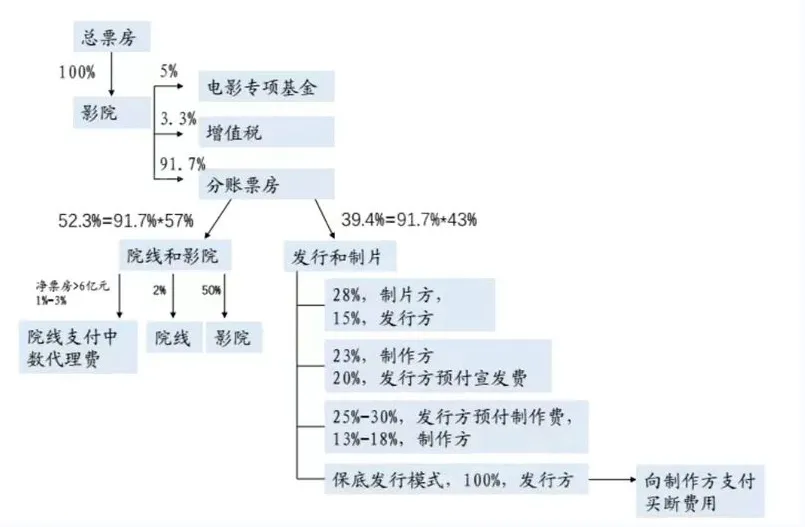
Generally speaking, Chinese film box office revenue can be divided into shareable box office and non-shareable box office, mainly distinguished as follows:
Non-shareable box office refers to all films screened in Mainland China—whether domestic, co-produced, or imported—which must first pay 3.3% of the total box office as special business tax (during the pandemic, the Ministry of Finance and the State Taxation Administration issued relevant policies exempting screening service enterprises from VAT in 2020) and 5% of the total box office as the film industry special fund.
Shareable box office, commonly known as “net box office,” refers to the portion remaining after deducting non-shareable box office from the total box office. It is generally divided as follows: 1. Theater chain distribution (generally 7%); 2. Cinema distribution (generally not exceeding 50%); 3. Producer and distributor distribution (principally not less than 43%, with China Film agency fees of 1%-3%).
As shown in the diagram below:
When participating in film investment, investors should first clarify the investment matter, then clarify the investment share. In通俗 terms, the proportion of film shares invested does not mean that the corresponding proportion of box office revenue represents the investor’s return. Before signing a contract, investors should clarify the film project being invested in, the investment share, the method of income distribution, the distribution base, cost items, and other terms. If the contract terms are unclear, or if no supplemental agreement is reached on factors affecting distribution afterwards, disputes may arise.
(B) Qualification Chain Review and Verification of Subject Eligibility
First, according to Article 13 of the Film Industry Promotion Law, “Legal persons and other organizations planning to produce films shall file the film script synopsis with the film主管部门 of the State Council or the film主管部门 of the province, autonomous region, or municipality directly under the Central Government; if the film script synopsis or script meets the provisions of Article 16 of this Law, the film主管部门 of the State Council shall publish the basic information of the film to be produced and issue a filing certificate or approval document.” To determine whether the proposed film investment project actually exists, investors can check the project’s filing information on the official website of the “National Film Administration.” The published content generally includes the film category, filing number, title, filing entity, screenwriter, filing result, and synopsis. This step can directly避免 falling into the trap of a “fake project.”
Second, check whether the proposed (co- or transferee) investor’s qualification is indicated on the film project’s script synopsis filing, project establishment documents, and public screening permit. Participants in the investment phase of a film project include multiple parties. Before signing a contract, investors should fully understand the qualifications of the main producer, the project filing status, the arrangements for priority recovery of returns among different investors, and the compensation arrangements for key creative personnel. Especially under multi-layer investment rights, the rights holder selling part of the film project’s rights may have obtained their investment rights from other entities, resulting in multiple layers of investment rights, making it difficult for investors at the end of the investment transaction chain to timely understand the progress and status of the film project, increasing the likelihood of disputes.
(C) Analysis of Rights and Obligations in Contract Terms
1. Risk Warnings for Investors Under Different Investment Models
Film project investment is generally divided into sole investment and joint investment, with the main differences as follows:
Sole investment, as the name suggests, involves a single investor making the full investment in a film project. The sole investor has the final decision-making power over the film project, exclusive ownership of the film copyright, and other related revenue. However, the risk is high and the financial pressure is significant, making joint investment a more common model in the film industry.
In a joint investment contract, it is typically agreed that one party is primarily responsible for filming, production, review submission, promotion, and theatrical release, while the other investors are mainly responsible for capital contribution, suggestions, and supervision. If the main producer fails to carry out production in accordance with the budget and schedule as agreed, under the joint investment model, the other investors have the right to supervise the production process and monitor the specific flow of funds.
2. Risk Warnings for Co-investment and Sale/Transfer of Investment Revenue Shares
Under the joint investment model, based on the form of revenue distribution, it can be further divided into “investment proportion determines revenue type” and “fixed return type.” Under the investment proportion determines revenue distribution model, investors need to share risks jointly, requiring higher investment literacy regarding the film project. Whether in terms of subject matter selection or choice of creative team, independent judgment is necessary. Otherwise, it may result in total loss.
Under the fixed return type cooperation model, regardless of whether the film project ultimately makes a profit or a loss, the investor has the right to recover the investment and obtain a fixed return. Under the fixed return type investment method, the nature of the contract should be distinguished based on the specific terms. If the investment contract only stipulates that the investor will recover the investment and returns upon maturity, without参与 the filming or distribution of the film work, and without享有 the film project’s copyright, derivative product development rights, or other衍生 rights of the film work series, the court may consider the “investment amount” under the contract as loan principal and the agreed “returns” as interest, characterizing it as an investment in name but a loan in substance.
“This court finds that… the contract in this case is an investment in name but a loan in substance; returns in name but interest in substance. According to law, a legally established contract has legal effect. The invalidity of some contract terms does not affect the validity of other terms. Therefore, the contract in this case should be recognized as a private lending contract, and a private lending legal relationship is established between the parties. The ‘investment principal’ provided by Dongyang XXle Company to Wuxi XXshen Company should be regarded as loan principal, and the ‘returns’ agreed in the contract should be regarded as interest…” Quoted from Beijing Intellectual Property Court (2020) Jing 73 Min Chu No. 2XX, Dongyang XXle Film and Entertainment Co., Ltd. v. Wuxi XXshen Film and Culture Co., Ltd., first-instance civil judgment on private lending dispute.
Under the multi-layer investment transaction chain model, some投机者 obtain a portion of investment revenue shares from upstream film investors (or even fail to obtain them), then attract end-investors to co-invest or purchase revenue shares by inflating production costs or exaggerating the project producer’s status. If the box office is unsatisfactory, investors may easily suffer losses. Worse still, some directly transfer the raised funds. Investors should be especially cautious when exposed to film investment through the internet, television, or investment promotional activities. Before signing an investment contract, the actual legality of the film project, the authenticity of the transferor’s or seller’s investment revenue, and the completeness of the revenue source chain should be carefully examined.
In practice, when courts handle film project investment disputes, they first clarify the nature of the contract terms involved and the investor’s investment structure. Second, they reference performance of the contract terms. Since film projects involve lengthy processes, broad interests, and multiple participants, the court generally determines the scope of trial based on the plaintiff’s claims. Therefore, when such disputes arise, formulating an appropriate litigation strategy is crucial for investors. Common approaches include: claiming contract invalidity or rescission on grounds of fraud and requesting return of investment; or claiming rescission due to fundamental breach and requesting return of investment. When handling such cases in practice, attention should be paid to case details, including but not limited to project authenticity, script (synopsis) filing timeline, public screening permit acquisition timeline, film release timeline, revenue settlement timeline, revenue sharing base and proportion, and film project cost items.
“This court finds that… regarding the investment return issue, the plaintiff’s evidence cannot prove that the defendant promised 2-3 times the investment return. Moreover, the contract fully informed of the investment risks. Furthermore, the film has not yet been released, and the investment return cannot be determined. Therefore, it is difficult to find that the defendant committed fraud on the film revenue issue. However, the plaintiff’s true expression of intent in signing the contract was to share the film’s revenue proportionally after signing. Whether the defendant owns 100% or 25% of the copyright does not directly affect the plaintiff’s right to proportional revenue sharing. Therefore, the plaintiff’s claim for rescission and return of the investment is not supported.” Quoted from Shanghai Songjiang District People’s Court (2020) Hu 0117 Min Chu No. 3XX1, Hu XX v. Shanghai TuoXX Film and Culture Media Co., Ltd., other contract dispute.
3. Legal Risks of Fraudulent Projects or Excessive/Unauthorized Transfers
In recent years, illegal fundraising, illegal absorption of public deposits, and contract fraud in the film investment field have occurred frequently, with criminals using various手段: attracting investors and defrauding funds through fake projects and fraudulent means, exaggerating revenue expectations or inflating project costs to capture investors’ attention, transferring more shares than held, or fabricating shares. If a film project involves criminal risks, it should be determined substantively based on the specific circumstances of the case, including the method of fraud and the scope of victims. Inexperienced end-investors are often attracted by gimmicks such as high film returns, hoping to ride the wave and share the profits, only to fall into the investment trap.
If caught in an investment trap, investors may choose to report to the public security authorities or file a lawsuit with the court based on the actual situation. If the investor files a lawsuit, the court will also review the film project. If it finds that the counterparty is not the producer or co-producer of the film, does not have rights to the film, or has no right to sell revenue shares, the court may reject the case and transfer it to the public security or procuratorial authorities on the grounds of “suspected criminal offense, not within the scope of court acceptance.”
“This court finds that… according to Article 11 of the Supreme People’s Court’s Provisions on Several Issues Concerning the Handling of Economic Dispute Cases Involving Criminal Suspicion, where a case accepted as an economic dispute is found upon trial not to be an economic case but to involve criminal suspicion, the lawsuit shall be dismissed and the relevant materials transferred to the public security or procuratorial authorities. In this case, the defendant Shanghai XXyi Film and Culture Media Co., Ltd. is not the producer or co-producer of the film, does not have the revenue rights to the film, and has no right to sell revenue shares. Moreover, there are multiple lawsuits against Shanghai XXyi Film and Culture Media Co., Ltd. with similar claims and factual bases. As a media company, Shanghai XXyi Film and Culture Media Co., Ltd., without having the qualification to absorb deposits, illegally absorbed funds from the unspecified public, disrupting financial management order. In summary, this case involves criminal suspicion and is not within the scope of court acceptance; it should be handled by the public security authorities first… The lawsuit is dismissed.” Quoted from Shanghai Chongming District People’s Court (2023) Hu 0151 Min Chu No. 8XX5, Zhao XX v. Shanghai XXyi Film and Culture Media Co., Ltd., other contract dispute.
Therefore, before investing in films, investors should conduct多方 verification, choose正规 investment channels, seek professional opinions, strictly review qualification documents, and carefully negotiate contract terms. For individual investors in particular, do not trust strangers easily, and do not invest through websites, WeChat groups, or apps from不明 sources. Once a dispute arises, attention should be paid to evidence preservation and rights protection awareness to avoid missing the time limit for exercising rights.
Conclusion
Film investment is a field with high risks, high returns, and strong professionalism. Although it presents excellent “prospects,” investment requires prudent decision-making and enhanced risk awareness. As far as possible, avoid legal risks and disputes from the source. The above is for reference only. We look forward to Chinese cinema achieving even greater success.