
Key Points for Customs Intellectual Property Recordation That Enterprises Must Know from the "Going Global" Perspective
Key Points for Customs Intellectual Property Recordation That Enterprises Must Know from the "Going Global" Perspective
Against the backdrop of accelerated overseas expansion by Chinese enterprises, customs intellectual property recordation has become a core tool for protecting independent brands and preventing cross-border infringement risks. This article systematically elaborates on the strategic value of customs recordation, including enabling dynamic supply chain management, leveraging customs ex officio enforcement to actively intercept infringing goods, and providing key evidence for subsequent administrative, criminal, or civil proceedings. The article details the application process, required materials, ten-year validity period with renewal mechanism, and measures for confiscation and destruction of goods after customs seizure. It also provides preventive recommendations for common practical issues such as incomplete materials, inaccurate authorization information, and dealing with seizure time limits. Overall, customs IP recordation offers high efficiency and low cost. Enterprises should combine regular infringement monitoring with professional management to build a solid cross-border brand moat and comprehensively protect their overseas commercial interests.
Under the wave of enterprises going overseas, more and more Chinese companies are taking their own brands, designs, technologies, and independently developed products to step out of the country and expand into global markets. In this process, intellectual property is undoubtedly the core competitiveness that enables enterprises to stand out in fierce market competition. How to protect independent intellectual property and maximize its value will be one of the decisive factors for the success or failure of Chinese enterprises going overseas.
Customs intellectual property recordation is an important way to protect the intellectual property of enterprises going overseas at the national (customs) border that they frequently cross. Based on the IP rights recorded by the right holder, customs can conduct targeted inspections of goods suspected of infringing intellectual property during import and export, thereby maximizing the protection of the right holder’s IP rights.
Regarding customs recordation, inspection, and enforcement involving Chinese enterprises, there are two common scenarios:
(1) First, Chinese enterprises register and apply for relevant trademark rights, design patents, and copyrights in China for their independently developed and独创 brands. Chinese enterprises have significant market shares both domestically and internationally, with production both at home and abroad, and products sold worldwide. To combat infringing products, enterprises record their intellectual property with Chinese customs. After recordation, when suspected infringing products are exported from China to abroad, the IP right holder can apply for customs ex officio seizure. Conversely, when suspected infringing products are imported from abroad into China, because they are recorded with customs, the IP right holder can also apply for customs ex officio seizure, protecting the domestic sales market — achieving dual protection both domestically and overseas, making it “impossible to go out or come in.”
(2) Correspondingly, Chinese enterprises may also encounter reasonable or improper enforcement by other countries’ customs during the going overseas process. For example, when Chinese enterprises engage in independent R&D and product innovation to expand production and seize overseas markets, their exported products may encounter customs interception triggered by IP recordations of other European or American brands. This requires a series of legal measures such as customs representations, IP objections, and trademark infringement litigation responses, enabling Chinese enterprises’ products to break through the “protective shield” of overseas customs and gain market share.
In this sense, the intellectual property issues involved in both scenarios relate to cross-border IP protection, requiring simultaneous attention to provide comprehensive protection for enterprises. For clarity and hierarchical discussion, this article will focus on the first scenario. The second scenario involves the application of laws across multiple jurisdictions and will be analyzed in a separate article. Readers are welcome to stay tuned.
I. Value of Enterprises Handling Customs IP Recordation
Customs IP recordation mainly refers to the process where IP right holders submit their IP rights information and supporting documents to the General Administration of Customs of China (GAC) in written form for registration and recordation. As long as an enterprise has completed customs IP recordation, when imported or exported products are suspected of infringing the right holder’s IP rights, customs has the authority to conduct administrative inspections based on the recorded content, detaining the infringing products, thereby combating infringement of counterfeit and shoddy products and protecting the brand owner’s market share.
Currently, the GAC accepts recordation of the following types of rights: trademark rights, design patent rights, copyright, etc. Based on the author’s practical experience, before 2020, customs IP recordation was primarily used by foreign-invested enterprises for supply chain management and IP protection. However, as domestic enterprises deepen their branding efforts and accelerate their going overseas pace, more and more Chinese enterprises are beginning to understand and utilize customs IP recordation, incorporating customs IP protection as an important component of their overall IP protection strategy. According to data disclosed by the GAC in the 2024 China Customs Intellectual Property Protection Status Report (《2024年中国海关知识产权保护状况》), of the IP rights approved for recordation in 2024, nearly three-quarters came from mainland Chinese enterprises. This shows that Chinese enterprises have fully recognized the important value of handling customs IP recordation and have taken action. For domestic enterprises, customs IP recordation can help achieve the following important values:
(1) Achieving Dynamic Supply Chain Management
When an enterprise handles customs IP recordation, it needs to register specific IP right authorizers, scope of authorization, and authorization period in the customs IP protection system. As the IP right holder, the enterprise can modify the scope of authorized products at any time, extend, shorten, or terminate the authorization period, and add or delete authorized entities at any time. These recordation operations all help enterprises gradually improve their ability to dynamically manage their supply chains.
(2) Preventing and Stopping Infringement Difficult to Detect by the Enterprise Itself
After an enterprise completes customs IP recordation, customs enforcement personnel have more sufficient basis and guidance to more efficiently and accurately identify goods suspected of infringing the recorded IP rights during daily inspections. After identifying potential infringement, customs will proactively notify the right holder ex officio, and the right holder decides whether customs should detain the batch of goods. According to the 2024 China Customs Intellectual Property Protection Status Report [1], in 2024, customs nationwide detained 3,732 batches of suspected infringing goods in the freight channel, a year-on-year increase of 31.81%. Among these, 3,627 batches and 65.142 million pieces were detained under ex officio protection measures, accounting for 97.16% and 97.81% of freight channel detentions, respectively. Detentions under application-based protection measures amounted to over 1.4435 million pieces, a nearly five-fold year-on-year increase. Notable enforcement effects were seen in emerging business formats. With the development of internet new business formats, enforcement in areas such as market procurement and cross-border e-commerce has shown continuous growth over multiple years. In 2024, customs nationwide detained 25,300 batches and 20.2738 million pieces of suspected infringing goods in cross-border e-commerce channels (including B2B). Cross-border e-commerce channel enforcement became the enforcement channel with the highest number of IP protection detentions in 2024. In 2024, customs nationwide detained 1,207 batches and 25.5378 million pieces of suspected infringing export goods under market procurement trade, accounting for 32.33% and 38.35% of freight channel enforcement, respectively, an increase of 3 percentage points compared with the previous year. Thus, customs IP recordation facilitates customs in initiating ex officio IP protection enforcement actions, effectively helping enterprises prevent and stop these types of infringement in advance.
(3) Providing Support for Subsequent Legal Actions
The evidence collected by customs in investigating infringement is highly recognized by market supervision departments, public security authorities, and people’s courts, facilitating right holders to take further legal actions such as administrative complaints, criminal reports, or civil lawsuits. This enables faster and more accurate handling of IP infringement disputes, reducing the cost of rights enforcement and increasing the likelihood of obtaining compensation.
Additionally, customs itself has the authority to investigate and impose administrative penalties for IP infringement. For entities found by customs to have engaged in IP infringement, customs will impose administrative penalties and also confiscate and dispose of the infringing goods under the supervision of the IP right holder.
The author has also represented many IP right holders in witnessing the customs process for handling IP-infringing goods. During the process, infringing goods are disposed of under customs supervision, either by removing identifying marks or, if marks cannot be easily removed, by direct physical or chemical destruction. The above process effectively prevents infringing goods from re-entering the market, thereby protecting the right holder’s effective market share.
II. Basic Process for Handling Customs Recordation and Post-Recordation Protection Measures
(1) Steps for Customs IP Recordation
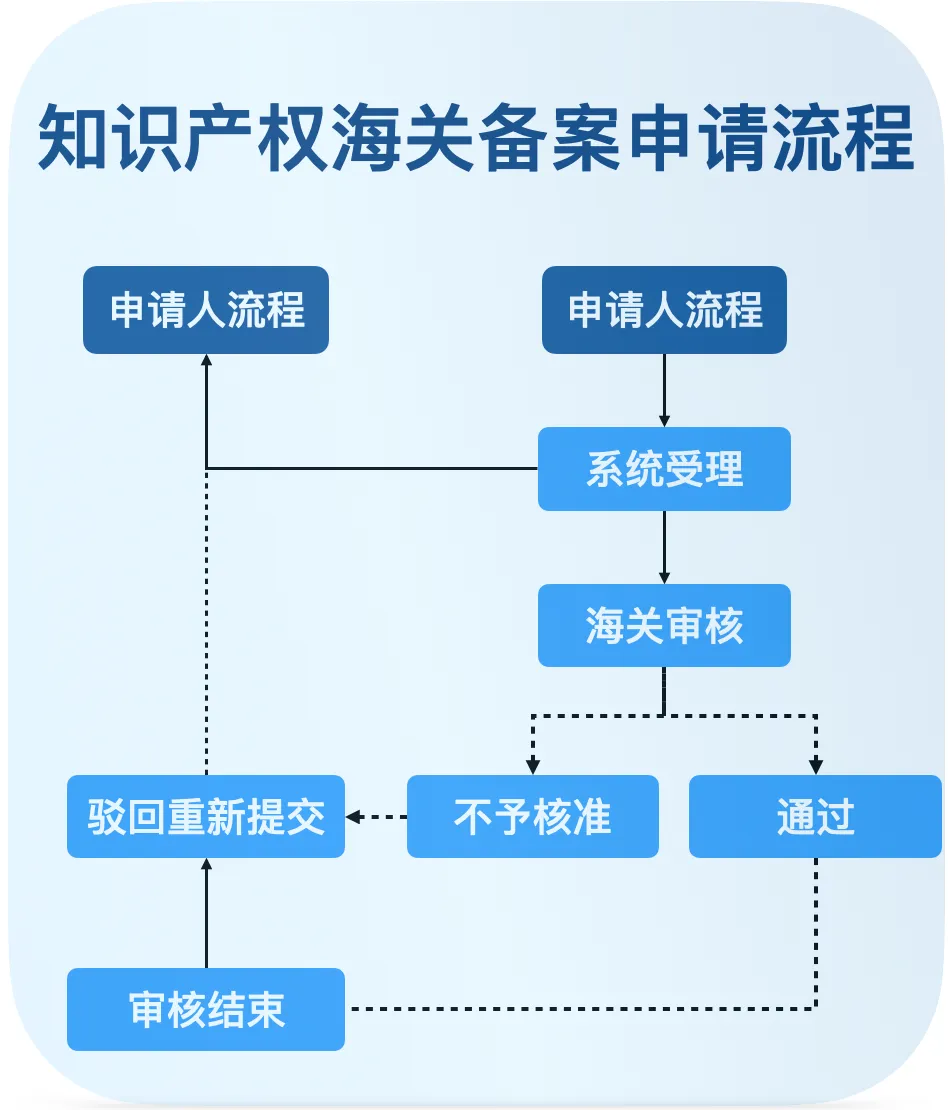
1. Register as a System User
: The right holder first needs to register on “Internet + Customs.” After registration is approved, the user clicks on the “Intellectual Property” section under the “Internet + Customs” column to enter the recordation system and complete relevant information. After review by the system administrator, the user can proceed with recordation application matters.
2. Submit IP Recordation Application in the Recordation System
: Fill in a detailed application form and provide relevant supporting documents, including but not limited to rights certificates, authorization letters, trademark registration certificates, or copyright registration certificates.
3. Check Customs Review Progress and Results
: After submission, the GAC will make a decision to approve or reject the application within 30 working days from the date of submission. If the application is rejected, the right holder may resubmit based on the rejection reasons provided by the GAC.
(2) Required Materials
To successfully complete customs IP recordation, the right holder needs to submit a recordation application to customs. The application must include the following information: 1. Basic information of the IP right holder; 2. Basic information of the registered trademark; basic information of the copyright work; basic information of the patent; 3. Name of the licensee, licensed goods, license period, etc.; 4. Name, origin, entry/exit customs, import/export trader, main features, price, etc., of the goods in which the IP right holder lawfully exercises the IP rights.
Simultaneously with the application, supporting documents must be attached: 1. Identity certification documents of the IP right holder; 2. IP rights documents, such as copies of trademark registration certificates, copies of copyright voluntary registration certificates, copies of patent certificates, etc.; 3. Documents authorizing others to use the registered trademark, work, or implement the patent; 4. Photos of the goods and their packaging in which the IP right holder lawfully exercises the IP rights; 5. Power of attorney — if an agency is entrusted to handle customs recordation, authorization documents must be issued in the format specified by customs.
(3) Renewal of Customs Recordation
The customs IP protection recordation takes effect from the date of approval by the GAC and is valid for 10 years. If the IP right’s validity period is less than 10 years, the recordation is valid for the remaining period of the IP right.
Provided the IP right remains valid, the IP right holder may submit a written application for renewal of the recordation to the GAC within 6 months before the expiration of the recordation validity period, along with relevant documents.
(4) Protection Measures Provided by Customs After Recordation
If customs discovers products suspected of infringing IP rights and confirms this after investigation, customs will take confiscation measures and notify the right holder. Regarding the actor, according to the Regulations of the People’s Republic of China on the Implementation of Customs Administrative Penalties (《中华人民共和国海关行政处罚实施条例》), customs will impose penalties based on different circumstances. If the conduct constitutes a crime, customs will transfer the case to public security authorities for criminal investigation according to law.
Regarding confiscated products, according to Article 27 of the Regulations of the People’s Republic of China on Customs Protection of Intellectual Property Rights (《中华人民共和国知识产权海关保护条例》), customs will take different后续 disposal measures based on different situations:
(1) If the confiscated infringing goods can be used for social welfare, customs shall transfer them to relevant welfare organizations for social welfare purposes. If the IP right holder is willing to purchase them, customs may transfer them to the IP right holder for a fee.
(2) If the confiscated infringing goods cannot be used for social welfare and the IP right holder is unwilling to purchase them, customs may auction them after removing the infringing features. However, for imported counterfeit trademark goods, except in special circumstances, the trademark标识 cannot merely be removed to allow the goods to enter commercial channels. If the infringing features cannot be removed, customs shall destroy them.
Therefore, for confiscated products that can be used for social welfare, they are generally donated to relevant welfare organizations after removing infringing标识. For those that cannot be used for social welfare or are not purchased by the right holder, they can be auctioned or directly destroyed. Based on the author’s experience in handling related cases, right holders typically require customs to directly destroy infringing products. During the destruction process, the right holder may appoint lawyers to witness and supervise the destruction process on-site.
III. Typical Issues in Customs IP Recordation
(1) Incomplete or Inaccurate Recordation Materials
As mentioned, after a customs IP recordation application is submitted, the GAC makes a decision to approve or reject within 30 working days. In practice, if the主体 information, IP rights certificates, or other information or materials submitted by the applicant contain errors or do not meet customs recordation requirements, the IP recordation may not be approved, requiring re-submission. Considering the review period for customs IP recordation, a failed recordation can result in at least two months of gap in customs IP protection, which is a significant loss for the IP right holder.
(2) Inaccurate Authorization Information
In customs recordation practice, the name of the licensee (including manufacturers and import/export traders), the type of licensed goods, and the start and end dates of the authorization must all be accurate. To facilitate customs clearance, the above information must be filled in both Chinese and English. If authorization information is incorrect or the Chinese and English information does not match properly, the authorized manufacturer’s goods may be seized, affecting normal shipments. Therefore, it is necessary to carefully verify the主体 information of the licensee and the authorized goods information during the customs recordation process, and it is recommended that personnel familiar with both Chinese and English handle and verify the above information.
According to the information displayed by the customs IP protection system, as of the end of March 2025, over 110,000 IP rights had been recorded in the customs IP protection system. Therefore, handling customs IP recordation is only the first step in customs border protection. To significantly enhance the effectiveness of customs IP protection, enterprises also need to strengthen monitoring of IP infringement in their daily work and, based on the results of IP infringement monitoring, enhance daily communication and coordination with customs. For example, if IP-infringing products targeting the enterprise primarily originate from specific regions, the enterprise should actively register for IP training activities organized by customs in those regions. If IP-infringing products targeting the enterprise are mainly exported through channels such as cross-border e-commerce or postal delivery, the enterprise needs to strengthen contact with various post office customs offices.
(4) Lack of Experience in Customs Rights Confirmation and Seizure Cases
According to the Regulations on Customs Protection of Intellectual Property Rights (《海关知识产权保护条例》), if customs discovers imported or exported goods suspected of infringing recorded IP rights, it shall immediately notify the IP right holder in writing. If the IP right holder believes that the imported or exported goods infringe IP rights, it must submit a seizure application within three working days from the date of service of the notice, in accordance with the provisions of the Regulations, and provide security according to relevant procedures. Only then will customs detain the suspected infringing goods.
However, in practice, many enterprises are unfamiliar with the procedures and time limits of customs IP protection, resulting in failure to confirm the infringement of goods within the statutory time limit or failure to pay the security deposit in the specified manner within the specified period. This ultimately forces customs to release the suspected infringing goods for export, thereby damaging the enterprise’s commercial interests.
IV. Conclusion
With enterprises going overseas in full swing, customs IP protection is not only a concern for large multinational corporations but also closely related to the commercial interests of many small and medium-sized enterprises.
Customs IP protection features high efficiency and low cost, effectively helping Chinese enterprises active in cross-border trade to build a brand moat, protect core commercial interests, and stand out in fierce international competition. To fully leverage the advantages of customs IP protection and achieve事半功倍 results, enterprises need to invest effort in daily work, engaging professionals familiar with customs IP protection rules and with extensive experience in customs IP protection for daily management of customs IP protection — this is essential.
Notes:
[1] Source: Customs Release (《海关发布》) WeChat official account, https://mp.weixin.qq.com/s/8fXQ7kULI_5Rqc93QXZiag