Strengthened Judicial Protection of Trade Secrets (Part 2): Damage Calculation and Enforcement Innovation
Strengthened Judicial Protection of Trade Secrets (Part 2): Damage Calculation and Enforcement Innovation
This article analyzes the second set of judicial protection trends for trade secrets, including strict examination of independent development and reverse engineering defenses, refined damage calculations with punitive damages, innovative enforcement mechanisms with differential late performance penalties, and clear protection orientation focusing on strategic sectors.
IV. Strict Defense Examination
1. Independent Development Defense
Courts apply substantive review of independent development claims. In Case (2023) SPC IP Civil Final 1669, the defendant claimed independent development, submitting work instructions and drawings. The court found deficiencies including incomplete drawing iterations, delayed submissions, and formal irregularities, rejecting the defense.
2. Public Information and Reverse Engineering
In Case (2023) SPC IP Civil Final 655, the court held that product sales do not necessarily cause trade secret disclosure—mere observation cannot reveal technical information like material tolerances or structural connections. In Case (2023) SPC IP Civil Final 2039, damping materials inside machinery could not be removed, and related process information could not be obtained through reverse engineering.
V. Enhanced Damages: Refined Calculation and Punitive Damages
“Punitive damages + refined calculation” represents the core damage determination approach.
1. Refined Calculation Models
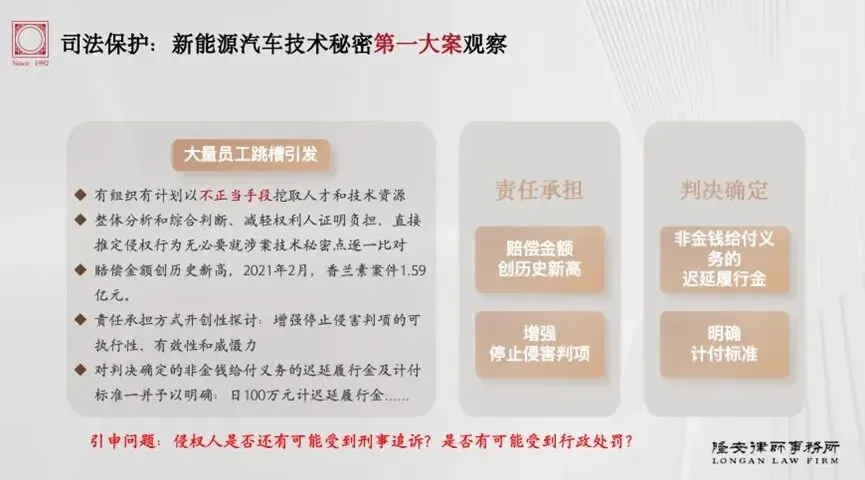
In Case (2023) SPC IP Civil Final 2039, the court constructed a three-factor model: infringement product sales × unit price × profit margin, combined with disclosed parent company annual reports to calculate sales volumes, resulting in a precise infringement profit calculation. With 3x punitive damages applied, total damages exceeded 380 million yuan.
2. Punitive Damages as Norm
Multiple cases applied punitive damages including Case (2023) SPC IP Civil Final 2467 (2+ billion yuan), Case (2023) SPC IP Civil Final 2039 (3.8+ billion yuan), and oral CBCT case (approximately 2 billion yuan awarded). Punitive damages focus on subjective malice (repeated infringement, organized infringement, bad-faith patent filings to cover infringement), duration, and profit scale.
3. Reasonable Cost Recovery
Courts also award reasonable costs including attorney fees. In Case (2023) SPC IP Civil Final 655, 150,000 yuan in attorney fees were separately awarded.
VI. Enforcement Innovation: Differential Late Performance Penalties
Courts innovate enforcement mechanisms through detailed cease infringement orders and differential late performance penalties.
1. Specific Cease Infringement Orders
Courts break down cessation obligations into concrete steps:
- Cease production and sales
- Destroy or surrender carriers under court supervision
- Notify relevant persons and require confidentiality commitments
- Restrict disposition of disputed patents
- Submit periodic compliance reports
2. Differential Late Performance Penalties
In Case (2023) SPC IP Civil Final 2039, differentiated late performance penalty rates were set:
- 1 million yuan/day for ceasing use of trade secrets
- 100,000 yuan/day for destroying drawings
- 5 million yuan one-time for notifying relevant persons
- 500,000 yuan per patent for disposition restrictions
This creates a triple protection system: late performance penalties + subsequent damages + judicial enforcement measures.
VII. Clear Protection Orientation
1. Focus on Strategic Sectors
Cases focus on AI and algorithms, high-end equipment manufacturing, aerospace and defense (quartz glass fiber), petroleum extraction (SAGD equipment), and medical devices (oral CBCT).
2. Equal Protection for Domestic and Foreign Parties
Case (2023) SPC IP Civil Final 2913 protected a New Zealand company’s foreign trade secrets, affirming equal protection for foreign parties.
3. Distinguishing Criminal and Civil Procedures
Courts clarify that civil infringement scope and damages are not limited by prior criminal judgments, allowing independent examination.